Sorry, you need to enable JavaScript to visit this website.
Skip to main content

Iran

Highlights The fourth quarter will be volatile as China still poses a risk of overtightening policy and undermining the global recovery. US political risks are also elevated. A debt default is likely to be averted in the end. Fiscal stimulus could be excessive. There is a 65% chance that taxes will rise in the New Year. A crisis over Iran’s nuclear program is imminent. Oil supply disruptions are likely. A return to diplomacy is still possible but red lines need to be underscored. European political risks are comparatively low, although they cannot go much lower, Russia still poses threats to its neighbors, and China’s economic wobbles will weigh on European assets. Our views still support Mexican equities and EU industrials over the long run but we are booking some gains in the face of higher volatility. Feature Our annual theme for 2021 was “No Return To Normalcy” and events have borne this out. The pandemic has continued to disrupt life while geopolitics has not reverted to pre-Trump norms. Going forward, the pandemic may subside but the geopolitical backdrop will be disruptive. This is primarily due to Chinese policy, unfinished business with Iran, and the struggle among various nations to remain stable in the aftermath of the pandemic. Chart 1Delta Recedes With Vaccinations Delta Recedes With Vaccinations Delta Recedes With Vaccinations Chart 2Global Recovery Marches On Global Recovery Marches On Global Recovery Marches On Chart 3Global Labor Markets On The Mend Global Labor Markets On The Mend Global Labor Markets On The Mend The underlying driver of markets in the fourth quarter will be the fact that the COVID-19 pandemic is waning as vaccination campaigns make progress (Chart 1). New cases of the Delta variant have rolled over in numerous countries and in US states that are skeptical toward vaccines. Global growth will still face crosswinds. US growth rates are unlikely to be downgraded further while Europe’s growth has been upgraded. However, forecasters are likely to downgrade Chinese growth expectations in the face of the government’s regulatory onslaught against various sectors and property sector instability (Chart 2). Barring a Chinese policy mistake, the global composite PMI is likely to stabilize. Labor markets will continue healing (Chart 3). The tug of war between unemployment and inflation will continue to give way in favor of inflation, given that wage pressures will emerge, stimulus-fueled household demand will be strong, and supply shortages will persist. Central banks will try to normalize policy but will not move aggressively in the face of any new setbacks to the recovery. Will China Spoil The Recovery? Maybe. Chinese policy and structural imbalances pose the greatest threat to the global economic recovery both in the short and the long run. The immediate risk to the recovery is clear from our market-based Chinese growth indicator, which has not yet bottomed (Chart 4). The historic confluence of domestic political and geopolitical risks in China is our key view for the year. China is attempting to make the economic transition that other East Asian states have made – away from the “miracle” manufacturing phase of growth toward something more sustainable. But there are two important differences: China is making its political and economic system less open and free (the opposite of Taiwan and South Korea) and it is confronting rather than befriending the United States. The Xi administration is focused on consolidating power ahead of the twentieth national party congress in fall 2022. Xi is attempting to stay in power beyond the ten-year limit that was in place when he took office. On one hand he is presenting a slate of socioeconomic reforms – dubbed “common prosperity” – to curry popular favor. This agenda represents a tilt from capitalism toward socialism within the context of the Communist Party’s overarching idea of socialism with Chinese characteristics. On the other hand, Xi is cracking down on the private sector – Big Tech, property developers – which theoretically provides the base of power for any political opposition. The crackdowns have caused Chinese equities to collapse relative to global and have reaffirmed the long trend of underperformance of cyclical sectors relative to defensives within Chinese investable shares (Chart 5, top panel). Chart 4China Threatens To Spoil The Party China Threatens To Spoil The Party China Threatens To Spoil The Party In terms of financial distress, so far only high-yield corporate bonds have seen spreads explode, not investment grade. But current policies force property developers to liquidate their holdings, pay off debts, and raise cash while forcing banks to cut bank on loans to property developers and homebuyers. (Not to mention curbs on carbon emissions and other policies squeezing industrial and other sectors.) Chart 5Beijing Could Easily Trigger Global Market Riot Beijing Could Easily Trigger Global Market Riot Beijing Could Easily Trigger Global Market Riot If these policies are not relaxed then property developers will continue to struggle, property prices will fall, credit tightening will intensify, and local governments will be starved of revenue and forced to cut back on their own spending. Yet the government’s signals of policy easing are so far gradual and behind the curve. If policy is not relaxed, then onshore equities will sell off (as well as offshore) and credit spreads will widen more generally (Chart 5, bottom panel). Broad financial turmoil cannot be ruled out in the fourth quarter. Ultimately, however, China will be forced to do whatever it takes to try to secure the post-pandemic recovery. Otherwise it will instigate a socioeconomic crisis ahead of the all-important political reshuffle in fall 2022. That would be the opposite of what Xi Jinping needs as he tries to consolidate power. Chinese households have stored their wealth, built up over decades of economic success, in the housing sector (Chart 6). Economic instability could translate to political instability. Chart 6Beijing Will Provide Bailouts And Stimulus … Or Face Political Instability Fourth Quarter Outlook: So Much For Normalcy! Fourth Quarter Outlook: So Much For Normalcy! Investors often ask how the government can ease policy if doing so will further inflate housing prices, which hurts the middle class and is the opposite of the common prosperity agenda. High housing prices are the biggest of the three “mountains” that are said to be crushing the common folks and weighing on Chinese birthrates and fertility (the other two are high education and medical costs). The answer is that while policymakers want to cap housing prices and encourage fertility, they must prevent a general collapse in prices and economic and financial crisis. There is no evidence that suppressing housing prices will increase fertility or birthrates – if anything, falling fertility is hard to reverse and goes hand in hand with falling prices. Rather, evidence from the US, Japan, South Korea, Thailand, and other countries shows that a bursting property bubble certainly does not increase fertility or birthrates (Charts 7A and 7B). Chart 7AEconomic Crash Not A Recipe For Higher Fertility Economic Crash Not A Recipe For Higher Fertility Economic Crash Not A Recipe For Higher Fertility Chart 7BEconomic Crash Not A Recipe For Higher Fertility Economic Crash Not A Recipe For Higher Fertility Economic Crash Not A Recipe For Higher Fertility Bringing it all together, investors should not play down negative news and financial instability emerging from China. There are no checks and balances on autocrats. Our China Investment Strategy has a high conviction view that policy stimulus is not forthcoming and regulatory curbs will not be eased. The implication is that China’s government could make major policy mistakes and trigger financial instability in the near term before changing its mind to try to preserve overall stability. At that point it could be too late. Will Countries Add More Stimulus? Yes. Chart 8Global Monetary Policy Challenges Global Monetary Policy Challenges Global Monetary Policy Challenges With China’s stability in question, investors face a range of crosswinds. Central banks are struggling with a surge in inflation driven by stimulus-fueled demand and supply bottlenecks. The global output gap is still large but rapid economic normalization will push inflation up further if kinks are not removed (Chart 8). A moderating factor in this regard is that budget deficits are contracting in 2022 and coming years – fiscal policy will shift from thrust to drag (Chart 9). However, the fiscal drag is probably overstated as governments are also likely to increase deficit spending on the margin. The US is certainly likely to do so. But before considering US fiscal policy we must address the immediate question: whether the US will default on national debt. Treasury Secretary Janet Yellen has designated October 18 as the “X-date” at which the Treasury will run out of extraordinary measures to make debt payments if Congress does not raise the statutory debt ceiling. There is presumably a few weeks of leeway after this date but markets will grow very jittery and credit rating agencies will start to downgrade the United States, as Standard & Poor’s did in 2011. Chart 9Global Fiscal Drag Rears Its Head Fourth Quarter Outlook: So Much For Normalcy! Fourth Quarter Outlook: So Much For Normalcy! Democrats have full control of Congress and can therefore suspend the debt ceiling through a party-line vote. They can do this through regular legislation, if Republicans avoid raising a filibuster, though that requires Democrats to make concessions in a back-room deal with Republicans. Or they can compromise the filibuster, though that requires convincing moderate Democrats who support the filibuster that they need to make an exception to preserve the faith and credit of the US. Or they can raise the debt ceiling via budget reconciliation, though this would run up against the time limit and so far Senate Leader Chuck Schumer claims to refuse this option. While the odds of a debt default are not zero, the Democrats have the power to avoid it and will also suffer the most in public opinion if it occurs. Therefore the debt limit will likely be suspended at the last minute in late October or early November. Investors should expect volatility but should view it as short-term noise and buy on dips – i.e. the opposite of any volatility that stems from Chinese financial turmoil. Congress is likely to pass Biden’s $550 billion bipartisan infrastructure bill (80% subjective odds). It is also likely to pass a partisan social welfare reconciliation bill over the coming months (65% subjective odds). The full impact on the deficit of both bills should range from $1.1-$1.6 trillion over ten years. This will not be enough to prevent the fiscal drag in 2022 but it will provide for a gradually expanding budget deficit over the course of the decade (Chart 10). Chart 10New Fiscal Stimulus Will Reduce Fiscal Drag On Margin Fourth Quarter Outlook: So Much For Normalcy! Fourth Quarter Outlook: So Much For Normalcy! The reconciliation package will be watered down and late in coming. Investors will likely buy the rumor and sell the news. If reconciliation fails, markets may cheer, as it will also include tax hikes and pose the risk of pushing up inflation and hastening Fed rate hikes. Elsewhere governments are also providing “soft budgets.” The German election results confirmed our forecast that the government will change to left-wing leadership that will be able to boost domestic investment but not raise taxes. This is due to the inclusion of at least one right-leaning party, most likely the Free Democrats. Fiscal deficits will go up. Germany has a national policy consensus on most matters of importance and thus can pass some legislation. But the new coalition will be ideologically split and barely have a majority in the Bundestag, so controversial or sweeping legislation will be unlikely. This outcome is positive for German markets and the euro. Looking at popular opinion toward western leaders and their ruling coalitions since the outbreak of COVID-19, the takeaway is that the Europeans have the strongest political capital (Chart 11). Governments are either supported by leadership changes (Italy, Germany) or likely to be supported in upcoming elections (France). The UK does not face an election until 2024, unless an early election is called. This seems doubtful to us given the government’s strong majority. Chart 11DM Shifts In Popular Opinion Since COVID-19 Fourth Quarter Outlook: So Much For Normalcy! Fourth Quarter Outlook: So Much For Normalcy! Chart 12EM Shifts In Popular Opinion Since COVID-19 Fourth Quarter Outlook: So Much For Normalcy! Fourth Quarter Outlook: So Much For Normalcy! After all, Canada called an early election and it became a much riskier affair than the government intended and did not increase the prime minister’s political capital. Spain is far more likely to see tumult and an early election. Japan’s election in November will not bring any surprises: as we have written, Kishidanomics will be Abenomics by a different name. The implication is that after November, most developed markets will be politically recapitalized and fiscal policy will continue to be accommodative across the board. In emerging markets, popular opinion has been much more damning for leaders, calling attention to our expectation that the aftershocks of the global pandemic will come in the form of social and political instability (Chart 12). Russia has a record of pursuing more aggressive foreign policy to distract from its domestic ills. The next conflict could already be emerging, with allegations that it is deliberately pushing up natural gas prices in Europe to try to force the new German government to certify and operate the NordStream II pipeline. The Americans are already brandishing new sanctions. Chart 13Stary Neutral Dollar For Now Stary Neutral Dollar For Now Stary Neutral Dollar For Now Brazil and Turkey both face extreme social instability in the lead-up to elections in 2022 and 2023. India has been the chief beneficiary of today’s climate but it also faces an increase in political and geopolitical risk due to looming state elections and its increasing alliance with the West against China. Putting it all together, the US is likely to stimulate further and pump up inflation expectations. Europe is politically stable but Russia disrupt it. Other emerging markets, including China, will struggle with economic, political, and social instability. This is an environment in which the US dollar will remain relatively firm and the renminbi will depreciate – with negative effects on EM currencies more broadly (Chart 13). Annual Views On Track Our three key views for 2021 are so far on track but face major tests in the fourth quarter: 1. China’s internal and external headwinds: If China overtightens policy and short-circuits the global economic recovery, then its domestic political risks will have exceeded even our own pessimistic expectations. We expect China to ease fiscal policy and do at least the minimum to secure the recovery. Investors should be neutral on risky assets until China provides clearer signals that it will not overtighten policy (Chart 14). 2. Iran is the crux of the US pivot to Asia: A crisis over Iran is imminent since Biden did not restore the 2015 nuclear deal promptly upon taking office. Any disruption of Middle Eastern energy flows will add to global supply bottlenecks and price pressures. Brent crude oil prices will see upside risks relative both to BCA forecasts and the forward curve (Chart 15). Chart 14Wait For China To Relax Policy Wait For China To Relax Policy Wait For China To Relax Policy Chart 15Expect A Near-Term Crisis Over Iran Expect A Near-Term Crisis Over Iran Expect A Near-Term Crisis Over Iran The reason is that Iran is expected to reach nuclear “breakout” capability by November or December (i.e. obtain enough highly enriched uranium to make a nuclear device). The Biden administration is focused on diplomacy and so far hesitant to impose a credible threat of war to halt Iranian advances. Israel’s new government has belatedly admitted that it would be a good thing for the US and Iran to rejoin the 2015 nuclear deal – if not, it supports a global coalition to impose sanctions, and finally a military option as a last resort. Biden will struggle to put together a global coalition as effective as Obama did, given worse relations with China and Russia. The US and Israel are highly likely to continue using sabotage and cyberattacks to slow Iran’s nuclear and missile progress. Chart 16Pivot To Asia Runs Through Iran Pivot To Asia Runs Through Iran Pivot To Asia Runs Through Iran Chart 17Europe: A Post-Trump Winner? Depends On China Europe: A Post-Trump Winner? Depends On China Europe: A Post-Trump Winner? Depends On China Thus the Iranians are likely to reach breakout capability at which point a crisis could erupt. The market is not priced for the next Middle East crisis (Chart 16). Incidentally, any additional foreign policy humiliation on top of Afghanistan could undermine the Biden administration more broadly, in both domestic and foreign policy. 3. Europe benefits most from a post-pandemic, post-Trump world: Europe is a cyclical economy and is also relatively politically stable in a world of structurally rising policy uncertainty and geopolitical risk. We thought it stood to benefit most from the global recovery and the passing of the Trump administration. However, China’s policy tightening has undermined European assets and will continue to do so. Therefore this view is largely contingent on the first view (Chart 17). Investment Takeaways Strategically we maintain a diversified portfolio of trades based on critical geopolitical themes: long gold, short China/Taiwan, long developed markets, long aerospace/defense, long rare earths, and long value over growth stocks. Taiwanese equities have continued to outperform despite bubbling geopolitical tensions. We maintain our view that Taiwan is overpriced and vulnerable to long-term semiconductor diversification as well as US-China conflict. Our rare earths basket, which focuses on miners outside China, has been volatile and stands to suffer if China’s growth decelerates. But global industrial, energy, and defense policy will continue to support rare earths and metals prices. Russian tensions with the West have been manageable over the course of the year and emerging European stocks have outperformed developed European peers, contrary to our recommendation. However, fundamental conflicts remain unresolved and the dispute over the recently completed Nord Stream II pipeline to Germany could still deal negative surprises. We will reassess this recommendation in a future report. We are booking gains on the following trades: long Mexico (8%), long aerospace and defense in absolute terms (4%), long EU industrials relative to global (4%), and long Italian BTPs relative to bunds (0.2%).   Matt Gertken Vice President Geopolitical Strategy mattg@bcaresearch.com   Appendix: GeoRisk Indicator China China: GeoRisk Indicator China: GeoRisk Indicator Russia Russia: GeoRisk Indicator Russia: GeoRisk Indicator United Kingdom UK: GeoRisk Indicator UK: GeoRisk Indicator Germany Germany: GeoRisk Indicator Germany: GeoRisk Indicator France France: GeoRisk Indicator France: GeoRisk Indicator Italy Italy: GeoRisk Indicator Italy: GeoRisk Indicator Canada Canada: GeoRisk Indicator Canada: GeoRisk Indicator Spain Spain: GeoRisk Indicator Spain: GeoRisk Indicator Taiwan Taiwan: GeoRisk Indicator Taiwan: GeoRisk Indicator Korea Korea: GeoRisk Indicator Korea: GeoRisk Indicator Turkey Turkey: GeoRisk Indicator Turkey: GeoRisk Indicator Brazil Brazil: GeoRisk Indicator Brazil: GeoRisk Indicator Australia Australia: GeoRisk Indicator Australia: GeoRisk Indicator Appendix: Geopolitical Calendar
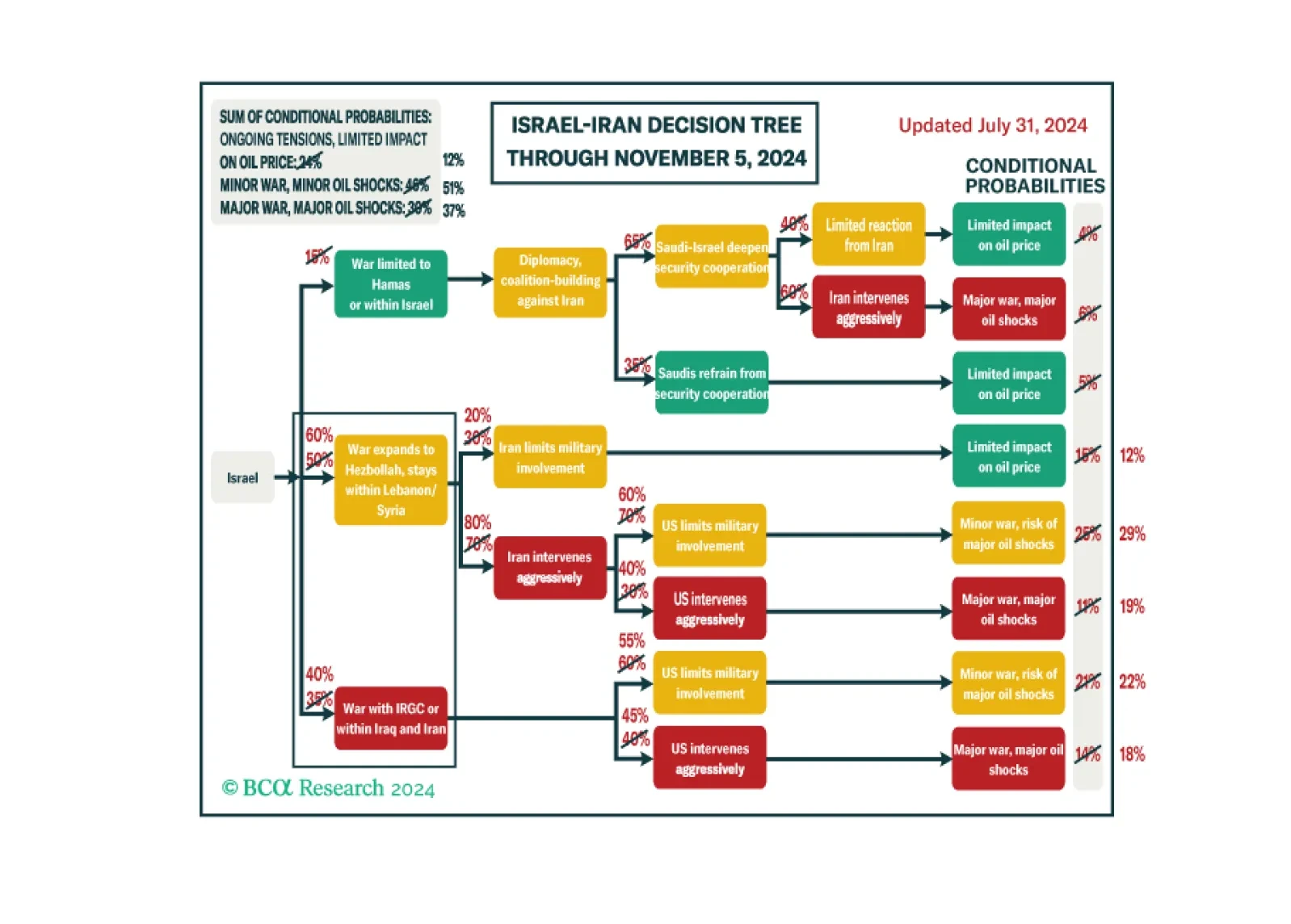
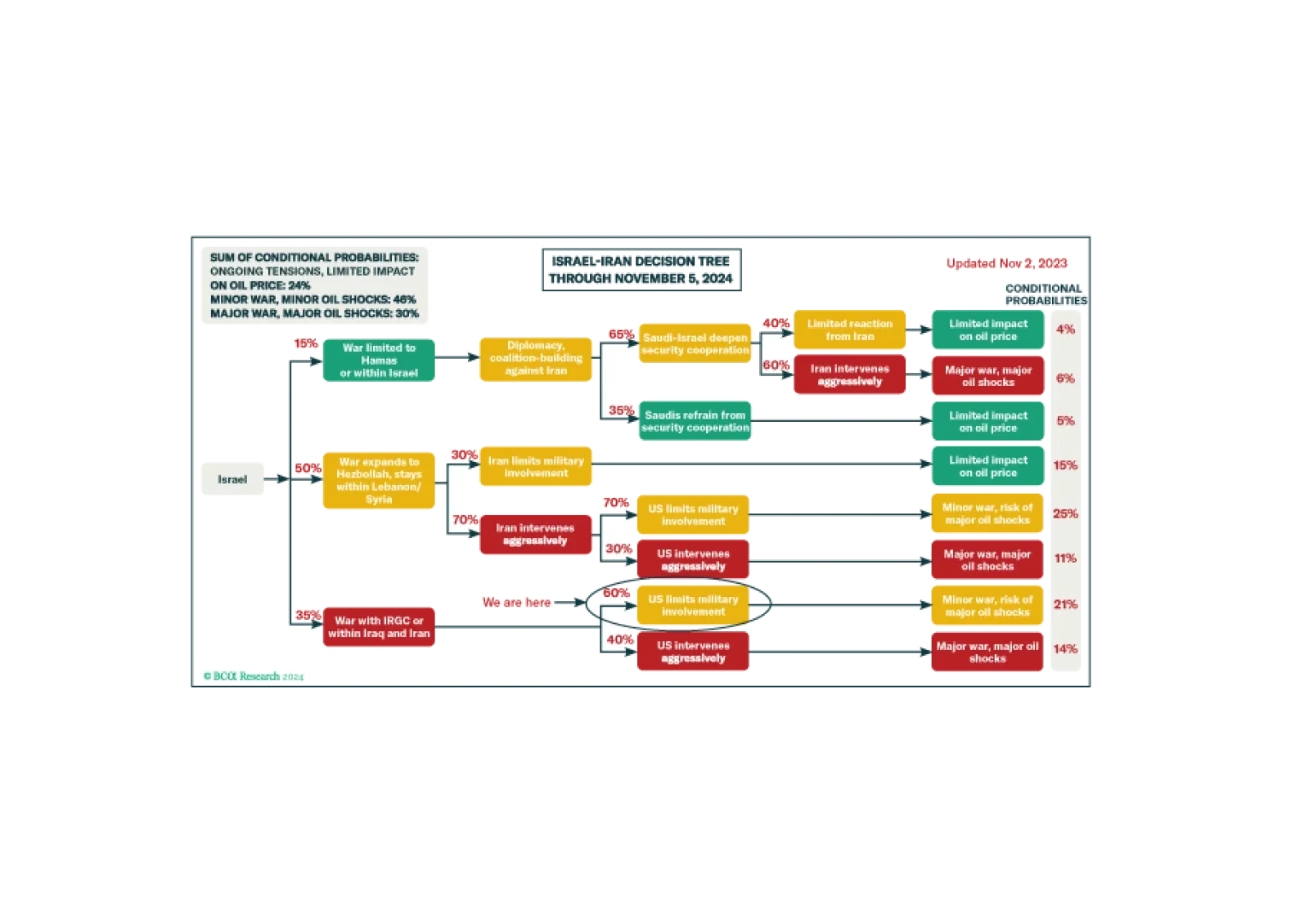
Highlights An Iran crisis is imminent. We still think a US-Iran détente is possible but our conviction is lower until Biden makes a successful show of force. Oil prices will be volatile. Fiscal drag is a risk to the cyclical global macro view. But developed markets are more fiscally proactive than they were after the global financial crisis. Elections will reinforce that, starting in Germany, Canada, and Japan. The Chinese and Russian spheres are still brimming with political and geopolitical risk. But China will ease monetary and fiscal policy on the margin over the coming 12 months. Afghanistan will not upset our outlook on the German and French elections, which is positive for the euro and European stocks. Feature Chart 1Bull Market In Iran Tensions Biden's Show Of Force (GeoRisk Update) Biden's Show Of Force (GeoRisk Update) Iran is now the most pressing geopolitical risk in the short term (Chart 1). The Biden administration has been chastened by the messy withdrawal from Afghanistan and will be exceedingly reactive if it is provoked by foreign powers. Nuclear weapons improve regime survivability. Survival is what the Islamic Republic wants. Iran is surrounded by enemies in its region and under constant pressure from the United States. Hence Iran will never ultimately give up its nuclear program, as we have maintained. Chart 2Biden Unlikely To Lift Iran Sanctions Unilaterally Biden's Show Of Force (GeoRisk Update) Biden's Show Of Force (GeoRisk Update) However, Supreme Leader Ali Khamenei could still agree to a deal in which the US reduces economic sanctions while Iran allows some restrictions on uranium enrichment for a limited period of time (the 2015 nuclear deal’s key provisions expire from 2023 through 2030). This would be a stopgap measure to delay the march into war. The problem is that rejoining the 2015 deal requires the US to ease sanctions first, since the US walked away from the deal in 2018. Iran would need domestic political cover to rejoin it. Biden has the executive authority to ease sanctions unilaterally but after Afghanistan he lacks the political capital to do so (Chart 2). So Biden cannot ease sanctions until Iran pares back its nuclear activities. But Iran has no reason to pare back if the US does not ease sanctions. Iran is now enriching some uranium to a purity of 60%. Israeli Defense Minister Benny Gantz says it will reach “nuclear breakout” capability – enough fissile material to build a bomb – within 10 weeks, i.e. mid-October. Anonymous officials from the Biden administration told the Associated Press it will be “months or less,” which could mean September, October, or November (Table 1). Table 1Iran Nearing "Breakout" Nuclear Capability Biden's Show Of Force (GeoRisk Update) Biden's Show Of Force (GeoRisk Update) Meanwhile the new Iranian government of President Ebrahim Raisi, a hardliner who is tipped to take over as Supreme Leader once Ali Khamenei steps down, is implying that it will not rejoin negotiations until November. All of these timelines are blurry but the implication is that Iran will not resume talks until it has achieved nuclear breakout. Israel will continue its campaign of sabotage against the regime. It may be pressed to the point of launching air strikes, as it did against nuclear facilities in Iraq in 1981 and Syria in 2007 under what is known as the “Begin Doctrine.” Chart 3Israel Cannot Risk Losing US Security Guarantee Biden's Show Of Force (GeoRisk Update) Biden's Show Of Force (GeoRisk Update) The constraint on Israel is that it cannot afford to lose America’s public support and defense alliance since it would find itself isolated and vulnerable in its region (Chart 3). But if Israeli intelligence concludes that the Iranians truly stand on the verge of achieving a deliverable nuclear weapon, the country will likely be driven to launch air strikes. Once the Iranians test and display a viable nuclear deterrent it will be too late. Four US presidents, including Biden, have declared that Iran will not be allowed to get nuclear weapons. Biden and the Democrats favor diplomacy, as Biden made clear in his bilateral summit with Israeli Prime Minister Naftali Bennett last week. But Biden also admitted that if diplomacy fails there are “other options.” The Israelis currently have a weak government but it is unified against a nuclear-armed Iran. At very least Bennett will underscore red lines to indicate that Israel’s vigilance has not declined despite hawkish Benjamin Netanyahu’s fall from power. Still, Iran may decide it has an historic opportunity to make a dash for the bomb if it thinks that the US will fail to support an Israeli attack. The US has lost leverage in negotiations since 2015. It no longer has troops stationed on Iran’s east and west flanks. It no longer has the same degree of Chinese and Russian cooperation. It is even more internally divided. Iran has no guarantee that the US will not undergo another paroxysm of nationalism in 2024 and try to attack it. The faction that opposed the deal all along is now in power and may believe it has the best chance in its lifetime to achieve nuclear breakout. The only reason a short-term deal is possible is because Khamenei may believe the Israelis will attack with full American support. He agreed to the 2015 deal. He also fears that the combination of economic sanctions and simmering social unrest will create a rift when he dies or passes the leadership to his successor. Iran has survived the Trump administration’s “maximum pressure” sanctions but it is still vulnerable (Chart 4). Chart 4Supreme Leader Focuses On Regime Survival Supreme Leader Focuses On Regime Survival Supreme Leader Focuses On Regime Survival Moreover Biden is offering Khamenei a deal that does not require abandoning the nuclear program and does not prevent Iran from enhancing its missile capabilities. By taking the deal he might prevent his enemies from unifying, forestall immediate war, and pave the way for a smooth succession, while still pursuing the ultimate goal of nuclear weaponization. Bringing it all together, the world today stands at a critical juncture with regard to Iran and the unfinished business of the US wars in the Middle East. Unless the US and Israel stage a unified and convincing show of force, whether preemptively or in response to Iranian provocations, the Iranians will be justified in concluding that they have a once-in-a-generation opportunity to pursue the bomb. They could sneak past the global powers and obtain a nuclear deterrent and regime security, like North Korea did. This could easily precipitate a war. Biden will probably continue to be reactive rather than proactive. If the Iranians are silent then it will be clear that Khamenei still sees the value in a short-term deal. But if they continue their march toward nuclear breakout, as is the case as we go to press, then Biden will have to make a massive show of force. The goal would be to underscore the US’s red lines and drive Iran back to negotiating table. If Biden blinks, he will incentivize Iran to make a dash for the bomb. Either way a crisis is imminent. Israel will continue to use sabotage and underscore red lines while the Iranians will continue to escalate their attacks on Israel via militant proxies and attacks on tankers (Map 1). Map 1Secret War Escalates In Middle East Biden's Show Of Force (GeoRisk Update) Biden's Show Of Force (GeoRisk Update) Bottom Line: After a crisis, either diplomacy will be restored, or the Middle East will be on a new war path. The war path points to a drastically different geopolitical backdrop for the global economy. If the US and Iran strike a short-term deal, Iranian oil will flow and the US will shift its strategic focus to pressuring China, which is negative for global growth and positive for the dollar. If the US and Iran start down the war path, oil supply disruptions will rise and the dollar will fall. Implications For Oil Prices And OPEC 2.0 The probability of a near-term conflict is clear from our decision tree, which remains the same as in June 2019 (Diagram 1). Diagram 1US-Iran Conflict: Critical Juncture In Our Decision Tree Biden's Show Of Force (GeoRisk Update) Biden's Show Of Force (GeoRisk Update) Shows of force and an escalation in the secret war will cause temporary but possibly sharp spikes in oil prices in the short term. OPEC 2.0 remains intact so far this year, as expected. The likelihood that the global economic recovery will continue should encourage the Saudis, Russians, Emiratis and others to maintain production discipline to drain inventories and keep Brent crude prices above $60 per barrel. OPEC 2.0 is a weak link in oil prices, however, because Russians are less oil-dependent than the Gulf Arab states and do not need as high of oil prices for their government budget to break even (Chart 5). Periodically this dynamic leads the cartel to break down. None of the petro-states want to push oil prices up so high that they hasten the global green energy transition. Chart 5OPEC 2.0 Keeps Price Within Fiscal Breakeven Oil Price Biden's Show Of Force (GeoRisk Update) Biden's Show Of Force (GeoRisk Update) Chart 6Oil Price Risks Lie To Upside Until US-Iran Deal Occurs Oil Price Risks Lie To Upside Until US-Iran Deal Occurs Oil Price Risks Lie To Upside Until US-Iran Deal Occurs As long as OPEC 2.0 remains disciplined, average Brent crude oil prices will gradually rise to $80 barrels per day by the end of 2024, according to our Commodity & Energy Strategy (Chart 6). Imminent firefights will cause prices to spike at least temporarily when large amounts of capacity are taken offline. Global spare capacity is probably sufficient to handle one-off disruptions but an open-ended military conflict in the Persian Gulf or Strait of Hormuz would be a different story. After the next crisis, everything depends on whether the US and Israel establish a credible threat and thus restore diplomacy. Any US-Iran strategic détente would unleash Iranian production and could well motivate the Gulf Arabs to pump more oil and deny Iran market share. Bottom Line: Given that any US-Iran deal would also be short-term in nature, and may not even stabilize the region, some of the downside risks are fading at the moment. The US and China are also sucking in more commodities as they gear up for great power struggle. The geopolitical outlook is positive for oil prices in these respects. But OPEC 2.0 is the weak link in this expectation so we expect volatility. Global Fiscal Taps Will Stay Open Markets have wavered in recent months over softness in the global economic recovery, COVID-19 variants, and China’s policy tightening. The world faces a substantial fiscal drag in the coming years as government budgets correct from the giant deficits witnessed during the crisis. Nevertheless policymakers are still able to deliver some positive fiscal surprises on the margin. Developed markets have turned fiscally proactive over the past decade. They rejected austerity because it was seen as fueling populist political outcomes that threatened the established parties. Note that this change began with conservative governments (e.g. Japan, UK, US, Germany), implying that left-leaning governments will open the fiscal taps further whenever they come to power (e.g. Canada, the US, Italy, and likely Germany next). Chart 7Global Fiscal Taps Will Stay Open Biden's Show Of Force (GeoRisk Update) Biden's Show Of Force (GeoRisk Update) Chart 7 updates the pandemic-era fiscal stimulus of major economies, with light-shaded bars highlighting new fiscal measures that are in development but have not yet been included in the IMF’s data set. The US remains at the top followed by Italy, which also saw populist electoral outcomes over the past decade. Chart 8US Fiscal Taps Open At Least Until 2023 US Fiscal Taps Open At Least Until 2023 US Fiscal Taps Open At Least Until 2023 The Biden administration is on the verge of passing a $550 billion bipartisan infrastructure bill. We maintain 80% subjective odds of passage – despite the messy pullout from Afghanistan. Assuming it passes, Democrats will proceed to their $3.5 trillion social welfare bill. This bill will inevitably be watered down – we expect a net deficit impact of around $1-$1.5 trillion for both bills – but it can pass via the partisan “budget reconciliation” process. We give 50% subjective odds today but will upgrade to 65% after infrastructure passes. The need to suspend the debt ceiling will raise volatility this fall but ultimately neither party has an interest in a national debt default. The US is expanding social spending even as geopolitical challenges prevent it from cutting defense spending, which might otherwise be expected after Afghanistan and Iraq. The US budget balance will contract after the crisis but then it will remain elevated, having taken a permanent step up as a result of populism. The impact should be a flat or falling dollar on a cyclical basis, even though we think geopolitical conflict will sustain the dollar as the leading reserve currency over the long run (Chart 8). So the dollar view remains neutral for now. Bottom Line: The US is facing a 5.9% contraction in the budget deficit in 2022 but the blow will be cushioned somewhat by two large spending bills, which will put budget deficits on a rising trajectory over the course of the decade. Big government is back. Developed Market Fiscal Moves (Outside The US) Chart 9German Opinion Favors New Left-Wing Coalition Biden's Show Of Force (GeoRisk Update) Biden's Show Of Force (GeoRisk Update) Fiscal drag is also a risk for other developed markets – but here too a substantial shift away from prudence has taken place, which is likely to be signaled to investors by the outperformance of left-wing parties in Germany’s upcoming election. Germany is only scheduled to add EUR 2.4 billion to the 25.6 billion it will receive under the EU’s pandemic recovery fund, but Berlin is likely to bring positive fiscal surprises due to the federal election on September 26. Germany will likely see a left-wing coalition replace Chancellor Angela Merkel and her long-ruling Christian Democrats (Chart 9). The platforms of the different parties can be viewed in Table 2. Our GeoRisk Indicator for Germany confirms that political risk is elevated but in this case the risk brings upside to risk assets (Appendix). Table 2German Party Platforms Biden's Show Of Force (GeoRisk Update) Biden's Show Of Force (GeoRisk Update) While we expected the Greens to perform better than they are in current polling, the point is the high probability of a shift to a new left-wing government. The Social Democrats are reviving under the leadership of Olaf Scholz (Chart 10). Tellingly, Scholz led the charge for Germany to loosen its fiscal belt back in 2019, prior to the global pandemic. Chart 10Germany: Online Markets Betting On Scholz Biden's Show Of Force (GeoRisk Update) Biden's Show Of Force (GeoRisk Update) Chart 11Canada: Trudeau Takes A Calculated Risk Biden's Show Of Force (GeoRisk Update) Biden's Show Of Force (GeoRisk Update) In June, the cabinet approved a draft 2022 budget plan supported by Scholz that would contain new borrowing worth EUR 99.7 bn ($119 billion). This amount is not included in the chart above but it should be seen as the minimum to be passed under the new government. If a left-wing coalition is formed, as we expect, the amount will be larger, given that both the Social Democrats and the Greens have been restrained by Merkel’s party. Canada turned fiscally proactive in 2015, when the institutional ruling party, the Liberals, outflanked the more progressive New Democrats by calling for budget deficits instead of a balanced budget. The Liberals saw a drop in support in 2019 but are now calling a snap election. Prime Minister Trudeau is not as popular in general opinion as he is in the news media but his party still leads the polls (Chart 11). The Conservatives are geographically isolated and, more importantly, are out of step with the median voter on the key issues (Table 3). Table 3Canada: Liberal Agenda Lines Up With Top Voter Priorities Biden's Show Of Force (GeoRisk Update) Biden's Show Of Force (GeoRisk Update) Nevertheless it is a risky time to call an election – our GeoRisk Indicator for Canada is soaring (Appendix). Granting that the Liberals are very unlikely to fall from power, whatever their strength in parliament, the key point is that parliament already approved of CAD 100 billion in new spending over the coming three years. Any upside surprise would give Trudeau the ability to push for still more deficit spending, likely focused on climate change. Chart 12Japan: Suga Will Go, LDP Will Stimulate Japan: Suga Will Go, LDP Will Stimulate Japan: Suga Will Go, LDP Will Stimulate Japanese politics are heating up ahead of the Liberal Democrats’ leadership election on September 29 and the general election, due by November 28. Prime Minister Yoshihide Suga’s sole purpose in life was to stand in for Shinzo Abe in overseeing the Tokyo Olympics. Now they are done and Suga will likely be axed – if he somehow survives the election, he will not last long after, as his approval rating is in freefall. The Liberal Democrats are still the only game in town. They will try to minimize the downside risks they face in the general election by passing a new stimulus package (Chart 12). Rumor has it that the new package will nominally be worth JPY 10-15 trillion, though we expect the party to go bigger, and LDP heavyweight Toshihiro Nikai has proposed a 30 trillion headline number. It is extremely unlikely that the election will cause a hung parliament or any political shift that jeopardizes passage of the bill. Abenomics remains the policy setting – and consumption tax hikes are no longer on the horizon to impede the second arrow of Abenomics: fiscal policy. Not all countries are projecting new spending. A stronger-than-expected showing by the Christian Democrats would result in gridlock in Germany. Meanwhile the UK may signal belt-tightening in October. Bottom Line: Germany, Canada, and Japan are likely to take some of the edge off of expected fiscal drag next year. Emerging Market Fiscal Moves (And China Regulatory Update) Among the emerging markets, Russia and China are notable in Chart 7 above for having such a small fiscal stimulus during this crisis. Russia has announced some fiscal measures ahead of the September 19 Duma election but they are small: $5.2 billion in social spending, $10 billion in strategic goals over three years, and a possible $6.8 billion increase in payments to pensioners. Fiscal austerity in Russia is one reason we expect domestic political risk to remain elevated and hence for President Putin to stoke conflicts in his near abroad (see our Russian risk indicator in the Appendix). There are plenty of signs that Belarussian tensions with the Baltic states and Poland can escalate in the near term, as can fighting in Ukraine in the wake of Biden’s new defense agreement and second package of military aid. China’s actual stimulus was much larger than shown in Chart 7 above because it mostly consisted of a surge in state-controlled bank lending. China is likely to ease monetary and fiscal policy on the margin over the coming 12 months to secure the recovery in time for the national party congress in 2022. But China’s regulatory crackdown will continue during that time and our GeoRisk Indicator clearly shows the uptick in risk this year (Appendix). Chart 13China Expands Unionization? China Expands Unionization? China Expands Unionization? The regulatory crackdown is part of a cyclical consolidation of Xi Jinping’s power as well as a broader, secular trend of reasserting Communist Party and centralization in China. The latest developments underscore our view that investors should not play any technical rebound in Chinese equities. The increase in censorship of financial media is especially troubling. Just as the government struggles to deal with systemic financial problems (e.g. the failing property giant Evergrande, a possible “Lehman moment”), the lack of transparency and information asymmetry will get worse. The media is focusing on the government’s interventions into public morality, setting a “correct beauty standard” for entertainers and limiting kids to three hours of video games per week. But for investors what matters is that the regulatory crackdown is proceeding to the medical sector. High health costs (like high housing and education costs) are another target of the Xi administration in trying to increase popular support and legitimacy. Central government-mandated unionization in tech companies will hurt the tech sector without promoting social stability. Chinese unions do not operate like those in the West and are unlikely ever to do so. If they did, it would compound the preexisting structural problem of rising wages (Chart 13). Wages are forcing an economic transition onto Beijing, which raises systemic risks permanently across all sectors. Bottom Line: Political and geopolitical risk are still elevated in China and Russia. China will ease monetary and fiscal policy gradually over the coming year but the regulatory crackdown will persist at least until the 2022 political reshuffle. Afghanistan: The Refugee Fallout September 2021 will officially mark the beginning of Taliban’s second bout of power in Afghanistan. Will Afghanistan be the only country to spawn an outflux of refugees? Will the Taliban wresting power in Afghanistan trigger another refugee crisis for Europe? How is the rise of the Taliban likely to affect geopolitics in South Asia? Will Afghanistan Be The Last Major Country To Spawn Refugees? Absolutely not. We expect regime failures to affect the global economy over the next few years. The global growth engine functions asymmetrically and is powered only by a fistful of countries. As economic growth in poor countries fails to keep pace with that of top performers, institutional turmoil is bound to follow. This trend will only add to the growing problem of refugees that the world has seen in the post-WWII era. History suggests that the number of refugees in the world at any point in time is a function of economic prosperity (or the lack thereof) in poorer continents (Chart 14). For instance, the periods spanning 1980-90 and 2015-20 saw the world’s poorer continents lose their share in global GDP. Unsurprisingly these phases also saw a marked increase in the number of refugees. With the world’s poorer continents expected to lose share in global GDP again going forward, the number of refugees in the world will only rise. Chart 14Refugee Flows Rise When Growth Weak In Poor Continents Biden's Show Of Force (GeoRisk Update) Biden's Show Of Force (GeoRisk Update) Citizens of Syria, Venezuela, Afghanistan, South Sudan, and Myanmar today account for two-thirds of all refugees globally. To start with, these five countries’ share in global GDP was low at 0.8% in the 1980s. Now their share in global GDP is set to fall to 0.2% over the next five years (Chart 15). Chart 15Refugee Exporters Hit All-Time Low In Global GDP Share Biden's Show Of Force (GeoRisk Update) Biden's Show Of Force (GeoRisk Update) Per capita incomes in top refugee source countries tend to be very low. Whilst regime fractures appear to be the proximate cause of refugee outflux, an economic collapse is probably the root cause of the civil strife and waves of refugee movement seen out of the top refugee source countries. Another factor that could have a bearing is the rise of multipolarity. Shifting power structures in the global economy affect the stability of regimes with weak institutions. Instability in Afghanistan has been a direct result of the rise and the fall of the British and Russian empires. American imperial overreach is just the latest episode. If another Middle Eastern war erupts, the implications are obvious. But so too are the implications of US-China proxy wars in Southeast Asia or Russia-West proxy wars in eastern Europe. Bottom Line: With poorer continents’ economic prospects likely to remain weak and with multipolarity here to stay, the world’s refugee problem is here to stay too. Is A Repeat Of 2015 Refugee Crisis Likely In 2021? No. 2021 will not be a replica of 2015. This is owing to two key reasons. First, Afghanistan has long witnessed a steady outflow of refugees – especially at the end of the twentieth century but also throughout the US’s 20-year war there. The magnitude of the refugee problem in 2021 will be significantly smaller than that in 2015. Secondly, voters are now differentiating between immigrants and refugees with the latter entity gaining greater acceptance (Chart 16). Chart 16DM Attitudes Permissive Toward Refugees Biden's Show Of Force (GeoRisk Update) Biden's Show Of Force (GeoRisk Update) Chart 17Refugees Will Not Change Game In German/French Elections Biden's Show Of Force (GeoRisk Update) Biden's Show Of Force (GeoRisk Update) Concerns about refugees will gain some political traction but it will reinforce rather than upset the current trajectory in the most important upcoming elections, in Germany in September and France next April. True, these countries feature in the list of top countries to which Afghan refugees flee and will see some political backlash (Chart 17). But the outcome may be counterintuitive. In the German election, any boost to the far-right will underscore the likely underperformance of the ruling Christian Democrats. So the German elections will produce a left-wing surprise – and yet, even if the Greens won the chancellorship (the true surprise scenario, looking much less likely now), investors will cheer the pro-Europe and pro-fiscal result. The French election is overcrowded with right-wing candidates, both center-right and far-right, giving President Macron the ability to pivot to the left to reinforce his incumbent advantage next spring. Again, the euro and the equity market will rise on the status quo despite the political risk shown in our indicator (Appendix). Of course, immigration and refugees will cause shocks to European politics in future, especially as more regime failures in the third world take place to add to Afghanistan and Ethiopia. But in the short run they are likely to reinforce the fact that European politics are an oasis of stability given what is happening in the US, China, Brazil, and even Russia and India. Bottom Line: 2021 will not see a repeat of the 2015 refugee crisis. Ironically Afghan refugees could reinforce European integration in both German and French elections. The magnitude of the Afghan crisis is smaller than in the past and most Afghan refugees are likely to migrate to Pakistan and Iran (Chart 17). But more regime failures will ensure that the flow of people becomes a political risk again sometime in the future. What Does The Rise Of Taliban Mean For India? The Taliban first held power in Afghanistan from 1996-2001. This was one of the most fraught geopolitical periods in South Asia since the 1970s. Now optimists argue that Taliban 2.0 is different. Taliban leaders are engaging in discussions with an ex-president who was backed by America and making positive overtures towards India. So, will this time be different? It is worth noting that Taliban 2.0 will have to function within two major constraints. First, Afghanistan is deeply divided and diverse. Afghanistan’s national anthem refers to fourteen ethnic groups. Running a stable government is inherently challenging in this mountainous country. With Taliban being dominated by one ethnic group and with limited financial resources at hand, the Taliban will continue to use brute force to keep competing political groups at bay. Chart 18Taliban In Line With Afghanis On Sharia Biden's Show Of Force (GeoRisk Update) Biden's Show Of Force (GeoRisk Update) At the same time, to maintain legitimacy and power, the Taliban will have to support aligned political groups operating in Afghanistan and neighboring Pakistan. Second, an overwhelming majority of Afghani citizens want Sharia law, i.e. a legal code based on Islamic scripture as the official law of the land (Chart 18). Hence if the Taliban enforces a Sharia-based legal system in Afghanistan then it will fall in line with what the broader population demands. It is against this backdrop that Taliban 2.0 is bound to have several similarities with the version that ruled from 1996-2001. Additionally, US withdrawal from Afghanistan will revive a range of latent terrorist movements in the region. This poses risks for outside countries, not least India, which has a long history of being targeted by Afghani terrorist groups. The US will remain engaged in counter-terrorism operations. To complicate matters, India’s North has an even more unfavorable view of Pakistan than the rest of India. With the northern voter’s importance rising, India’s administration may be forced to respond more aggressively to a terrorist event than would have been the case about a decade ago. It is also possible that terrorism will strike at China over time given its treatment of Uighur Muslims in Xinjiang. China’s economic footprint in Afghanistan could precipitate such a shift. Bottom Line: US withdrawal from Afghanistan is bound to add to geopolitical risks as latent terrorist forces will be activated. India has a long history of being targeted by Afghani terrorist movements. Incidentally, it will take time for transnational terrorism based in Afghanistan to mount successful attacks at the West once again, given that western intelligence services are more aware of the problem than they were in 2000. But non-state actors may regain the element of surprise over time, given that the western powers are increasingly focused on state-to-state struggle in a new era of great power competition.   Matt Gertken Vice President Geopolitical Strategy mattg@bcaresearch.com Ritika Mankar, CFA Editor/Strategist ritika.mankar@bcaresearch.com   Section II: GeoRisk Indicator China China: GeoRisk Indicator China: GeoRisk Indicator Russia Russia: GeoRisk Indicator Russia: GeoRisk Indicator United Kingdom UK: GeoRisk Indicator UK: GeoRisk Indicator Germany Germany: GeoRisk Indicator Germany: GeoRisk Indicator France France: GeoRisk Indicator France: GeoRisk Indicator Italy Italy: GeoRisk Indicator Italy: GeoRisk Indicator Canada Canada: GeoRisk Indicator Canada: GeoRisk Indicator Spain Spain: GeoRisk Indicator Spain: GeoRisk Indicator Taiwan Taiwan: GeoRisk Indicator Taiwan: GeoRisk Indicator Korea Korea: GeoRisk Indicator Korea: GeoRisk Indicator Turkey Turkey: GeoRisk Indicator Turkey: GeoRisk Indicator Brazil Brazil: GeoRisk Indicator Brazil: GeoRisk Indicator Australia Australia: GeoRisk Indicator Australia: GeoRisk Indicator Section III: Geopolitical Calendar
Highlights Commodity markets will face growing supply challenges over the next decade as the US and China prepare for war, if only to deter war. Chinese President Xi Jinping's push for greater self-reliance at home and supply chain security abroad is reinforced by the West’s focus on the same interests. The erosion of a single rules-based global trade system increases the odds of economic and even military conflict. The competition for security is precipitating a reforging of global supply chains and a persistent willingness to use punitive measures, which can escalate into boycotts, embargoes, and even blockades (i.e. not only Huawei). The risk of military engagements will rise, particularly along global chokepoints and sea lanes needed to transport vital commodities. Import dependency and supply chain risk are powerful drivers of decarbonization efforts, especially in China. On net, geopolitical trends will keep the balance of commodity-price risks tilted to the upside. Commodity and Energy Strategy remains long commodity index exposure on a strategic basis via the S&P GSCI and the COMT ETF.  Note: Even in the short term, a higher geopolitical risk premium is warranted in oil prices due to US-Iran conflict. Feature The Chinese Communist Party (CCP) under President Xi Jinping has embarked on a drive toward autarky, or economic self-sufficiency, that has enormous implications, especially for global commodities. Beijing believes it can maintain central control, harness technology, enhance its manufacturing prowess, and grow at a reasonable rate, all while bulking up its national security. The challenge is to maintain social stability and supply security through the transition. China lives in desperate fear of the chaos that reigned throughout most of the twentieth and twenty-first centuries, which also enabled foreign domination (Chart 1). The problem for the rest of the world is that Chinese nationalism and assertive foreign policy are integral aspects of the new national strategy. They are needed to divert the public from social ills and deter foreign powers that might threaten China’s economy and supply security. Chart 1China Fears Any Risk Of Another ‘Century Of Humiliation’ US-China: War Preparation Pushes Commodity Demand US-China: War Preparation Pushes Commodity Demand The chief obstacle for China is the United States, which remains the world leader even though its share of global power and wealth is declining over time. The US is formally adopting a policy of confrontation rather than engagement with China. For example, the Biden administration is co-opting much of the Trump administration's agenda. Infrastructure, industrial policy, trade protectionism, and the “pivot to Asia” are now signature policies of Biden as well as Trump (Table 1).1 Table 1US Strategic Competition Act Highlights Return Of Industrial Policy, Confrontation With China US-China: War Preparation Pushes Commodity Demand US-China: War Preparation Pushes Commodity Demand Many of these policies are explicitly related to the strategic aim of countering China’s rise, which is seen as vitiating the American economy and global leadership. Biden’s Trump-esque policies are a powerful indication of where the US median voter stands and hence of long-term significance (Chart 2). Thus competition between the US and China for global economic, military, and political leadership is entering a new phase. China’s drive for self-reliance threatens the US-led global trade system, while the US’s still-preeminent geopolitical power threatens China’s vital lines of supply. Chart 2US Public’s Fears Are China-Centric US-China: War Preparation Pushes Commodity Demand US-China: War Preparation Pushes Commodity Demand Re-Ordering Global Trade The US’s and China’s demonstrable willingness to use tariffs, non-tariff trade barriers, export controls, and sanctions cannot be expected to abate given that they are locked in great power competition (Chart 3). More than likely, the US and China will independently pursue trade relations with their respective allies and partners, which will replace the mostly ineffective World Trade Organization (WTO) framework. The WTO is the successor to the rules-based and market-oriented system known as the General Agreement on Tariffs and Trade (GATT), which was formed following World War II. The GATT’s founders shared a strong desire to avoid a repeat of the global economic instability brought on by World War I, the Great Crash of 1929, and the retreat into autarky and isolationism that led to WWII. Chart 3US and China Imposing Trade Restrictions US and China Imposing Trade Restrictions US and China Imposing Trade Restrictions This inter-war period saw domestically focused monetary policies and punishing tariffs that spawned ruinous bouts of inflation and deflation. Minimizing tariffs, leveling the playing field in trading markets, and reducing subsidization of state corporate champions were among the GATT's early successes. The WTO, like the GATT before it, has no authority to command a state to change its economy or the way it chooses to organize itself. At its inception the GATT's modus vivendi was directed at establishing a rules-based system free of excessive government intrusion and regulation. If governments agreed to reduce their domestic favoritism, they could all improve their economic efficiency while avoiding a relapse into autarky and the military tensions that go with it.2 The prime mover in the GATT's founding and early evolution – the USA – firmly believed that exclusive trading blocs had created the groundwork for economic collapse and war. These trading blocs had been created by European powers with their respective colonies. During the inter-war years the revival of protectionism killed global trade and exacerbated the Great Depression. After WWII, Washington was willing to use its power as the global hegemon to prevent a similar outcome. Policymakers believed that European and global economic integration would encourage inter-dependency and discourage protectionism and war. The fall of the Soviet Union reinforced this neoliberal Washington Consensus. Countries like India and China adopted market-oriented policies. The WTO was formed along with a range of global trade deals. Ultimately the US and the West cleared the way for China to join the trading bloc, hoping that the transition from communism to capitalism would eventually be coupled with social and even political liberalization. The world took a very different turn as the United States descended into a morass of domestic political divisions and foreign military adventures. China seized the advantage to expand its economy free of interference from the US or West. The West failed to insist that liberal economic reforms keep pace.3 Moreover, when China joined the WTO in 2001, the organization was in a state of "regulatory stalemate," which made it incapable of dealing with the direct challenges presented by China.4 Today President Xi has consolidated control over the Communist Party and directs its key economic, political, and military policymaking bodies. He has deepened party control down to the management level of SOEs – hiring and firing management. SOEs have benefited from Xi’s rule (Chart 4). But now the West is also reasserting the role of the state in the economy and trade, which means that punitive measures can be brought to bear on China’s SOEs. Chart 4State-Owned Enterprises Benefit From Xi Administration State-Owned Enterprises Benefit From Xi Administration State-Owned Enterprises Benefit From Xi Administration What Comes After The WTO? The CCP has shown no interest in coming around to the WTO's founding beliefs of government non-interference in the private sector. For example, it is doubling down on subsidization and party control of SOEs, which compete against firms in other WTO member states. Nor has the party shown any inclination to accept a trade system based on the GATT/WTO founding members' Western understanding of the rule of law. These states represent market-based economies with long histories of case law for settling disputes. Specifically, China’s fourteenth five-year plan and recent policies re-emphasize the need to upgrade the manufacturing sector rather than rebalancing the economy toward household consumption. The latter would reduce imbalances with trade deficit countries like the US but China is wary of the negative social consequences of too rapidly de-industrializing its economy. It wants to retain its strategic and economic advantage in global manufacturing and it fears the social and political consequences of fully adopting consumer culture (Chart 5). Chart 5China’s Economic Plans Re-Emphasize Manufacturing, Not Consumption US-China: War Preparation Pushes Commodity Demand US-China: War Preparation Pushes Commodity Demand The US, EU, and Japan have proposed reform measures for the WTO aimed at addressing “severe excess capacity in key sectors exacerbated by government financed and supported capacity expansion, unfair competitive conditions caused by large market-distorting subsidies and state owned enterprises, forced technology transfer, and local content requirements and preferences.”5 But these measures are unlikely to succeed. China disagrees with the West’s characterization. In 2018-19, during the trade war with the US, Beijing contended that WTO members must “respect members’ development models.” China formally opposes “special and discriminatory disciplines against state-owned enterprises in the name of WTO reform.”6 In bilateral negotiations with the US this year, China’s first demand is that the US not to oppose its development model of “socialism with Chinese characteristics” (Table 2). Table 2China’s Three Diplomatic Demands Of The United States (2021) US-China: War Preparation Pushes Commodity Demand US-China: War Preparation Pushes Commodity Demand Yet it is hard for the US not to oppose this model because it involves Beijing using the state’s control of the economy to strengthen national security strategy, namely by the fusion of civil and military technology. Going forward, the Biden administration will violate the number one demand that Chinese diplomats have made: it will attempt to galvanize the democracies to put pressure on China’s development model. China’s demand itself reflects its violation of the US primary demand that China stop using the state to enhance its economy at the expense of competitors. If a breakdown in global trading rules is replaced by the US and China forming separate trading blocs with their allies and partners, the odds of repeating the mistakes of the inter-bellum years of 1918-39 will significantly increase. Tariff wars, subsidizing national champions, heavy taxation of foreign interests, non-tariff barriers to trade, domestic-focused monetary policies, and currency wars would become more likely. China’s Strategic Vulnerability The CCP has delivered remarkable prosperity and wealth to the average Chinese citizen in the 43 years since it undertook market reforms, and especially since its accession to the WTO in 2001 (Chart 6). China has transformed from an economic backwater into a $15.4 trillion (2020) economy and near-peer competitor to the US militarily and economically.7 This growth has propelled China to the top of commodity-importing and -consuming states globally for base metals and oil. We follow these markets closely, because they are critical to sustaining economic growth, regardless of how states are organized. Production of and access to these commodities, along with natural gas, will be critical over the next decade, as the world decarbonizes its energy sources, and as the US and China address their own growth and social agendas while vying for global hegemony. Decarbonization is part of the strategic race since all major powers now want to increase economic self-sufficiency and technological prowess. Chart 6CCPs Remarkable Success In Growing Chinas Economy CCPs Remarkable Success In Growing Chinas Economy CCPs Remarkable Success In Growing Chinas Economy Over recent decades China has become the largest importer of base metals ores (Chart 7) and the world's top refiner of many of these metals. In addition, it is the top consumer of refined metal (Chart 8). Chart 7China Is World’s Top Ore Importer US-China: War Preparation Pushes Commodity Demand US-China: War Preparation Pushes Commodity Demand Chart 8China Is Worlds Top Refined Metal Consumer China Is Worlds Top Refined Metal Consumer China Is Worlds Top Refined Metal Consumer By contrast, the US is not listed among ore importers or metals consumers in the Observatory of Economic Complexity (OEC) databases we used to map these commodities. This reflects not only domestic supplies but also the lack of investment and upgrades to the US's critical infrastructure over 2000-19.8 Going forward, the US is trying to invest in “nation building” at home. An enormous change has taken shape in strategic liabilities. In the oil market, the US went from being the world's largest importer of oil in 2000, accounting for more than 24% of imports globally, to being the largest oil and gas producer by 2019, even though it still accounted for more than 12% of the world's imports (Chart 9). In 2000, China accounted for ~ 3.5% of the world's oil imports and by 2019 it was responsible for nearly 21%. China is far behind per capita US energy consumption, given its large population, but it is gradually closing the gap (Chart 10). Overall energy consumption in China is much higher than in the US (Chart 11). Chart 9US Oil Imports Collapse As Shale Production Grows US-China: War Preparation Pushes Commodity Demand US-China: War Preparation Pushes Commodity Demand Chart 10Energy Use Per Capita In China Far From US Levels... Energy Use Per Capita In China Far From US Levels... Energy Use Per Capita In China Far From US Levels... Chart 11China Is World’s Largest Primary Energy Consumer US-China: War Preparation Pushes Commodity Demand US-China: War Preparation Pushes Commodity Demand China's impressive GDP growth in the twenty-first century is primarily responsible for China's stunning growth in imports and consumption of oil (Chart 12) and copper (Chart 13), which we track closely as a proxy for the entire base-metals complex. Chart 12Global Oil Demand Forecast Remains Steady Chinas GDP Drives Oil Consumption, Imports Global Oil Demand Forecast Remains Steady Chinas GDP Drives Oil Consumption, Imports Global Oil Demand Forecast Remains Steady Chinas GDP Drives Oil Consumption, Imports Chart 13Global Oil Demand Forecast Remains Steady Chinas GDP Drives Refined Copper Consumption And Ore Imports Global Oil Demand Forecast Remains Steady Chinas GDP Drives Refined Copper Consumption And Ore Imports Global Oil Demand Forecast Remains Steady Chinas GDP Drives Refined Copper Consumption And Ore Imports China’s importance in these markets points to an underlying strategic weakness, which is its dependency on imports. This in turn points to the greatest danger of the breakdown in US-China relations and the global trade system. The Road To War? China is extremely anxious about maintaining supply security in light of these heavy import needs. Its pursuit of economic self-sufficiency, including decarbonization, is driven by its fear of the US’s ability to cut off its key supply lines. China’s first goal in modernizing its military in recent years was to develop a naval force capable of defending the country from foreign attack, particularly in its immediate maritime surroundings. Historically China suffered from invaders across the sea who took advantage of its weak naval power to force open its economy and exploit it. Today China is thought to have achieved this security objective. It is believed to have a high level of capability within the “first island chain” that surrounds the coast, from the Korean peninsula to the Spratly Islands, including southwest Japan and Taiwan (Map 1).9 China’s militarization of the South China Sea, suppression of Hong Kong, and intimidation of Taiwan shows its intention to dominate Greater China, which would put it in a better strategic position relative to other countries. Map 1China’s Navy Likely Achieved Superiority Within The First Island Chain US-China: War Preparation Pushes Commodity Demand US-China: War Preparation Pushes Commodity Demand China’s capability can be illustrated by comparing its naval strength to that of the United States, the most powerful navy in the world. While the US is superior, China would be able to combine all three of its fleets within the first island China, while the US navy would be dispersed across the world and divided among a range of interests to defend (Table 3). China would also be able to bring its land-based air force and missile firepower to bear within the first island chain, as opposed to further abroad.10 Table 3China’s Naval Growth Enables Primacy Within First Island Chain US-China: War Preparation Pushes Commodity Demand US-China: War Preparation Pushes Commodity Demand In this sense China is militarily capable of conquering Taiwan or other nearby islands. President Xi Jinping had in fact ordered China’s armed forces be capable of doing so by 2020.11 Taiwan continues to be the most significant source of insecurity for the regime. True, a military victory would likely be a pyrrhic victory, as Taiwan’s wealth and tech industry would be destroyed, but China probably has the raw military capability to defeat Taiwan and its allies within this defined space. However, this military capability needs to be weighed against economic capability. If China seized military control of Taiwan, or Okinawa or other neighboring territories, the US, Japan, and their allies would respond by cutting off China’s access to critical supplies. Most obviously oil and natural gas. China’s decarbonization has been impressive but the reliance on foreign oil is still a fatal strategic vulnerability over the next few years (Chart 14). China is rapidly pursuing a Eurasian strategy to diversify away from the Middle East in particular. But it still imports about half its oil from this volatile region (Chart 15). The US navy is capable of interdicting China’s critical oil flows, a major inhibition on China’s military ambitions within the first island chain. Chart 14Chinas Energy Diversification Still Leaves Vulnerabilities Chinas Energy Diversification Still Leaves Vulnerabilities Chinas Energy Diversification Still Leaves Vulnerabilities Of course, if the US and its allies ever blockaded China, or if China feared they would, Beijing could be driven to mount a desperate attack to prevent them from doing so, since its economic, military, and political survival would be on the line. Chart 15China Still Dependent On Middle East Energy Supplies China Still Dependent On Middle East Energy Supplies China Still Dependent On Middle East Energy Supplies The obvious historical analogy is the US-Japan conflict in WWII. Invasions that lead to blockades will lead to larger invasions, as the US and Japan learned.12 However, the lesson from WWII for China is that it should not engage the US navy until its own naval power has progressed much further. In the event of a conflict, the US would be imposing a blockade at a distance from China’s naval and missile forces. When it comes to the far seas, China’s naval capabilities are extremely limited. Military analysts highlight that China lacks a substantial naval presence in the Indian Ocean. China relies on commercial ports, where it has partial equity ownership, for ship supply and maintenance (Table 4). This is no substitute for naval basing, because dedicated military facilities are lacking and host countries may not wish to be drawn into a conflict. Table 4China’s Network Of Part-Owned Ports Across The World: Useful But Not A Substitute For Military Bases US-China: War Preparation Pushes Commodity Demand US-China: War Preparation Pushes Commodity Demand Further, Beijing lacks the sea-based air power necessary to defend its fleets should they stray too far. And it lacks the anti-submarine warfare capabilities necessary to defend its ships.13 These capabilities are constantly improving but at the moment they are insufficient to overthrow US naval control of the critical chokepoints like the Strait of Hormuz or Strait of Malacca. While China’s naval power is comparable to the US’s Asia Pacific fleet (the seventh fleet headquartered in Japan), it is much smaller than the US’s global fleet and at a much greater disadvantage when operating far from home. China’s navy is based at home and focused on its near seas, whereas US fleet is designed to operate in the far seas, especially the Persian Gulf, which is precisely the strategic area in question (Chart 16).14 China is gradually expanding its navy and operations around the world, so over time it may gain the ability to prevent the US from cutting off its critical supplies in the Persian Gulf. But not immediately. The implication is that China will have to avoid direct military conflict with the United States until its military and naval buildup has progressed a lot further. Chart 16China’s Navy At Huge Disadvantage In Distant Seas US-China: War Preparation Pushes Commodity Demand US-China: War Preparation Pushes Commodity Demand Meanwhile Beijing will continue diversifying its energy sources, decarbonizing, and forging supply chains across Eurasia via the Belt and Road Initiative. What could go wrong? We would highlight a few risks that could cause China to risk war even despite its vulnerability to blockade: Chart 17China’s Surplus Of Males Undergirds Rise In Nationalism US-China: War Preparation Pushes Commodity Demand US-China: War Preparation Pushes Commodity Demand Domestic demographic pressure. China is slated to experience a dramatic bulge in the male-to-female ratio over the coming decade (Chart 17).15 A surfeit of young men could lead to an overshoot of nationalism and revanchism. This trend is much more important than the symbolic political anniversaries of 2027, 2035, and 2049, which analysts use to predict when China’s military might launch a major campaign. Domestic economic pressure. China’s turn to nationalism reflects slowing income growth and associated social instability. An economic crisis in China would be worrisome for regional stability for many reasons, but such pressures can lead nations into foreign military adventures. Domestic political pressure. China has shifted from “consensus rule” to “personal rule” under Xi Jinping. This could lead to faulty decision-making or party divisions that affect national policy. A leadership that carefully weighs each strategic risk could decay into a leadership that lacks good information and perspective. The result could be hubris and belligerence abroad. Foreign aggression. Attempts by the US or other powers to arm China’s neighbors or sabotage China’s economy could lead to aggressive reaction. The US’s attempt to build a technological blockade shows that future embargoes and blockades are not impossible. These could prompt a war rather than deter it, as noted above. Foreign weakness. China’s capabilities are improving over time while the US and its allies lack coordination and resolution. An opportunity could arise that China’s strategists believe they cannot afford to miss. Afghanistan is not one of these opportunities, but a US-Iran war or another major conflict with Russia could be. The breakdown in global trade is concerning because without an economic buffer, states may resort to arms to resolve disputes. History shows that military threats intended to discourage aggressive behavior can create dilemmas that incentivize aggression. The behavior of the US and China suggests that they are preparing for war, even if we are generous and assume that they are doing so only to deter war. Both countries are nuclear powers so they face mutually assured destruction in a total war scenario. But they will seek to improve their security within that context, which can lead to naval skirmishes, proxy wars, and even limited wars with associated risks of going nuclear. Investment Takeaways The pursuit of the national interest today involves using fiscal means to create more self-sufficient domestic economies and reduce international supply risks. Both China and the West are engaged in major projects to this end, including high-tech industrialization, domestic manufacturing, and decarbonization. These trends are generally bullish for commodities, even though they include trends like military modernization and naval expansion that could well be a prelude to war. War itself leads to commodity shortages and commodity price inflation, but of course it is disastrous for the people and economies involved. Fortunately, strategic deterrence continues to operate for the time being. The underlying geopolitical trend will put commodity markets under continual pressure. A final urgent update on oil and the Middle East: The US attempt to conduct a strategic “pivot” to Asia Pacific faces a critical juncture. Not because of Afghanistan but because of Iran. The Biden administration will have trouble unilaterally lowering sanctions on Iran after the humiliating Afghanistan pullout. The new administrations in both Iran and Israel are likely to establish red lines and credible threats. A higher geopolitical risk premium is thus warranted immediately in global oil markets. Beyond short-term shows of force, everything depends on whether the US and Iran can find a temporary deal to avoid the path to a larger war. But for now short-term geopolitical risks are commodity-bullish as well as long-term risks.   Robert P. Ryan Chief Commodity & Energy Strategist rryan@bcaresearch.com Matt Gertken Vice President Geopolitical Strategy mattg@bcaresearch.com   Footnotes 1     There are also significant differences between Biden and Trump in other areas such as redistribution, immigration, and social policy. 2     See Ravenhill, John (2020), Regional Trade Agreements, Chapter 6 in Global Political Economy, which he edited for Oxford University Press, particularly pp. 156-9. 3    “As time went by, the United States realized that Communism not only did not retreat, but also further advanced in China, with the state-owned economy growing stronger and the rule of the Party further entrenched in the process." See Henry Gao, “WTO Reform and China Defining or Defiling the Multilateral Trading System?” Harvard International Law Journal 62 (2021), p. 28, harvardilj.org.  4    See Mavroidis, Petros C. and Andre Sapir (2021), China and the WTO, Why Multilateralism Still Matters (Princeton University Press) for discussion.  See also Confronting the Challenge of Chinese State Capitalism published by the Center for Strategic & International Studies 22 January 2021. 5    Gao (2021), p. 19. 6    Gao (2021), p. 24. 7     Please see China's GDP tops 100 trln yuan in 2020 published by Xinhuanet 18 January 2021. 8    We excluded 2020 because of the COVID-19 pandemic's effects on supply and demand for these ores, metals and crude oil. 9    See Captain James Fanell, “China’s Global Navy Strategy and Expanding Force Structure: Pathway To Hegemony,” Testimony to the US House of Representatives, May 17, 2018, docs.house.gov. 10   Fanell (2018), p. 13. 11    He has obliquely implied that his vision for national rejuvenation by 2035 would include reunification with Taiwan. Others suggest that the country’s second centenary of 2049 is the likely deadline, or the 100th anniversary of the People’s Liberation Army. 12    The US was a major supplier of oil to Japan, and in 1941 it froze Japan's assets in the US and shut down all oil exports, in response to Japan's military incursion into China in the Second Sino-Japanese War of 1937-45.  Please see Anderson, Irvine H. Jr. (1975), "The 1941 De Facto Embargo on Oil to Japan: A Bureaucratic Reflex," Pacific Historical Review, 44:2, pp. 201-231.  13   See Jeffrey Becker, “Securing China’s Lifelines Across the Indian Ocean,” China Maritime Report No. 11 (Dec 2020), China Maritime Studies Institute, digital-commons.usnwc.edu. 14   See Rear Admiral Michael McDevitt, “Becoming a Great ‘Maritime Power’: A Chinese Dream,” Center for Naval Analyses (June 2016), cna.org. 15   For discussion see Major Tiffany Werner, “China’s Demographic Disaster: Risk And Opportunity,” 2020, Defense Technical Information Center, discover.dtic.mil.  
Highlights The chaotic US withdrawal from Afghanistan is symbolic – the US is conducting a strategic pivot to Asia Pacific to confront China. US-Iran negotiations are the linchpin of this pivot. If they fail, war risk will revive in the Middle East and the US will remain entangled in the region. At the moment, there is no deal, so investors should brace for a geopolitical risk premium in oil prices. That is, as long as global demand holds up despite COVID-19, and as long as the OPEC 2.0 cartel remains disciplined. We think they will in the short run. The US and Iran still have fundamental reasons to agree to a deal. If they do, the US will regain global room for maneuver while China’s and Russia’s window of opportunity will close. The implication is that markets face near-term oil supply risks – and long-term geopolitical risks due to Great Power rivalry in Eastern Europe and East Asia. Feature Events in Afghanistan have little macroeconomic significance but the geopolitical changes underway are profound and should be viewed through the lens of our second key view for 2021: the US strategic pivot to Asia. Chart 1The US Pivot To Asia Runs Through Iran Not Afghanistan The US Pivot To Asia Runs Through Iran Not Afghanistan The US Pivot To Asia Runs Through Iran Not Afghanistan As we go to press the Taliban is reconquering swathes of Afghanistan while US armed forces evacuate embassy staff and civilians. The chaotic scenes are reminiscent of the US’s humiliating flight from Saigon, Vietnam in 1975. As with Vietnam, the immediate image is one of American weakness but the reality over the long run is likely to be different. Over the past decade we have chronicled the US’s efforts to disentangle itself from wars of choice in the Middle East and South Asia. In accordance with US grand strategy, Washington is refocusing its attention on its rivalries with Russia and especially China, the only power capable of supplanting the US as a global leader (Chart 1). The US has struggled to conduct this “pivot to Asia” over the past decade but the underlying trajectory is clear: while trying to manage its strategic interests in the Middle East through naval power, the US will need to devote greater resources and attention to shoring up its economic and military ties in Asia Pacific (Map 1). The Middle East still plays a critical role – notably through China’s energy import needs – but primarily via the Persian Gulf. Map 1The US Seeks Balance In Middle East In Order To Pivot To Asia And Confront China Afghanistan? Watch Iran And China Afghanistan? Watch Iran And China Thus the critical geopolitical risks today stem from Iran and the Middle East on one hand, and China on the other. They do not stem from the US’s belated and messy exit from Afghanistan, which has limited market relevance outside of South Asia. First, however, we will address the political impact in the United States. US Political Implications Chart 2Americans Agree With Biden And Trump On Exit From Afghanistan Afghanistan? Watch Iran And China Afghanistan? Watch Iran And China American popular opinion has long turned against the “forever wars” in Iraq and Afghanistan, which cumulatively have cost $6.4 trillion and about 7,000 American troops dead1 (Chart 2). Three presidents, from two political parties, campaigned and won election on the basis of winding down these wars. The only presidential candidate since Republicans George W. Bush and John McCain who took a hawkish stance for persistent military engagement, Hillary Clinton, nearly lost the Democratic nomination and did lose the general election to a Republican, President Trump, who had reversed his party’s stance to advocate strategic withdrawal. War hawks have been sidelined in both parties. This is notable even if it were not the case that the current President Biden, whose son Beau fought in Afghanistan, had opposed the troop surge there under Obama. True, Biden will use drones, surgical strikes, and limited troop rotations to manage the aftermath in Afghanistan, both militarily and politically. Americans are still concerned about terrorism in general and any sign of a resurgent terrorist threat to the US homeland will be politically potent (Chart 3). But neither Biden nor the US can roll back the Taliban’s latest gains or achieve anything in Afghanistan that has not been achieved over the past twenty years.   Chart 3American Public Cares About Terrorism, Not Afghanistan Per Se Afghanistan? Watch Iran And China Afghanistan? Watch Iran And China True, Biden will suffer a political black eye from Afghanistan. His approval rating has already fallen to 49.6%, slipping beneath 50% for the first time, in the face of the Delta variant of COVID-19 and the Afghan debacle. In both cases his early optimistic statements have now become liabilities. Biden is also 79 years old, which will make the 2024 campaign questionable, and he faces mounting problems in other areas, from lax border security and immigration enforcement to rising domestic crime. Nevertheless, Biden still has sufficient political capital to push through one or both of his major domestic legislative proposals by the end of the year, despite thin majorities in both the House and Senate. Afghanistan will not affect that, for three reasons: 1. The US economy is likely to continue to recover despite hiccups due to the lingering pandemic, since the vaccines so far are effective. The labor market is recovering and business capex and government support are robust. Setbacks, such as volatile consumer confidence, will help Biden pass bills designed to shore up the economy. 2. The public fundamentally agrees with Biden (and Trump) on military withdrawal, as mentioned. Voters will only turn against him if a major attack reinforces an image of weakness on terrorism. A major attack based in Afghanistan is not nearly as likely to succeed as it was prior to the September 11, 2001 attacks. But Biden also faces an imminent increase in tensions in the Middle East that could result in attacks on the US or its allies, or other events that reinforce any image of foreign policy failure. 3. Biden has broad popular support for his infrastructure deal, which also has bipartisan buy-in, with 19 Republican Senators already having voted for it. Further, the Democratic Party has a special fast-track mechanism for passing his social spending agenda, though conviction levels must be modest on this $3.5 trillion bill, which is controversial and will have to be winnowed to pass on a partisan vote in the Senate. If we are correct that Afghanistan will not derail Biden’s legislative efforts then it will not fundamentally affect US fiscal policy or the global macro outlook. Note, however, that a failure of Biden’s bills would be significant for both domestic and global economy and financial markets as it would suggest that US fiscal policy is dysfunctional even under single party rule and would thus help to usher back in a disinflationary context. Might Afghanistan affect the midterm elections and hence the US policy setup post-2022? Not decisively. Republicans are more likely than not to retake at least the House of Representatives regardless. This is a cyclical aspect of US politics driven by voter turnout and other factors. Democrats are partly shielded in public opinion due to the Trump administration’s attempts to pull out of foreign wars. But surely a black eye on terrorism or foreign policy would not help. Similarly, a major failure to manage the Middle East, South Asia, and the pivot to Asia Pacific would marginally hurt the Democrats in 2024, but that is a long way off. Geopolitical Implications The Taliban’s reconquest of Afghanistan has very little if any direct significance for global financial markets. Pakistan and India are the two major markets most likely to be directly affected – and their own geopolitical tensions will escalate as a result – yet both equity markets have been outperforming over the course of the Taliban’s military gains (Chart 4). Afghanistan’s impacts are indirect at best. However, the US withdrawal connects with major geopolitical currents, with both macro and market significance. Afghanistan often marks the tendency of empires to overreach. Russia’s failure in Afghanistan contributed to the collapse of the Soviet Union, though Russia’s command economy was unsustainable anyway. British failures in Afghanistan in the nineteenth and twentieth centuries did not lead to the British empire’s decline – that was due to the world wars – but Afghanistan did accentuate its limitations. Since 9/11 and the US’s wars in Iraq and Afghanistan, the US public’s economic malaise, political polarization, and loss of faith in public institutions have gotten worse. In turn, political divisions have impeded the government’s ability to respond cogently to financial and economic crisis, the resurgence of Russia, the rise of China, nuclear proliferation, constitutional controversies, and the COVID-19 pandemic. Once again Afghanistan marked imperial overreach. It is natural for investors to be concerned about the stability of the United States. And yet the US’s global power has recently stabilized (Chart 5). The US survived the 2020 stress test and innovated new vaccines for the pandemic. It is passing laws to upgrade its domestic technological, manufacturing, and infrastructural base and confronting its global rivals. Chart 4If Indo-Pak Markets Shrug Off Taliban Wins, So Can You If Indo-Pak Markets Shrug Off Taliban Wins, So Can You If Indo-Pak Markets Shrug Off Taliban Wins, So Can You Chart 5US Geopolitical Power Is Stabilizing Afghanistan? Watch Iran And China Afghanistan? Watch Iran And China Chart 6US Not Shrinking From Global Role US Not Shrinking From Global Role US Not Shrinking From Global Role The US is not retreating from its global role, judging by defense spending or trade balances (Chart 6). While the desire to phase out wars could theoretically open the way to defense cuts, the reality is that the great power confrontation with China and Russia will demand continued large defense spending. The US also continues to run large trade deficits, due to its shortage of domestic savings, which gives it influence as a consumer and provider of dollar liquidity across the world. The critical geopolitical problem is Iran, where events have reached a critical juncture: To create a semblance of a balance of power in the Middle East, the US needs an understanding with Iran, which is locked in a struggle with Saudi Arabia over the vulnerable buffer state of Iraq. President Biden was not able to rejoin the 2015 détente with Iran prior to the inauguration of the new president, Ebrahim Raisi, who is a hawk and whose confrontational policies will lead to an escalation of Middle Eastern geopolitical risk in the short term – and, if no US-Iran deal is reached, over the long term. Iran recognizes the US’s war-weariness, as demonstrated by withdrawals from Iraq and Afghanistan. It was also exposed to economic sanctions after the US’s 2018-19 abrogation of the 2015 nuclear deal – it cannot trust the US to hold to a deal across administrations. Still, both the US and Iran face substantial strategic forces pressuring them to conclude a deal. The US needs to pivot to Asia while Iran needs to improve its economy and reduce social unrest prior to its looming leadership succession. But the time frame for negotiation is uncertain. Any failure to agree would revive the risk of a major war that would keep the US entangled in the region. Thus the pivot to Asia could be disrupted again, with major consequences for global politics, not because of Afghanistan but because of a failure to cut a deal with Iran. If the US succeeds in reducing its commitments to the Middle East and South Asia, the window of opportunity that China and Russia have enjoyed since 2001 will close. They will face a United States that has greater room for maneuver on a global scale. This is a threat to their own spheres of influence. But neither Beijing nor Moscow has an interest in a nuclear-armed Iran, so a US-Iran deal is still possible. Unless and until the US and Iran normalize relations, the Middle East is exposed to heightened geopolitical risk and hence oil supply risk. Global oil spare capacity is sufficient to swallow small disturbances but not major risks to stability, such as in Iraq or the Strait of Hormuz. Investment Takeaways Chart 7Near-Term US-Iran Risks Help Oil...Long-Term US-China Risks Help Dollar Near-Term US-Iran Risks Help Oil...Long-Term US-China Risks Help Dollar Near-Term US-Iran Risks Help Oil...Long-Term US-China Risks Help Dollar Back in 2001, the combination of American war spending, and conflict in the Middle East, combined with China’s massive economic opening after joining the WTO, led to a falling US dollar and an oil bull market. Today the US’s massive budget deficits and current account deficits present a structural headwind to the US dollar. Yet the greenback has remained resilient this year. While the pandemic will fade as long as vaccines continue to be effective, China’s potential growth is slowing even as it faces an unprecedented confrontation with the US and its allies. Until the US and Iran normalize relations, geopolitics will tend to threaten Middle Eastern oil supply and put upward pressure on oil prices. However, if the US manages the pivot to Asia, China will face more resolute opposition in its sphere of influence, which will tend to strengthen the dollar. The dollar and oil still tend to move in opposite directions. These geopolitical trends will be influential in determining which direction prevails (Chart 7). Thus geopolitics poses an upward risk to oil prices for now.     Matt Gertken Vice President Geopolitical Strategy mattg@bcaresearch.com   Footnotes 1 Please see Crawford, Neta, "United States Budgetary Costs and Obligations of Post 9/11 Wars Through FY 2020: $6.4 trillion", Watson Institute, Brown University.
Highlights A critical aspect of the diffusion of global geopolitical power – “multipolarity” – is the structural rise of India. India will gain influence in the coming five years as a growing importer of goods, services, oil, and capital. Trade with China is a positive factor in Sino-Indian relations but it will not be enough to offset the build-up of strategic tensions. Indo-Russian relations will also wane. India’s slow transition to green energy will give it greater sway in the Middle East but will not remove its vulnerability if the region destabilizes anew over Iran. Sino-Indian tensions have already affected capital flows, with the US building on its position as a major foreign investor. Feature Chart 1Sino-Pak Alliance’s Geopolitical Power Is Thrice That Of India The Future Of India’s Power: Trade, Guns, Capital, And Oil The Future Of India’s Power: Trade, Guns, Capital, And Oil India’s geopolitical power pales in comparison to that of the China-Pakistan alliance (Chart 1). India is traditionally an independent and “non-aligned” power that has managed conflicts with its neighbors by influencing either Russia or America to display a pro-India tilt. This strategy has held India in good stead as it helps create the illusion of a “balance of power” in the South Asian region. Structural changes are now afoot: Sino-Pakistani assertiveness toward India continues. But in a break from the past India’s Modi-led Bhartiya Janata Party (BJP) has been constrained to adopt a far more assertive stance itself. Russo-Indian relations face new headwinds. Russia has been a close historical partner of India. But Russia under President Vladimir Putin has courted closer ties with China, while the US has tried to warm up with India since President Bush. Under Presidents Trump and Biden, the US is taking a more confrontational approach to Russia and China and will continue to court India. Against this backdrop the key question is this: In a multipolar world, how will India’s relations with the Great Powers evolve over the next five years? Will the alliances of the early 2000s stay the same or will they change? And if they change, what will it mean for global investors? In this special report we provide a helicopter view of India’s relations with key countries. We do so by examining India’s trade and capital flows with the world. A country’s power to a large extent is a function not only of its population and military strength but also of the business interests it represents. India today is the second largest arms importer globally (guns), fifth largest recipient of global FDI flows (capital) and third largest importer of energy (oil). Looking at the trajectory of these business relations, we quantify the magnitude and sources of India’s geopolitical power over the next five years and its investment implications. Trade: India’s Imports Not Enough To Offset China Tensions “The 11th Law of Power - Learn to Keep People Dependent on You. To maintain your independence, you must always be needed and wanted. The more you are relied on, the more freedom you have.” – Robert Greene, The 48 Laws of Power1 A small and closed economy in the 1980s, India today is large and open. Since India lacked industrial capabilities, and was energy-deficient to start with, its import needs grew manifold over this period. India’s current account deficit has increased by nine times from 1980 to 2019. The magnitude of India’s appetite for imports is such that its current account deficit is the fifth largest in the world today (Chart 2). Chart 2India Is The Fifth Largest Importer Of Goods And Services The Future Of India’s Power: Trade, Guns, Capital, And Oil The Future Of India’s Power: Trade, Guns, Capital, And Oil Given its lack of domestic energy and industrial capabilities, India’s role as a client of the world will only become more pronounced as it grows. In fact, India appears all set to become the third largest importer of goods and services globally over the next five years (Chart 3). Chart 3India Will Become The Third Largest Net Importer, After US And UK, By 2026 The Future Of India’s Power: Trade, Guns, Capital, And Oil The Future Of India’s Power: Trade, Guns, Capital, And Oil Global history suggests that the client is king. The rise and fall of empires have been driven by the strength of their economies and militaries. Great powers import lots of goods and resources – and tend to export arms. The UK’s geopolitical decline over the nineteenth century, and America’s rise over the twentieth, were linked to their respective status as importers within the global economy. India’s rise as a large global importer will prove to be a key source of diplomatic leverage over the next five years. For example, India’s high appetite for imports from China will give India much-needed leverage in bilateral relations. Also, India’s slow transition to green energy continued reliance on oil will strengthen its bargaining power vis-à-vis oil producers. But these trends also bring challenges. Structurally, Sino-Indian tensions are rising and trade will not be enough to prevent them. Meanwhile dependency on the volatile Middle East is a geopolitical vulnerability. China: India’s Growing Might As A Consumer Increases Leverage Vis-à-Vis China China’s rising assertiveness in South Asia and India’s own inclination to adopt an assertive foreign policy stance will lead to structurally higher geopolitical tensions in the region. So, is a full-blooded confrontation between the two nigh? No. First, Sino-Indian wars have always been constrained by geography: they are separated by the Himalayas, which help to keep their territorial disputes contained, driving them toward proxy battles rather than direct and total war. Second, India, Pakistan, and China are nuclear-armed powers which means that war is constrained by the principle of mutually assured destruction. This principle is not absolute – world history is filled with tragedy. There are huge structural tensions lurking in the combination of China’s Eurasian strategy and growing Sino-Indian naval competition that will keep Sino-Indian geopolitical risks elevated. Nevertheless, the bar to a large-scale war remains high. In the meantime, India’s growing might as a consumer could act as a much-needed deterrent to conflict. The last two decades saw America’s share in Chinese exports decline from a peak of 21% to 17% today. With US-China relations expected to remain fraught under Biden and with the US looking to revive its strategic anchor in the Pacific and shore up its domestic manufacturing strength, China’s trade relations with America will continue to deteriorate regardless of which party holds the White House. Against such a backdrop, China will try to build stronger trading ties with countries like India whose share in China’s exports has been growing (Chart 4). After excluding Hong Kong, India today is the eighth-largest exporting destination for China. While it only accounts for 3% of China’s exports, this ratio is comparable to that of larger exporting partners like Vietnam (4% share in China’s exports), South Korea (4%), Germany (3%), Netherlands (3%), and the UK (3%). In other words, China’s need for India is underrated and growing. There are two problems with Sino-Indian trade going forward. First, the strategic tensions mentioned above could prevent trade ties from improving. Over the past decade, Sino-Indian maritime and territorial disputes have escalated while Sino-Indian trade has merely grown in line with that of other emerging markets (Chart 5). China’s rising import dependency has led it to develop both a navy and an overland Eurasian strategy. The Eurasian strategy threatens India’s security in border areas of South Asia, while India’s own naval rise and alliances heighten China’s maritime supply insecurity. These trends may or may not prevent trade from living up to its potential, but they could result in strategic conflict regardless. Chart 4Amongst Top Chinese Export Clients, India’s Importance Has Increased The Future Of India’s Power: Trade, Guns, Capital, And Oil The Future Of India’s Power: Trade, Guns, Capital, And Oil Chart 5India’s Imports From China Have Broadly Grown In Line With Peers India's Imports From China Have Broadly Grown In Line With Peers India's Imports From China Have Broadly Grown In Line With Peers Second, the trade relationship itself is imbalanced. India imports heavily from China but sells little into China. China is responsible for more than a third of India’s trade deficit. At the same time, India increasingly shares the western world’s concern about network security in a world where cheap Chinese hardware could become integral to the digital economy. If Sino-Indian diplomacy cannot redress trade imbalances, then trade will generate new geopolitical tensions rather than resolve other ones. One should expect China to court India in the context of rising American and western strategic pressure. Yet China has failed to do so. Why? Because China’s economic transition – falling export orientation and declining potential GDP – is motivating a rise in nationalism and an assertive foreign policy. Meanwhile India’s own economic difficulties – the need to create jobs for a growing population – are generating an opposing wave of nationalism. Thus, while Sino-Indian trade will discourage conflict on the margin, it may not be enough to prevent it over the long run. Oil: As India Lags On Green Transition, Its Significance As An Oil Consumer Will Rise Whilst renewable energy’s share of India’s energy mix is expected to grow, the pace will be slow. Moreover, India’s increased reliance on green energy sources over the next decade will come at the expense of coal and not oil (Chart 6). Consequently, India’s reliance on oil for its energy needs is expected to stay meaningful. Chart 6India’s Reliance On Oil Will Persist For The Next Decade And Beyond The Future Of India’s Power: Trade, Guns, Capital, And Oil The Future Of India’s Power: Trade, Guns, Capital, And Oil Chart 7India’s Importance As An Oil Client Has Been Rising The Future Of India’s Power: Trade, Guns, Capital, And Oil The Future Of India’s Power: Trade, Guns, Capital, And Oil The International Energy Agency (IEA) forecasts that India’s net dependence on imported oil for its overall oil needs will increase from 75% today to above 90% by 2040. But India’s relative importance as an oil client will also grow as most large oil consumers will be able to transition to green energy faster than India. In fact, data pertaining to the last decade confirms that this trend is already underway. India’s share of the global oil trade has been rising (Chart 7). In particular, India has taken advantage of Iraq’s rise as a producer after the second Gulf War and has marginally increased imports from Saudi Arabia (Chart 8). Chart 8India’s Importance As A Client Has Been Rising For Top Oil Exporters The Future Of India’s Power: Trade, Guns, Capital, And Oil The Future Of India’s Power: Trade, Guns, Capital, And Oil Iran is the country most likely to gain from this dynamic in the coming years – if the US and Iran strike a deal to curb Iran’s nuclear program in exchange for the US lifting economic sanctions. India has maintained stable imports from the Middle East over the past decade despite nominally eliminating imports of oil from Iran (Chart 9). Chart 9India Has Maintained Stable Imports From The Middle East The Future Of India’s Power: Trade, Guns, Capital, And Oil The Future Of India’s Power: Trade, Guns, Capital, And Oil However, while India will have greater bargaining power between OPEC and non-OPEC suppliers, dependency on the unstable Middle East is always a geopolitical liability. If the US and Iran fail to arrive at a deal, a regional conflict is likely, in which case India’s slow green transition and vulnerability to supply disruptions will become a costly liability. Bottom Line: India’s growing importance to both Chinese manufacturers and global oil producers will give it leverage in trade negotiations. However, ultimately, national security will trump economics when it comes to China, while India will remain extremely vulnerable to instability in the Middle East. Guns: Indo-Russian Relations Weaken “When the war broke out [between India & Pakistan in 1971], the Soviet Union cast aside all pretentions of neutrality and non-partisanship… the Russians were in no hurry to terminate the fighting since their interest was better served by the continuation of hostilities leading to an India victory … The factors that decisively determined the outcome of the war were: first, Soviet military assistance to India; secondly the USSR’s role in the UN Security council; and thirdly, Russia strategy to prevent a direct Chinese intervention in the war.” – Zubeida Mustafa, "The USSR and the Indo-Pakistan War"2 The true origins of Russia’s pro-India tilt can be traced back to 1971. The former Soviet Union’s support for India played a critical role in helping India win the Indo-Pakistan war of 1971. Half a century later the Indo-Russia relationship persists, but its intensity has declined and will continue declining over the next few years. We see three reasons: America’s withdrawal from Iraq and Afghanistan will allow the US to focus more intently on its rivalry with China and Russia – a dynamic that is reinforcing China’s and Russia’s move closer together. Meanwhile India’s relationship with the US continues to improve. The China-Pakistan alliance continues to strengthen. Beyond cooperation on China’s ambitious Belt and Road Initiative, Pakistan shares a deep relationship with China based on defense and trade (Chart 10). Hence India is distrustful of closer Russo-Chinese relations. In light of this strategic re-alignment, Russia may see value in developing a closer defense relationship with China. Trading relations between Russia and India are minimal even today. Hence unlike in the case of China, there exists no backstop on weakening of Russo-Indian relations. Less than 1.5% of India’s merchandise imports come from Russia and less than 1% of India’s exports go to Russia. Russia’s share of Indian oil imports has grown in recent years but only to 1.4% of total. Meanwhile the US share of India’s imports has catapulted to 5.7% since the US became an exporter. Any removal of Iran sanctions will come at the cost of other Middle Eastern exporters, not these two alternatives to the risky Persian Gulf, but Russia’s share is still small. Now the backbone of Indo-Russia relations has been their arms trade. However, India’s reliance on Russia for arms could decline over the next five years. India today is Russia’s largest arms client accounting for 23% of its arms sales (Chart 10). However, second in line is China which accounts for 18% of Russia’s arms sales. Given that Russia’s share in global arms exports has been declining (Chart 11), Russia will be keen to reverse or at least halt this trend. Russia can do so most easily by selling more arms to India or to China. Even as China appears to be increasingly focused on developing indigenous arms production capabilities, for reasons of strategy, China appears like a better client for Russia to bank on for the next decade. After all, in 1989, when western countries imposed an arms embargo against China in response to events at Tiananmen Square, Russia became the prime supplier of arms to China. Chart 10India Is A Key Client For Russia, As Is China The Future Of India’s Power: Trade, Guns, Capital, And Oil The Future Of India’s Power: Trade, Guns, Capital, And Oil By contrast, for reasons of strategy India appears like a less promising client to bank on for Russia. India’s import demand for arms has been declining while China’s demand is increasing (Chart 12). India under the Modi-led Bhartiya Janata Party (BJP) has been reducing its reliance on imported arms. Last month, for example, the Indian Ministry of Defense (MoD) said that it has set aside 64% of the defense capital budget for acquisitions from domestic companies.3 This is an increase of 6% over last year, which was the first time such a distinction between domestic and foreign defense expenditure was made. Whilst it will take years for India to develop its domestic arms production capabilities, India’s inward tilt is worrying for traditional suppliers like Russia. Chart 11Among Top Arms Exporters, Russia Is Losing Market Share The Future Of India’s Power: Trade, Guns, Capital, And Oil The Future Of India’s Power: Trade, Guns, Capital, And Oil Chart 12India’s Appetite For Arms Imports Is Falling The Future Of India’s Power: Trade, Guns, Capital, And Oil The Future Of India’s Power: Trade, Guns, Capital, And Oil Moreover, Russia is aware that the situation is rife for US-India arms trade to strengthen given that India is starting to display a pro-US tilt. Groundwork for a sound defense relationship with India has already been laid out by the US as evinced by: Foundational agreements: India and the US signed the Communications, Compatibility, and Security Agreement (COMCASA) in 2018 and the Basic Exchange and Cooperation Agreement (BECA) in 2020. Sanction exemptions: The US had applied sanctions on Turkey under the Countering America's Adversaries Through Sanctions Act (CAATSA) for Ankara’s purchase of Russia’s S-400 missile defense system in 2020. The US has threatened India with CAATSA sanctions for buying S-400 missile defense systems from Russia but has not applied these sanctions to India (at least not yet). Not applying CAATSA sanctions to India allows the US to strengthen its strategic relations with India that can help further the American goal of creating a counter to China in Asia. Bottom Line: India-Russia relations will remain amicable, but this relationship is bound to fade over the next five years as the US counters China and Russia. Limited backstops exist for Indo-Russia ties. Economic ties between India and Russia are minimal, as India is cutting back on arms imports and only marginally increasing oil imports. Capital: China Investment Down, US Investment Up “America has no permanent friends or enemies, only interests.” – Henry Kissinger, Former US Secretary of State India’s economic growth rates could be higher if it did not have to deal with the paradox of plentiful savings alongside capital scarcity. Even as Indian households are known to be thrifty, only a limited portion of their savings is available for being borrowed by small firms. Almost a quarter of bank deposits are blocked in government securities. More than a third of adjusted net bank credit must be made available for government-directed lending. With what is left, banks prefer lending the residual funds to large top-rated corporates. It is against this backdrop that foreign direct investment (FDI) flows provide much needed succor to Indian corporates, particularly capital-guzzling start-ups. FDI inflows into India have become a key source of funding for Indian corporates over the last decade with annual FDI flows often exceeding new bank credit. Correspondingly, for FDI investors, India provides the promise of high returns on investment in an emerging market that offers political stability. India emerged as the fifth largest FDI destination globally in 2020. Amongst suppliers of FDI into India (excluding tax havens like Cayman Islands), the US and China have been top contributors. Whilst China has been a leading investor into the Indian start-up space, geopolitical tensions have translated into regulatory barriers that prevent Chinese funds from investing in India. Separately, as Indo-US relations improve, the symbiotic relationship between capital-rich US funds and capital-hungry Indian start-ups should strengthen. In fact, in 2020 itself, Chinese private equity (PE) and venture capital (VC) investments into India shrank whilst American investments into India doubled, according to Venture Intelligence (Chart 13). Distinct from Chinese funds’ restrained ability to invest in Indian firms, Indian tech start-ups could potentially benefit from reduced global investor appetite in Chinese tech stocks owing to China’s regulatory crackdown and breakup with the United States. China’s foreign policy assertiveness and domestic policy uncertainty may lead to a reallocation of FDI flows away from China and into India. China (including Hong Kong) has been a top host country for FDI, attracting 4x times more funds than India (Chart 14). However, India’s ability to absorb these reallocated funds over the next five years will be a function of sectoral competencies. For instance, India’s information and communications technology (ICT) sector appears best positioned to benefit from this trend. But the same may not be the case for sectors like manufacturing that traditionally attract large FDI flows in China yet are relatively underdeveloped in India. On the goods’ front, given that India’s comparative advantage lies in the production of capital-light, labor-light and medium-tech intensive products, pharmaceuticals and chemicals could be two other industries that attract FDI flows in India. Chart 13Chinese PE/VC Investments Into India In 2020 Slowed Significantly The Future Of India’s Power: Trade, Guns, Capital, And Oil The Future Of India’s Power: Trade, Guns, Capital, And Oil Chart 14China Has Been A Top Host Country For FDI, Attracting 4x More Flows Than India The Future Of India’s Power: Trade, Guns, Capital, And Oil The Future Of India’s Power: Trade, Guns, Capital, And Oil Bottom Line: Whilst trade between India and China has not been affected much by geopolitical tensions, capital flows have been. Given that the US historically has been a top FDI contributor in India, and given improving Indo-US relations, FDI investment into India from the US appears set to rise steadily over the next five years, particularly into the ICT sector. Investment Conclusions China-India geopolitical tensions are here to stay and will be a recurring feature of South Asia’s geopolitical landscape. However, a growing trade relationship could discourage conflict, especially if it becomes more balanced. It may not be enough to prevent conflict forever but it is an important constraint to acknowledge. India’s current account deficit will remain vulnerable to swings in oil prices, but it may be able to manage its energy bill better as its bargaining power relative to oil suppliers improves. The problem then will become energy insecurity, particularly if the US and Iran fail to normalize relations. As India and Russia explore new alignments with USA and China respectively, the historic Indo-Russia relationship will weaken. It will not collapse entirely because Russia provides a small but growing alternative to Mideast oil. US-India business interests may deepen as India considers joint ventures with American arms manufacturers and American funds court India’s capital-hungry information and communications technology sector. Against this backdrop we reiterate our constructive strategic view on India. However, for the next 12 months, we remain worried about near-term geopolitical and macro headwinds that India must confront.   Ritika Mankar, CFA Editor/Strategist ritika.mankar@bcaresearch.com Footnotes 1 (Viking Press, 1998). 2 Mustafa, Zubeida. "The USSR and the Indo-Pakistan War, 1971" Pakistan Horizon 25, No. 1 (1972): 45-52. 3 Ajai Shukla, "Local procurement for defence to see 6% hike this year: Govt to Parliament" Business Standard, July 2021.
Highlights China’s July Politburo meeting signaled that policy is unlikely to be overtightened. The Biden administration is likely to pass a bipartisan infrastructure deal – as well as a large spending bill by Christmas. Geopolitical risk in the Middle East will rise as Iran’s new hawkish president stakes out an aggressive position. US-Iran talks just got longer and more complicated. Europe’s relatively low political risk is still a boon for regional assets. However, Russia could still deal negative surprises given its restive domestic politics. Japan will see a rise in political turmoil after the Olympic games but national policy is firmly set on the path that Shinzo Abe blazed. Stay long yen as a tactical hedge. Feature Chart 1Rising Hospitalizations Cause Near-Term Jitters, But UK Rolling Over? China’s Khodorkovsky Moment? And Other Questions From Clients China’s Khodorkovsky Moment? And Other Questions From Clients Our key view of 2021, that China would verge on overtightening policy but would retreat from such a mistake to preserve its economic recovery, looks to be confirmed after the Politburo’s July meeting opened the way for easier policy in the coming months. Meanwhile the Biden administration is likely to secure a bipartisan infrastructure package and push through a large expansion of the social safety net, further securing the American recovery. Growth and stimulus have peaked in both the US and China but these government actions should keep growth supported at a reasonable level and dispel disinflationary fears. This backdrop should support our pro-cyclical, reflationary trade recommendations in the second half of the year. Jitters continue over COVID-19 variants but new cases have tentatively peaked in the UK, US vaccinations are picking up, and death rates are a lot lower now than they were last year, that is, prior to widescale vaccination (Chart 1). This week we are taking a pause to address some of the very good client questions we have received in recent weeks, ranging from our key views of the year to our outstanding investment recommendations. We hope you find the answers insightful. Will Biden’s Infrastructure Bill Disappoint? Ten Republicans are now slated to join 50 Democrats in the Senate to pass a $1 trillion infrastructure bill that consists of $550 billion in new spending over a ten-year period (Table 1). The deal is not certain to pass and it is ostensibly smaller than Biden’s proposal. But Democrats still have the ability to pass a mammoth spending bill this fall. So the bipartisan bill should not be seen as a disappointment with regard to US fiscal policy or projections. The Republicans appear to have the votes for this bipartisan deal. Traditional infrastructure – including broadband internet – has large popular support, especially when not coupled with tax hikes, as is the case here. Both Biden and Trump ran on a ticket of big infra spending. However, political polarization is still at historic peaks so it is possible the deal could collapse despite the strong signs in the media that it will pass. Going forward, the sense of crisis will dissipate and Republicans will take a more oppositional stance. The Democratic Congress will pass President Joe Biden’s signature reconciliation bill this fall, another dollop of massive spending, without a single Republican vote (Chart 2). After that, fiscal policy will probably be frozen in place through at least 2025. Campaigning will begin for the 2022 midterm elections, which makes major new legislation unlikely in 2022, and congressional gridlock is the likely result of the midterm. Republicans will revert to belt tightening until they gain full control of government or a new global crisis erupts. Table 1Bipartisan Infrastructure Bill Likely To Pass China’s Khodorkovsky Moment? And Other Questions From Clients China’s Khodorkovsky Moment? And Other Questions From Clients Chart 2Reconciliation Bill Also Likely To Pass China’s Khodorkovsky Moment? And Other Questions From Clients China’s Khodorkovsky Moment? And Other Questions From Clients Chart 3Biden Cannot Spare A Single Vote In Senate China’s Khodorkovsky Moment? And Other Questions From Clients China’s Khodorkovsky Moment? And Other Questions From Clients Hence the legislative battle over the reconciliation bill this fall will be the biggest domestic battle of the Biden presidency. The 2021 budget reconciliation bill, based on a $3.5 trillion budget resolution agreed by Democrats in July, will incorporate parts of the American Jobs Plan that did not pass via bipartisan vote (such as $436 billion in green energy subsidies), plus a large expansion of social welfare, the American Families Plan. This bill will likely pass by Christmas but Democrats have only a one-seat margin in the Senate, which means our conviction level must be medium, or subjectively about 65%. The process will be rocky and uncertain (Chart 3). Moderate Democratic senators will ultimately vote with their party because if they do not they will effectively sink the Biden presidency and fan the flames of populist rebellion. US budget deficit projections in Chart 4 show the current status quo, plus scenarios in which we add the bipartisan infra deal, the reconciliation bill, and the reconciliation bill sans tax hikes. The only significant surprise would be if the reconciliation bill passed shorn of tax hikes, which would reduce the fiscal drag by 1% of GDP next year and in coming years. Chart 4APassing Both A Bipartisan Infrastructure Bill And A Reconciliation Bill Cannot Avoid Fiscal Cliff In 2022 … China’s Khodorkovsky Moment? And Other Questions From Clients China’s Khodorkovsky Moment? And Other Questions From Clients Chart 4B… The Only Major Fiscal Surprise Would Come If Tax Hikes Were Excluded From This Fall’s Reconciliation Bill China’s Khodorkovsky Moment? And Other Questions From Clients China’s Khodorkovsky Moment? And Other Questions From Clients Chart 5Biden Stimulus Overshadowed By China Policy Tightening ... But China Is Now Marginally Easing Biden Stimulus Overshadowed By China Policy Tightening ... But China Is Now Marginally Easing Biden Stimulus Overshadowed By China Policy Tightening ... But China Is Now Marginally Easing There are two implications. First, government support for the economy has taken a significant step up as a result of the pandemic and election in 2020. There is no fiscal austerity, unlike in 2011-16. Second, a fiscal cliff looms in 2022 regardless of whether Biden’s reconciliation bill passes, although the private economy should continue to recover on the back of vaccines and strong consumer sentiment. This is a temporary problem given the first point. Monetary policy has a better chance of normalizing at some point if fiscal policy delivers as expected. But the Federal Reserve will still be exceedingly careful about resuming rate hikes. President Biden could well announce that he will replace Chairman Powell in the coming months, delivering a marginally dovish surprise (otherwise Biden runs the risk that Powell will be too hawkish in 2022-23). Inflation will abate in the short run but remain a risk over the long run. Essentially the outlook for US equities is still positive for H2 but clouds are forming on the horizon due to peak fiscal stimulus, tax hikes in the reconciliation bill, eventual Fed rate hikes (conceivably 2022, likely 2023), and the fact that US and Chinese growth has peaked while global growth is soon to peak as well. All of these factors point toward a transition phase in global financial markets until economies find stable growth in the post-pandemic, post-stimulus era. Investors will buy the rumor and sell the news of Biden’s multi-trillion reconciliation bill in H2. The bill is largely priced out at the moment due to China’s policy tightening (Chart 5). The next section of this report suggests that China’s policy will ease on the margin over the coming 12 months. Bottom Line: US fiscal policy is delivering, not disappointing. Congress is likely to pass a large reconciliation bill by Christmas, despite no buffer in the Senate, because Democratic Senators know that the Biden presidency hangs in the balance. China’s Khodorkovsky Moment? Many clients have asked whether China’s crackdown on private business, from tech to education, is the country’s “Khodorkovsky moment,” i.e. the point at which Beijing converts into a full, autocratic regime where private enterprise is permanently impaired because it is subject to arbitrary seizure and control of the state. The answer is yes, with caveats. Yes, China’s government is taking a more aggressive, nationalist, and illiberal stance that will permanently impair private business and investor sentiment. But no, this process did not begin overnight and will not proceed in a straight line. There is a cyclical aspect that different investors will have to approach differently. First a reminder of the original Khodorkovsky moment. After the Soviet Union’s collapse, extremely wealthy oligarchs emerged who benefited from the privatization of state assets. When President Putin began to reassert the primacy of the state, he arbitrarily imprisoned Khodorkovsky and dismantled his corporate energy empire, Yukos, giving the spoils to state-owned companies. Russia is a petro state so Putin’s control of the energy sector would be critical for government revenues and strategic resurgence, especially at the dawn of a commodity boom. Both the RUB-USD and Russian equity relative performance performed mostly in line with global crude oil prices, as befits Russia’s economy, even though there was a powerful (geo)political risk premium injected during these two decades due to Russia’s centralization of power and clash with the West (Chart 6). Investors could tactically play the rallies after Khodorkovsky but the general trend depended on the commodity cycle and the secular rise of geopolitical risk. Chart 6Russia's 'Khodorkovsky Moment' Was A Geopolitical Turning Point...But Russian Assets Benefited From Oil Bull Market For A While Longer Russia's 'Khodorkovsky Moment' Was A Geopolitical Turning Point...But Russian Assets Benefited From Oil Bull Market For A While Longer Russia's 'Khodorkovsky Moment' Was A Geopolitical Turning Point...But Russian Assets Benefited From Oil Bull Market For A While Longer President Xi Jinping is a strongman and hardliner, like Putin, but his mission is to prevent Communist China from collapsing like the Soviet Union, rather than to revive it from its ashes. To that end he must reassert the state while trying to sustain the country’s current high level of economic competitiveness. Since China is a complex economy, not a petro state, this requires the state-backed pursuit of science, technology, competitiveness, and productivity to avoid collapse. Therefore Beijing wants to control but not smother the tech companies. Hence there is a cyclical factor to China’s regulatory crackdown. A crackdown on President Xi Jinping’s potential rivals or powerful figures was always very likely to occur ahead of the Communist Party’s five-year personnel reshuffle in 2022, as we argued prior to tech exec Jack Ma’s disappearance. Sackings of high-level figures have happened around every five-year leadership rotation. Similarly a crackdown on the media was expected. True, the pre-party congress crackdowns are different this time around as they are targeted at the private sector, innovative businesses, tech, and social media. Nevertheless, as in the past, a policy easing phase will follow the tightening phase so as to preserve the economy and the mobilization of private capital for strategic purposes. The critical cyclical factor for global investors is China’s monetary and credit impulse. For example, the crackdown on the financial sector ahead of the national party congress in 2017 caused a global manufacturing slowdown because it tightened credit for the entire Chinese economy, reducing imports from abroad. One reason Chinese markets sold off so heavily this spring and summer, was that macroeconomic indicators began decelerating, leaving nothing for investors to sink their teeth into except communism. The latest Politburo meeting suggests that monetary, fiscal, and regulatory policy is likely to get easier, or at least stay just as easy, going forward (Table 2). Once again, the month of July has proved an inflection point in central economic policy. Financial markets can now look forward to a cyclical easing in regulation combined with easing in monetary and fiscal policy over the next 12-24 months. Table 2China’s Politburo Prepares To Ease Policy, Secure Recovery China’s Khodorkovsky Moment? And Other Questions From Clients China’s Khodorkovsky Moment? And Other Questions From Clients Despite all of the above, for global investors with a lengthy time horizon, the government’s crackdown points to a secular rise of Communist and Big Government interventionism into the economy, with negative ramifications for China’s private sector, economic freedoms, and attractiveness as a destination for foreign investment. The arbitrary and absolutist nature of its advances will be anathema to long-term global capital. Also, social media, unlike other tech firms, pose potential sociopolitical risks and may not boost productivity much, whereas the government wants to promote new manufacturing, materials, energy, electric vehicles, medicine, and other tradable goods. So while Beijing cannot afford to crush the tech sector, it can afford to crush some social media firms. Chart 7China's Crackdown On Private Sector Reinforces Past Decade's Turn Away From Liberal Reform China's Crackdown On Private Sector Reinforces Past Decade's Turn Away From Liberal Reform China's Crackdown On Private Sector Reinforces Past Decade's Turn Away From Liberal Reform China’s equity market profile looks conspicuously like Russia’s at the time of Khodorkovsky’s arrest (Chart 7). Chinese renminbi has underperformed the dollar on a multi-year basis since Xi Jinping’s rise to power, in line with falling export prices and slowing economic growth, as a result of economic structural change and the administration’s rolling back Deng Xiaoping’s liberal reform era. We expect a cyclical rebound to occur but we do not recommend playing it. Instead we recommend other cyclical plays as China eases policy, particularly in European equities and US-linked emerging markets like Mexico. Bottom Line: The twentieth national party congress in 2022 is a critical political event that is motivating a cyclical crackdown on potential rivals to Communist Party power. Chinese equities will temporarily bounce back, especially with a better prospect for monetary and fiscal easing. But over the long run global investors should stay focused on the secular decline of China’s economic freedoms and hence productivity. What Happened To The US-Iran Deal? Our second key view for 2021 was the US strategic rotation from the Middle East and South Asia to Asia Pacific. This rotation is visible in the Biden administration’s attempt to withdraw from Iraq and Afghanistan while rejoining the 2015 nuclear deal with Iran. However, Biden here faces challenges that will become very high profile in the coming months. The Biden administration failed to rejoin the 2015 deal under the outgoing leadership of the reformist President Hassan Rouhani. This means a new and much more difficult negotiation process will now begin that could last through Biden’s term or beyond. On August 5, President Ebrahim Raisi will take office with an aggressive flourish. The US is already blaming Iran for an act of sabotage in the Persian Gulf that killed one Romanian and one Briton. Raisi will need to establish that he is not a toady, will not cower before the West. The new Israeli government of Prime Minister Naftali Bennett also needs to demonstrate that despite the fall of his hawkish predecessor Benjamin Netanyahu, Jerusalem is willing and able to uphold Israel’s red lines against Iranian nuclear weaponization and regional terrorism. Hence both Iran and its regional rivals, including Saudi Arabia, will rattle sabers and underscore their red lines. The Persian Gulf and Strait of Hormuz will be subject to threats and attacks in the coming months that could escalate dramatically, posing a risk of oil supply disruptions. Given that the Iranians ultimately do want a deal with the Americans, the pressure should be low-to-medium level and persistent, hence inflationary, as opposed to say a lengthy shutdown of the Strait of Hormuz that would cause a giant spike in prices that ultimately kills global demand. Short term, the US attempt to reduce its commitments in Iraq and Afghanistan will invite US enemies to harass or embarrass the Biden administration. The Taliban is likely to retake control of Afghanistan. The US exit will resemble Saigon in 1975. This will be a black eye for the Biden administration. But public opinion and US grand strategy will urge Biden to be rid of the war. So any delays, or a decision to retain low-key sustained troop presence, will not change the big picture of US withdrawal. Long term, Biden needs to pivot to Asia, while President Raisi is ultimately subject to the Supreme Leader Ali Khamenei, who wants to secure Iran’s domestic stability and his own eventual leadership succession. Rejoining the 2015 nuclear deal leads to sanctions relief, without requiring total abandonment of a nuclear program that could someday be weaponized, so Iran will ultimately agree. The problem will then become the regional rise of Iranian power and the balancing act that the US will have to maintain with its allies to keep Iran contained. Bottom Line: The risk to oil prices lies to the upside until a US-Iran deal comes together. The US and Iran still have a shared interest in rejoining the 2015 deal but the time frame is now delayed for months if not years. We still expect a US-Iran deal eventually but previously we had anticipated a rapid deal that would put downward pressure on oil prices in the second half of the year. What Comes After Biden’s White Flag On Nord Stream II? Our third key view for 2021 highlighted Europe’s positive geopolitical and macro backdrop. This view is correct so far, especially given that China’s policymakers are now more likely to ease policy going forward. But Russia could still upset the view. Italy has been the weak link in European integration over the past decade (excluding the UK). So the national unity coalition that has taken shape under Prime Minister Mario Draghi exemplifies the way in which political risks were overrated. Italy is now the government that has benefited the most from the overall COVID crisis in public opinion (Chart 8). The same chart shows that the German government also improved its public standing, although mostly because outgoing Chancellor Angela Merkel is exiting on a high note. Her Christian Democrat-led coalition has not seen a comparable increase in support. The Greens should outperform their opinion polling in the federal election on September 26. But the same polling suggests that the Greens will be constrained within a ruling coalition (Chart 9). The result will be larger spending without the ability to raise taxes substantially. Markets will cheer a fiscally dovish and pro-European ruling coalition. Chart 8European Political Risk Limited, But Rising, Post-COVID China’s Khodorkovsky Moment? And Other Questions From Clients China’s Khodorkovsky Moment? And Other Questions From Clients The chief risk to this view of low EU political risk comes from Russia. Russia is a state in long-term decline due to the remorseless fall in fertility and productivity. The result has been foreign policy aggression as President Putin attempts to fortify the country’s strategic position and frontiers ahead of an even bleaker future. Chart 9German Election Polls Point To Gridlock? German Election Polls Point To Gridlock? German Election Polls Point To Gridlock? Now domestic political unrest has grown after a decade of policy austerity and the COVID-19 pandemic. Elections for the Duma will be held on September 19 and will serve as the proximate cause for Russia’s next round of unrest and police repression. Foreign aggressiveness may be used to distract the population from the pandemic and poor economy. We have argued that there would not be a diplomatic reset for the US and Russia on par with the reset of 2009-11. We stand by this view but so far it is facing challenges. Putin did not re-invade Ukraine this spring and Biden did not impose tough sanctions canceling the construction of the Nord Stream II gas pipeline to Germany. Russia is tentatively cooperating on the US’s talks with Iran and withdrawal from Afghanistan. The US gave Germany and Russia a free point by condoning the NordStream II. Now the US will expect Germany to take a tough diplomatic line on Russian and Chinese aggression, while expecting Russia to give the US some goodwill in return. They may not deliver. The makeup of the new German coalition will have some impact on its foreign policy trajectory in the coming years. But the last thing that any German government wants is to be thrust into a new cold war that divides the country down the middle. Exports make up 36% of German output, and exports to the Russian and Chinese spheres account for a substantial share of total exports (Chart 10). The US administration prioritizes multilateralism above transactional benefits so the Germans will not suffer any blowback from the Americans for remaining engaged with Russia and China, at least not anytime soon. Russia, on the other hand, may feel a need to seize the moment and make strategic gains in its region, despite Biden’s diplomatic overtures. If the US wraps up its forever wars, Russia’s window of opportunity closes. So Russia may be forced to act sooner rather than later, whether in suppressing domestic dissent, intimidating or attacking its neighbors, or hacking into US digital networks. In the aftermath of the German and Russian elections, we will reassess the risk from Russia. But our strong conviction is that neither Russian nor American strategy have changed and therefore new conflicts are looming. Therefore we prefer developed market European equities and we do not recommend investors take part in the Russian equity rally. Chart 10Germany Opposes New Cold War With Russia Or China China’s Khodorkovsky Moment? And Other Questions From Clients China’s Khodorkovsky Moment? And Other Questions From Clients Bottom Line: German and European equities should benefit from global vaccination, Biden’s fiscal and foreign policies, and China’s marginal policy easing (Chart 11). Eastern European emerging markets and Russian assets are riskier than they appear because of latent geopolitical tensions that could explode around the time of important elections in September. Chart 11Geopolitical Tailwinds To European Equities Geopolitical Tailwinds To European Equities Geopolitical Tailwinds To European Equities What Comes After The Olympics In Japan? Japan is returning to an era of “revolving door” prime ministers. Prime Minister Yoshihide Suga’s sole purpose was to tie up the loose ends of the Shinzo Abe administration, namely by overseeing the Olympics. After the games end, he will struggle to retain leadership of the Liberal Democratic Party. He will be blamed for spread of Delta variant even if the Olympics were not a major factor. If he somehow retains the party’s helm, the October general election will still be an underwhelming performance by the Liberal Democrats, which will sow the seeds of his downfall within a short time (Chart 12). Suga will need to launch a new fiscal spending package, possibly as an election gimmick, and his party has the strength in the Diet to push it through quickly, which will be favorable for the economy. For the elections the problem is not the Liberal Democrats’ popularity, which is still leagues above the nearest competitor, but rather low enthusiasm and backlash over COVID. Abe’s retirement, and the eventual fall of Abe’s hand-picked deputy, does not entail the loss of Abenomics. The Bank of Japan will retain its ultra-dovish cast at least until Haruhiko Kuroda steps down in 2023. The changes that occurred in Japan from 2008-12 exemplified Japan’s existence as an “earthquake society” that undergoes drastic national changes suddenly and rapidly. The paradigm shift will not be reversed. The drivers were the Great Recession, the LDP’s brief stint in the political wilderness, the Tohoku earthquake and Fukushima nuclear crisis, and the rise of China. The BoJ became ultra-dovish and unorthodox, the LDP became more proactive both at home and abroad. The deflationary economic backdrop and Chinese nationalism are still a powerful impetus for these trends to continue – as highlighted by increasingly alarming rhetoric by Japanese officials, including now Shinzo Abe himself, regarding the Chinese military threat to Taiwan. In other words, Suga’s lack of leadership will not stand even if he somehow stays prime minister into 2022. The Liberal Democrats have several potential leaders waiting in the wings and one of these will emerge, whether Yuriko Koike, Shigeru Ishiba, or Shinjiro Koizumi, or someone else. The popular and geopolitical pressures will force the Liberal Democrats and various institutions to continue providing accommodation to the economy and bulking up the nation’s defenses. This will require the BoJ to stay easier for longer and possibly to roll out new unorthodox policies, as with yield curve control in the 2010s. Japan has some of the highest real rates in the G10 as a result of very low inflation expectations and a deeply negative output gap (Chart 13). Abenomics was bearing fruit, prior to COVID-19, so it will be justified to stay the course given that deflation has reemerged as a threat once again. Chart 12Japan: Back To Revolving Door Of Prime Ministers China’s Khodorkovsky Moment? And Other Questions From Clients China’s Khodorkovsky Moment? And Other Questions From Clients Chart 13Japan To Keep Fighting Deflation Post-Abe Japan To Keep Fighting Deflation Post-Abe Japan To Keep Fighting Deflation Post-Abe Bottom Line: The political and geopolitical backdrop for Japan is clear. The government and BoJ will have to do whatever it takes to stay the course on Abenomics even in the wake of Abe and Suga. Prime ministers will come and go in rapid succession, like in past eras of political turmoil, but the trajectory of national policy is set. We would favor JGBs relative to more high-beta government bonds like American and Canadian. Given deflation, looming Japanese political turmoil, and the secular rise in geopolitical risk, we continue to recommend holding the yen. These views conform with those of BCA’s fixed income and forex strategists. Investment Takeaways China’s policymakers are backing away from the risk of overtightening policy this year. Policy should ease on the margin going forward. Our number one key forecast for 2021 is tentatively confirmed. Base metals are still overextended but global reflation trades should be able to grind higher. The US fiscal spending orgy will continue through the end of the year via Biden’s reconciliation bill, which we expect to pass. Proactive DM fiscal policy will continue to dispel disinflationary fears. Sparks will fly in the Middle East. The US-Iran negotiations will now be long and drawn out with occasional shows of force that highlight the tail risk of war. We expect geopolitics to add a risk premium to oil prices at least until the two countries can rejoin the 2015 nuclear deal. Germany’s Green Party will surprise to the upside in elections, highlighting Europe’s low level of geopolitical risk. China policy easing is positive for European assets. Russia’s outward aggressiveness is the key risk.   Matt Gertken Vice President Geopolitical Strategy mattg@bcaresearch.com
Highlights The rapid spread of the COVID-19 delta variant in Asia will re-focus precious metals markets anew on the possibility of another round of lockdowns and the implications for demand, particularly in Greater China and India, which account for 33% and 12% of global physical demand for gold (Chart of the Week).1 Regulatory crackdowns across various sectors in China will continue to roil markets over coming months.  Policy uncertainty around these crackdowns is elevated in local financial markets, and could spill into global markets.  This will support the USD at the margin, which creates a headwind for gold and silver prices. Ambiguous and contradictory signaling from Fed officials following the July FOMC meeting re its $120-billion-per-month bond-buying program also adds uncertainty to precious-metals and general commodity forecasts. Despite this uncertainty, we remain bullish gold and silver.  More efficacious jabs will become available, which will support the global economic re-opening, particularly in EM economies.  In DM economies, vaccination uptake likely increases as risks become more apparent.  We continue to expect gold to trade to $2,000/oz and silver to trade to $30/oz this year. Feature Markets once again are focused on the possibility lockdowns will follow rising COVID-19 infections and deaths, as the delta variant – the most contagious variant to date – spreads through Asia and elsewhere. Chart of the WeekCOVID-19 Delta Variant Rampages Uncertainty Checks Gold's Recovery Uncertainty Checks Gold's Recovery Chart 2COVID-19 Infections, Deaths Rising Uncertainty Checks Gold's Recovery Uncertainty Checks Gold's Recovery Infection and death rates are moving higher globally (Chart 2). COVID-19 infections are still rising in 78 countries. Based on the latest 7-day-average data, the countries reporting the most new infections daily are the US, India, Indonesia, Brazil, and Iran. The countries reporting the most deaths each day are Indonesia, Brazil, Russia, India, and Mexico. Globally, more than 42% of infections were in Asia and the Middle East, where ~ 1mm new infections are reported every 4 days. We expect more efficacious jabs will become available, which will support the global economic re-opening, particularly in EM economies. In DM economies, vaccination uptake likely increases as risks become more apparent. China's Regulatory Crackdown Markets also are contending with a regulatory crackdowns across multiple sectors in China, which is part of a years-long reform process initiated by the Politburo.2 Industries ranging from internet, property, education, healthcare to capital markets will have new rules imposed on them under China's 14th Five-Year Plan as part of this process. Our colleagues in BCA's China Investment Service note the pace of regulatory tightening will not moderate in the near term, as policymakers transition from an annual planning cycle focused on setting economic growth targets to a multi-year planning horizon. "This allows policymakers to have a higher tolerance for near-term distress in exchange for long-term benefits," according to our colleagues. The overarching goal of this reform process is to introduce more social equality in the society. Of immediate import for precious metals markets is the potential for spillover effects outside China arising from the policy uncertainty that already is emanating from that market. Uncertainty boosts the USD and gold. This makes its effect uncertain. In our most recent modeling of gold prices, we have found strong two-way feedback between US and Chinese policy uncertainty.3 We also find that broad real foreign exchange rates for the USD and RMB exert a negative influence on gold prices, while higher economic uncertainty pushes gold prices higher (Chart 3). In addition, across markets – Chinese and US economic policy uncertainty – have similar effects, suggesting economic uncertainty across these markets has a similar effect as domestic uncertainty at home (Chart 4).4 Chart 3Domestic Uncertainty, Real FX Rates Strongly Affect Gold Prices... Domestic Uncertainty, Real FX Rates Strongly Affect Gold Prices... Domestic Uncertainty, Real FX Rates Strongly Affect Gold Prices... Chart 4...As Do Cross-Border Uncertainty, Real FX Rates ...As Do Cross-Border Uncertainty, Real FX Rates ...As Do Cross-Border Uncertainty, Real FX Rates This is yet another reason to pay close attention to PBOC and Fed policy innovations and surprises: they affect each other in similar ways within and across borders. Fed Officials Add Uncertainty Following the FOMC meeting at that end of last month, various Fed officials expressed their views of Chair Jerome Powell's post-meeting remarks, or again resumed their campaigns to begin tapering the US central bank's bond-buying program. Chair Powell's remarks reinforced the data-dependency of the Fed in directing its bond buying and monetary accommodation. He emphasized the need to see solid improvement in the jobs picture in the US before considering any lift-off of rates. As to the Fed's bond-buying program, this, too, will depend on progress on reducing unemployment in the US. Powell also reiterated the Fed views the current inflation in the US as transitory, a point that was emphasised by Fed Governor Lael Brainard two days after Powell's presser. Some very important Fed officials, most notably Fed Vice Chair Richard Clarida, are staking out an early position on what will get them to consider reducing the Fed's current accommodative policies, chiefly an "overshoot" of PCE inflation, the Fed's favored gauge, above 3%. Other Fed officials are urging strong action now: St. Louis Fed President James Bullard is adamant that tapering of the Fed's bond-buying program needed to begin in the Autumn and should be done early next year. Bullard is supported by Governor Christopher Waller. The Fed's bond-buying program is more than a year old. Beginning in July 2020, the Fed started buying $80 billion of Treasurys and $40 billion of mortgage-backed securities every month, or ~ $1.6 trillion so far. This lifted the Fed's balance sheet to ~ $8.3 trillion. Thinking about this as a commodity, that's a lot of asset supply removed from the Treasury and MBS market, which likely explains the high cost of the underlying debt instruments (i.e., their low interest rates). It is understandable why the gold market would get twitchy whenever Fed officials insist the winddown of this program must begin forthwith and be done in relatively short order. The loss of that steady stream of buying could send interest rates higher quickly, possibly raising nominal and real interest rates in the process, which, given the sensitivity of gold prices to US real rates would be bearish (Chart 5). While it is impossible to know when the tapering of the Fed's asset-purchase program will end, these occasional choruses of its imminent inauguration add to uncertainty in the US, which also depresses precious metals prices, as Chart 5 indicates. A larger issue attends this topic: economic policy uncertainty is not contained within national borders. Above, we noted there is a two-way feedback between US and China economic policy uncertainty. There also is a long-term relationship in levels of economic policy uncertainty re China and Europe, which makes sense given the trading relationship between these states. Changes in the two measures of economic policy uncertainty exhibit strong co-movement (Chart 6). Chart 5Taper Talk Makes Precious Metals Markets Twitchy Taper Talk Makes Precious Metals Markets Twitchy Taper Talk Makes Precious Metals Markets Twitchy Chart 6Economic Policy Uncertainty Goes Across National Borders Uncertainty Checks Gold's Recovery Uncertainty Checks Gold's Recovery Investment Implications The increase in COVID-19 infection and re-infection rates, and death rates, is forcing commodity markets to reevaluate demand projections and the likelihood of continued monetary accommodation globally. This ultimately affects the prospects for commodity prices. Conflicting interpretations of the state of local and the global economies increases uncertainty across markets, especially precious metals, which are exquisitely sensitive to even a hint of a change in policy. This uncertainty is compounded when top officials at systematically important central banks provide sometimes-contradictory interpretations of the state of their economies. Despite this uncertainty we remain bullish gold and silver, expecting efficacious vaccines to become more widely available, which will allow the global recovery to regain its footing. We are less sanguine about the prospects for the winding down of the massive monetary accommodation globally, particularly that of the US, where data-dependent policymakers still feel compelled to provide almost-certain policy prescriptions in an increasingly uncertain world.This is a fundamental factor driving global uncertainty. We remain long gold expecting it to trade to $2,000/oz this year, and long silver, expecting it to hit $30/oz.   Robert P. Ryan Chief Commodity & Energy Strategist rryan@bcaresearch.com Ashwin Shyam Research Associate Commodity & Energy Strategy ashwin.shyam@bcaresearch.com   Commodities Round-Up Energy: Bullish While US crude oil inventories rose 3.6mm barrels in the week ended 30 July 2021 gasoline stocks fell 5.3mm barrels, contributing to an overall decline in crude and product inventories in the US of 1.2mm barrels, according to the US EIA's latest tally (Chart 7). US crude and product stocks have been falling throughout the COVID-19 pandemic, and now stand ~ 13% below year earlier levels at 1.7 billion barrels. Crude oil stocks, at 439mm barrels, are just over 15% below year-ago levels. This reflects the decline in US domestic production, which is down 7.1% y/y and now stands at 11.2mm b/d. US refined-product demand, however, is up close to 9% over the January-July period y/y, and stands at 21.2mm b/d. Base Metals: Bullish Workers at the world's largest copper mine, Escondida in Chile, are in government-mediated talks with management that end on Saturday to see if they can avert a strike. There is a chance talks could be extended five days beyond that date, under Chilean law. The mine is majority owned by BHP. Workers at a Codelco-owned mine also voted to strike and will enter government-mediated talks as well. These potential strikes most likely explain why copper prices have been holding relatively steady as other commodities have come under pressure, as markets reassess the odds of a demand slowdown brought about by surging COVID-19 infections, which are hitting Asian markets particularly hard (Chart 8). Chart 7 Uncertainty Checks Gold's Recovery Uncertainty Checks Gold's Recovery Chart 8 Copper Prices Recovering Copper Prices Recovering   Footnotes 1     We flagged this risk in our July 8, 2021 report entitled Assessing Risks To Our Commodity Views, which is available at ces.bcaresearch.com. 2     Please see Pricing A Tighter Regulatory Grip published on August 4, 2021 by our China Investment Strategy.  It is available at cis.bcaresearch.com. 3    We measure this using Granger-Causality tests. 4    These broad real FX rates are handy explanatory variables, in that they combine two very important factors affecting gold prices – inflation and broad FX trade-weighted indexes.  Additional modelling also suggests these broad real FX rates for the USD and RMB coupled with US real 2- and 5-year rates also provide good explanatory models for gold prices. Investment Views and Themes Strategic Recommendations Tactical Trades Commodity Prices and Plays Reference Table Trades Closed in 2021 Summary of Closed Trades Image
Highlights The US is withdrawing from the Middle East and South Asia and making a strategic pivot to Asia Pacific. The third quarter will see risks flare around Iran and the US rejoin the 2015 Iranian nuclear deal. The result is briefly negative for oil prices but the rise of Iran is a new geopolitical trend that will increase Middle Eastern risk over the long run. The geopolitical outlook is dollar bullish, while the macroeconomic outlook is getting less dollar-bearish due to China’s risk of over-tightening policy. Stay neutral USD and be wary of commodities and emerging markets in the third quarter. European political risk is bottoming. The German and French elections are at best minor risks. However, the continent is ripe for negative black swans, especially due to Russian aggression. Go tactically long global large caps and defensives. Feature Chart 1Three Key Views On Track (So Far) Three Key Views On Track (So Far) Three Key Views On Track (So Far) We chose “No Return To Normalcy” as the theme of our 2021 outlook. While the COVID-19 vaccine promised economic recovery, we argued that normalization would create complacency regarding fundamental changes that have taken place in the geopolitical environment. A contradiction between an improving macroeconomic backdrop and a foreboding geopolitical backdrop would develop in 2021 and beyond. The “reflation trade” has begun to lose steam as we go to press. However, global recovery will still be the dominant story in the second half of the year as vaccination spreads. The question for the third quarter and the rest of the year is whether reflation will continue. As a matter of forecasting, we think it will. But as a matter of investment strategy, we are taking a more defensive stance until China relaxes economic policy. In our annual outlook we highlighted three key geopolitical views: (1) China’s headwinds, both at home and abroad (2) US détente with Iran and pivot to Asia (3) Europe’s opportunity. All three trends are broadly on track and can be illustrated by looking at equity performance in the relevant regions for the year so far: Chinese stocks sold off, UAE stocks rallied, and European stocks rallied (Chart 1). However, these trends are not exclusively tied to absolute equity performance. The most important question is what happens to global growth and the US dollar as these three key views continue. Stay Neutral On The Dollar It paid off for us to maintain a neutral stance on the dollar. True, the global recovery and exorbitant US trade and budget deficits are bearish for the dollar and bullish for other currencies. But the greenback’s “counter-trend bounce” is proving more formidable than many investors expected. The fundamentals of the American economy and global position remain strong. Since the outbreak of COVID-19, the US has secured its recovery with fiscal policy, maintained rule of law amid a contested election, innovated and distributed vaccines, benefited from more flexible social restrictions, refurbished global alliances, and put pressure on its geopolitical rivals. In essence, the combined effect of President Trump’s and Biden’s policies has been to make America “great again” (Chart 2). From a geopolitical perspective, the dollar is appealing. Chart 2Trump-Biden Make America Great Again? Trump-Biden Make America Great Again? Trump-Biden Make America Great Again? In addition, the first two geopolitical views mentioned above – China’s headwinds and the US-Iran détente – imply a negative environment for China and the renminbi. The reason for the US to do a suboptimal deal with Iran, both in 2015 and 2021, is to reduce the risk of war and buy time to enable a strategic pivot to Asia Pacific. Three US presidents have been elected on the pledge to conclude the “forever wars” in the Middle East and South Asia. Biden is withdrawing US troops from Afghanistan in September. There can be little doubt Biden is committed to an Iran deal, which is supposed to free up the US’s hands (Chart 3). Meanwhile the US public and Congress are unified in their desire to better defend US interests against China’s economic and military rise. There has not yet been a stabilization of US-China policies. Biden is not likely to hold a summit with Chinese President Xi Jinping until late October at earliest – and that is a guess, not a confirmed summit. The Biden administration has completed its review of China policy and is maintaining the Trump administration’s hawkish posture, as predicted. The US and China may resume their strategic and economic dialogue at some point but it is impossible to go back to the status quo ante 2015. That was the year the US adopted a more confrontational stance toward China – a stance later supercharged by Trump’s election and trade tariffs. The hawkish consensus on China is one of the rare unifying factors in a deeply divided America. The Biden administration explicitly says the US-China relationship is now defined by “competition” instead of “engagement.”1 One exception to this neutral view on the dollar has been our decision to go long the Japanese yen and Swiss franc, which has not panned out so far. Our reasoning is that geopolitical risk will boost these currencies but otherwise the reduction of geopolitical risk will weigh on the dollar in the context of global growth recovery. So far geopolitical risk has remained subdued while the US dollar has outperformed. We are still sympathetic to these safe-haven currencies, however, as they are attractively valued as long as one expects geopolitical risks to materialize (Chart 4). Chart 3US Pivot To Asia Runs Through Iran US Pivot To Asia Runs Through Iran US Pivot To Asia Runs Through Iran Our third key view, that EU was the real winner of the US election last year, remains on track. This is marginally positive for the euro at the expense of the dollar. Given the above points, we favor an equal-weighted basket of the euro and the dollar relative to the renminbi (Chart 5). Chart 4Safe-Haven Currencies Attractive Safe-Haven Currencies Attractive Safe-Haven Currencies Attractive Chart 5Favor Euro And Dollar Over Renminbi Favor Euro And Dollar Over Renminbi Favor Euro And Dollar Over Renminbi The geopolitical outlook is dollar-bullish. The macroeconomic outlook is dollar-bearish, except that China’s economy looks to slow down. We expect China to ease policy in the second half of the year but it may come late. We remain neutral dollar in the third quarter. Wait For China To Relax Policy July 1 marks the centenary of the Communist Party of China. The main thing investors should know is that the Communist Party predates China’s capitalist phase by sixty years. The party adopted capitalism to improve the economy – it never sacrificed its political or foreign policy goals. This poses a major geopolitical problem today because the Communist Party’s consolidation of power across Greater China, symbolized by Beijing’s revocation of Hong Kong’s special status in 2019, has convinced the western democracies that China is no longer compatible with the liberal world order. China launched a 13.8% of GDP monetary-and-fiscal stimulus over 2018-20 due to the trade war and COVID-19 pandemic. So the economy is stable for the hundredth anniversary celebration. The centenary goals are largely accomplished: GDP is larger, poverty is nearly extinguished, although urban incomes are still lagging (Chart 6). General Secretary Xi Jinping will mark the occasion with a speech. The speech will contribute to his governing philosophy, Xi Jinping Thought, a synthesis of communist Mao Zedong Thought and the pro-capitalist “socialism with Chinese characteristics” pioneered by General Secretary Deng Xiaoping in the 1980s-90s. The effect is to reassert Communist Party and central government primacy after the long period of decentralization that enabled China’s rapid growth phase. It is also to endorse an inward economic turn after the four-decade export-manufacturing boom. The Xi administration’s re-centralization of policy has entailed mini-cycles of tightening and loosening control over the economy. The administration leans against the country’s tendency to gorge itself on debt and grow at any cost – until it must lean the other way for fear of triggering a destabilizing slowdown. For this reason Beijing tightened policy proactively last year, producing a sharp drop in money, credit, and fiscal expansion in 2021 that now threatens to undermine the global recovery. By our measures, any further tightening will result in undershooting the regime’s money and credit targets, i.e. overtightening, and hence threaten to drag on the global recovery (Chart 7). Chart 6China's Communist Party Centenary Goals China's Communist Party Centenary Goals China's Communist Party Centenary Goals Chart 7China Verges On Over-Tightening Policy China Verges On Over-Tightening Policy China Verges On Over-Tightening Policy Overtightening would be a policy mistake with potentially disastrous consequences. So the base case should be that the government will relax policy rather than undermine the post-COVID recovery. However, investors cannot be confident about the timing. The 2015 financial turmoil and renminbi devaluation occurred because policymakers reacted too slowly. One reason to believe policy will be eased is that after July 1 the government will turn its attention to the twentieth national party congress in 2022, the once-in-five-years rotation of the Central Committee and Politburo. The party congress begins at the local level at the beginning of next year and culminates in the fall of 2022 with the national rotation of top party leaders. Xi Jinping was originally slated to step down in 2022. So he needs to squash any last-minute push against him by opposing factions of the party. He may have himself named chairman of the Communist Party, like Mao before him. Most importantly he will put his stamp on the “seventh generation” of China’s leaders by promoting his followers into key positions. All of this suggests that the Xi administration cannot risk triggering a recession, even if its preferences remain hawkish on economic policy. Policy easing could come as early as the end of July. As a rule of thumb, we have noticed that the Politburo’s July meeting on economic policy is often an inflection point, as was the case in 2007, 2015, 2018, and 2020 (Table 1). Some observers claim the April Politburo meeting already signaled an easing in policy, although we do not see that. If July clearly signals relaxation, global investors will cheer and emerging market assets and commodities will rise. Table 1China’s Politburo Often Hits Inflection Point On Economic Policy In July Third Quarter Outlook 2021: The Pivot To Asia Runs Through Iran Third Quarter Outlook 2021: The Pivot To Asia Runs Through Iran Still we maintain a defensive posture going into the third quarter because we do not have a high level of confidence that policymakers will act preemptively. A market riot may precede and motivate the inflection point in policy. Also the negative impact of previous policy tightening will be felt in the third quarter. China plays and industrial metals are extremely vulnerable to further correction (Chart 8). Chart 8China Plays And Metals Vulnerable To Further Correction China Plays And Metals Vulnerable To Further Correction China Plays And Metals Vulnerable To Further Correction The earliest occasion for a Biden-Xi summit comes at the end of October, as mentioned. While US-China talks will occur at some level, relations will remain fundamentally unstable. While a Biden-Xi summit may improve the atmosphere and lead to a new round of strategic and economic dialogue, or Phase Two trade talks, the fact is that the US is seeking to contain China’s rise and China is seeking to break out of the strictures of the US-led world order. The global elite and mainstream media will put a lot of emphasis on the post-Trump return to diplomatic “normalcy” and summits. But this is to overemphasize style at the expense of substance. Note that the positive feelings of the Biden-Putin summit on June 16 fizzled in less than a week when Russia allegedly dropped bombs in the path of a British destroyer in the Black Sea. The US and UK were training Ukraine’s military. Britain denies any bombs were dropped but Russia says next time they will hit their target. (More on this below.) This episode is instructive for US-China relations: summitry is overrated. China is building a sphere of influence and the US no longer believes dialogue alone is the answer. Tit-for-tat punitive measures and proxy battles in China’s neighboring areas, from the Korean peninsula to the Taiwan Strait to the South and East China Seas, are the new normal. Bottom Line: Tactically, stay defensive on global risk assets, especially China plays. Strategically, maintain a constructive outlook on the cycle given the global recovery and China’s need eventually to relax monetary and fiscal policy. US-Iran Deal Likely – Then The Real Trouble Starts The US will likely rejoin the 2015 Iranian nuclear deal (Joint Comprehensive Plan of Action) by August and pull out of its longest-ever war in Afghanistan in September. The US is wrapping up its “forever wars” to meet the demands of a war-weary public. Ironically, the long-term consequence is to create power vacuums that invite new geopolitical conflicts in the context of the US’s great power struggle with China and Russia. But for now a deal with Iran – once it is settled – reduces geopolitical risk by reducing the odds of military escalation in the region. The Iran talks are more significant than the Afghanistan pullout. We are confident in a deal because Biden can rejoin the 2015 deal unilaterally – it was never approved by the US Senate as a formal treaty. The Iranians will not support any militant action so aggressive as to scupper a deal that offers them the chance of reviving their economy at a critical time in the regime’s history. Reviving the deal poses a downside risk for oil prices in the third quarter though not over the long run. It is negative in the short run because investors will have to price not only Iran’s current and future production (Chart 9) but also any resulting loss of OPEC 2.0 discipline. Brent crude is trading at $76 per barrel as we go to press, above the $65-$70 per barrel average that our Commodity & Energy Strategy service expects to see over the coming five years (Chart 10). Chart 9Iran's Oil Production Will Return Iran's Oil Production Will Return Iran's Oil Production Will Return Chart 10Brent Price Faces Short-Term Downside Risk From Iranian Crude Brent Price Faces Short-Term Downside Risk From Iranian Crude Brent Price Faces Short-Term Downside Risk From Iranian Crude The oil price ceiling is enforced by the cartel of oil producers who fear that too high of prices will incentivize US shale oil production as well as the global shift to renewable energy. The Russians have always dragged their feet over oil production cuts and are now pushing for production hikes. The government needs an oil price of around $50-55 per barrel for the budget to break even. The Saudis need higher prices to break even, at $70-75 per barrel. Moscow must coordinate various oil producers, led by the country’s powerful oligarchs and their factions, which is inherently more difficult than the Saudi position of coordinating one producer, Aramco. The Russians and Saudis have maintained cartel discipline so far in 2021, as expected, because the wounds of the market-share war last year are still raw. They retreated from that showdown in less than a month. However, a major escalation in Saudi Arabia’s strategic conflict with Iran could push the Saudis to seek greater market share at Iran’s expense, as occurred before the original Iran deal in 2014-15. Hence our view that the risk to oil prices will shift from the upside to the downside in the second half of the year if the US-Iran deal is reconstituted. Over the long run, the deal is not negative for oil prices. The deal is a tradeoff for lower geopolitical risk today but higher risk in the future. The reason is that Iran’s economic recovery will strengthen its strategic hand and generate a backlash in the region. The global oil supply and demand balance will fluctuate according to circumstances but regional conflict will inject a risk premium over time. Biden’s likely decision to rejoin the 2015 deal should be seen as a delaying tactic. It is impossible to go back to 2015, when the US had mustered a coalition of nations to pressure Iran and when Iran’s “reformist” faction stood to receive a historic boost from the opening of the country’s economy. Now the US lacks a coalition and the reformists are leaving office in disgrace, with the hardliners (“principlists”) taking full power for the foreseeable future. Iran is happy to go back to complying with a deal that consists of sanctions relief in exchange for temporary limits on its nuclear program. The 2015 deal’s restrictions on Iran’s nuclear program begin expiring in 2023 and continue to expire through 2040. Biden has no chance of negotiating a newer and more expansive deal that extends these sunset clauses while also restricting Iran’s ballistic missile program and regional militant activities. He will say that easing sanctions is premised on a broader “follow on” deal to achieve these US goals. But the broader deal is unlikely to materialize anytime soon. The Iranians will commit to future talks but they will have no intention of agreeing to a more expansive deal unless forced. The country’s leaders will never abandon their nuclear program after witnessing the invasions of non-nuclear Libya and Ukraine – in stark contrast with nuclear-armed North Korea. Moreover Biden cannot possibly reassemble the P5+1 coalition with Russia and China anytime soon. The US is directly confronting these states. They could conceivably work with the US when Iran is on the brink of obtaining nuclear weapons but not before then. They did not prevent North Korea. The Supreme Leader Ali Khamenei, the soon-to-be-inaugurated President Ebrahim Raisi, the Iranian Revolutionary Guard Corps, the Ministry of Intelligence, and other pillars of the regime are focused exclusively on strengthening the regime in advance of Khamenei’s impending succession sometime in the coming decade. The succession could easily lead to domestic unrest and a political crisis, which makes the 2020s a critical period for the Islamic Republic. With Tehran focused on a delicate succession, it is not a foregone conclusion that Iran will go on the offensive to expand its sphere of influence immediately after the US deal. But sooner or later a major new geopolitical trend will emerge: the rise of Iran. With sanctions removed, trade and investment increasing, and Chinese and Russian support, Iran will be capable of pursuing its strategic aims in the region more effectively. It will extend its influence across the “Shia Crescent,” including Iraq. The fear that this will inspire in Israel and the Gulf Arab states has already generated a slow-boiling war in the region. This war will intensify as the US will be reluctant to intervene. The purpose of the deal is to enable the war-weary US to reduce its active involvement in the region. The US foreign policy and defense establishment do not entirely see it this way – they emphasize that the US will remain engaged. But US allies in the Middle East will not be convinced. The region already has a taste for the way this works after the US’s precipitous withdrawal from Iraq in 2011, which lead to the rise of the Islamic State terrorist group. Biden will try not to be so precipitous but the writing is on the wall: the US will reduce its focus and commitment. A scramble for power in the region will begin the moment the ink dries on Biden’s signature of the JCPA. Israel and the Arab states are forming a de facto alliance – based on last year’s Abraham Accords – to prepare for Iran’s push to dominate the region. Even if Iran is not overly aggressive (a big if), Israel and the Gulf Arabs will overreact as a result of their fear of abandonment. They will also seek to hedge their bets by improving ties with the Chinese and Russians, making the Middle East the scene of a major new proxy battle in the global great power struggle. As a risk to our view: if the Biden administration changes course this summer and refuses to lift sanctions or rejoin the Iran deal – low but not zero probability – then tensions with Iran will explode almost instantaneously. The Iranians will threaten to close the Strait of Hormuz and a crisis will erupt in the third or fourth quarter. Bottom Line: The US will most likely rejoin the Iranian nuclear deal by August to avoid an immediate crisis or war. The Biden administration will wager that it can lend enough support to regional allies to keep Iran contained. This might work, as the Iranians will focus on fortifying the regime ahead of its leadership succession. However, Iran’s hardline leadership will see an opportunity in America’s withdrawal from its “forever wars.” Iran will increasingly cooperate with Russia and China. Iran’s conflict with Israel and Saudi Arabia will be extremely difficult to manage and will escalate over time, quite possibly creating a revolution or war in Iraq. The Gulf Arabs are already under immense pressure from the green energy revolution. Thus while oil prices might temporarily fall on the return of Iranian exports, they will later see upward pressure from a new wave of Middle Eastern instability. European Political Risk Has (Probably) Bottomed By contrast with all the above we have viewed Europe as a negligible source of (geo)political risk in 2021. European policy uncertainty is falling in Europe relative to these other powers and the rest of the world (Chart 11). Chart 11Europe's Relative Policy Uncertainty Bottoming Europe's Relative Policy Uncertainty Bottoming Europe's Relative Policy Uncertainty Bottoming Chart 12EU Break-Up Risk Hits Floor (Again) EU Break-Up Risk Hits Floor (Again) EU Break-Up Risk Hits Floor (Again) The risk of a break-up of the European Union has wilted and remains at historic lows (Chart 12). There is no immediate threat of any European countries emulating the UK and attempting to exit. Even Italian support for the euro has surged. Immigration flows have plummeted. European solidarity is not on the ballot in the upcoming German and French elections. Germany is choosing between the status quo and a “green revolution” that would not really be a revolution due to the constraints of coalition politics. The Greens have lost some momentum relative to their polling earlier this year but underlying trends suggest they will surprise to the upside in the September 26 vote (Charts 13A and 13B). They embrace EU solidarity, robust government spending, weariness with the Merkel regime, and concerns about climate change, Russia, China, and social justice. Chart 13AGerman Greens Will Surprise To Upside Third Quarter Outlook 2021: The Pivot To Asia Runs Through Iran Third Quarter Outlook 2021: The Pivot To Asia Runs Through Iran Chart 13BGerman Greens Will Surprise To Upside Third Quarter Outlook 2021: The Pivot To Asia Runs Through Iran Third Quarter Outlook 2021: The Pivot To Asia Runs Through Iran We expect the Greens to surprise to the upside. But as they are forced into a coalition with the ruling Christian Democrats then they will be limited to raising spending rather raising taxes (Table 2). The market will cheer this result. Table 2German Greens’ Ambitious Tax Hike Proposals Third Quarter Outlook 2021: The Pivot To Asia Runs Through Iran Third Quarter Outlook 2021: The Pivot To Asia Runs Through Iran If the Greens disappoint then a right-leaning government and too early fiscal tightening could become a risk – but it is a minor risk because Merkel’s hand-picked successor, the CDU Chancellor Candidate Armin Laschet, will be pro-Europe and fiscally dovish, just like the mainstream of his party under Merkel. The only limitation on this dovishness is that it would take another global shock for there to be enough votes in the Bundestag to loosen the schuldenbremse or “debt brake.” In France, President Emmanuel Macron is likely to win re-election – the populist candidate Marine Le Pen remains an underdog who is unlikely to make it through France’s two-round electoral system. In Italy, Prime Minister Mario Draghi is overseeing a national unity coalition that will dole out EU recovery funds. An election cannot be held ahead of the presidential election in January, which will be secured by the establishment parties as a major check on any future populist ruling coalition. The risk in these countries, as in Spain and elsewhere, is that neoliberal structural reform and competitiveness are falling by the wayside. Fiscal largesse is positive for securing the recovery but long-term growth potential will remain depressed (Chart 14). Chart 14European And Global Fiscal Stimulus (Updated June 2021) Third Quarter Outlook 2021: The Pivot To Asia Runs Through Iran Third Quarter Outlook 2021: The Pivot To Asia Runs Through Iran Europe remains stuck in a liquidity trap over the long run. It depends on the rest of the world for growth. This is a problem given that China’s potential growth is slowing and there is no ready substitute that will prop up global growth. Europe is increasingly ripe for negative “black swan” events. The power vacuum in the Middle East described above will lead to instability and regime failures that will threaten European security. Russia will remain aggressive, a reflection of its crumbling structural foundations. The Putin administration has not changed its strategy of building a sphere of influence in the former Soviet Union and pushing back against the West, as signaled by the threat to bomb ships that sail in Crimean waters – a unilateral expansion of Russia’s territorial waters following the Crimean invasion. The Biden administration is not seeking anything comparable to the diplomatic “reset” with Russia from 2009-11, which ended in acrimony. In other words, European political risk may be bottoming as we speak. Investment Takeaways Chart 15Limited Equity Upside From Likely US Infrastructure Bill Limited Equity Upside From Likely US Infrastructure Bill Limited Equity Upside From Likely US Infrastructure Bill US Peak Fiscal Stimulus: The Biden administration is highly likely to pass an infrastructure package through Congress, either as a bipartisan deal with Republicans or as part of the American Jobs Plan. The result is another $1-$1.5 trillion fiscal stimulus, albeit over an eight-year period, with infrastructure funding taking until 2024-25 to ramp up. Biden’s other plans probably will not pass before the 2022 midterm election, which will likely bring gridlock. Investors are well aware of these proposals and the policy setting will probably be frozen after this year. Hence there is limited remaining upside for global materials sector and US infrastructure plays (Chart 15). The extravagant US fiscal thrust of 2020-21 will turn into a huge fiscal drag in 2022 (Chart 16). The Federal Reserve, however, will remain ultra-dovish as long as labor market slack persists – regardless of who is at the helm. Chart 16US Fiscal Drag Very Large In 2022 Third Quarter Outlook 2021: The Pivot To Asia Runs Through Iran Third Quarter Outlook 2021: The Pivot To Asia Runs Through Iran Chart 17Go Long Large Caps And Defensives Go Long Large Caps And Defensives Go Long Large Caps And Defensives China’s Headwinds Persist: China may or may not ease policy in time to prevent a market riot. China plays and industrial metals are highly exposed to a correction and we recommend steering clear. US-Iran Deal Weighs On Oil Price: Tactically we are neutral on oil and oil plays. An Iran deal could depress oil prices temporarily – and potentially in a major way if the Saudis agree with the Russians on increasing production. Fundamentals are positive but depend on the OPEC 2.0 cartel. The cartel faces the risk that higher prices will incentivize both alternative oil providers and the green revolution. Europe’s Opportunity: We continue to see the euro and European stocks offering value. Given the troubles with Russia we favor developed Europe plays over emerging Europe. The German election would be a bullish catalyst for European assets but headwinds from China will prevail, which is negative for cyclical European stocks. The Russian Duma election, also in September, creates high potential for Russia to clash with the West between now and then. Tactically, go long global large caps and defensives (Chart 17).   Matt Gertken Vice President Geopolitical Strategy mattg@bcaresearch.com   Footnotes 1 Independent Vermont Senator Bernie Sanders recently felt it was necessary to warn against a second cold war. Sanders, a democratic socialist, is a reliable indicator of the left wing of the Democratic Party and a dissenter who puts pressure on the center-left Biden administration. His fears underscore the dominance of the new hawkish consensus. Appendix China China: GeoRisk Indicator China: GeoRisk Indicator Russia Russia: GeoRisk Indicator Russia: GeoRisk Indicator UK UK: GeoRisk Indicator UK: GeoRisk Indicator Germany Germany: GeoRisk Indicator Germany: GeoRisk Indicator France France: GeoRisk Indicator France: GeoRisk Indicator Italy Italy: GeoRisk Indicator Italy: GeoRisk Indicator Canada Canada: GeoRisk Indicator Canada: GeoRisk Indicator Spain Spain: GeoRisk Indicator Spain: GeoRisk Indicator Taiwan – Province Of China Taiwan Territory: GeoRisk Indicator Taiwan Territory: GeoRisk Indicator Korea Korea: GeoRisk Indicator Korea: GeoRisk Indicator Turkey Turkey: GeoRisk Indicator Turkey: GeoRisk Indicator Brazil Brazil: GeoRisk Indicator Brazil: GeoRisk Indicator Australia Australia: GeoRisk Indicator Australia: GeoRisk Indicator
Highlights Entering 2H21, oil and metals' price volatility will rise as inventories are drawn down to cover physical supply deficits brought about by the re-opening of major economies ex-China. As demand increases and oil and metals supply become more inelastic, forward curves will backwardate further.  This will weaken commodity-price correlations with the USD and boost commodity-index returns. Going into next week's OPEC 2.0 meeting, the Kingdom of Saudi Arabia (KSA) and Russia likely will hold off on further production increases, until greater clarity around US-Iran negotiations and the return of Iran as a bona fide exporter is available. Chinese authorities will release 100k MT of copper, aluminum and zinc into tight domestic markets in July.  A two-day rally followed the news. Since bottoming in March 2020, the XOP and XME ETFs covering oil and gas producers and metals miners are up ~ 218% and ~ 196%, respectively, following the ~ 230% move in crude oil and the ~ 100% rise copper prices.  Higher volatility will present buying opportunities for these ETFs  (Chart of the Week). We remain long commodity index exposure – S&P GSCI and COMT ETF – expecting steeper backwardations. We will go long the PICK ETF at tonight's close again, after being stopped out last week with a 23.9% return. Feature Heading into 2H21, industrial commodity markets will continue to tighten.  In the case of oil, this is caused by OPEC 2.0's production-management strategy – i.e., keeping supply below demand – and capital discipline among producers in the price-taking cohort.1 Base metals, on the other hand, are tightening because demand is recovering much faster than supply.2 Re-opening of major economies will boost refined-product demand in oil markets – e.g., gasoline and jet fuel – which will leave refiners little choice but to continue drawing on inventories to cover supply shortfalls in the near term (Chart 2). Chart of the WeekResources ETFs Follow Prices Higher Resources ETFs Follow Prices Higher Resources ETFs Follow Prices Higher Chart 2Refiners Will Continue Drawing Crude Investments Refiners Will Continue Drawing Crude Investments Refiners Will Continue Drawing Crude Investments Base metals – particularly copper and aluminum – will remain well bid in the face of constrained supply and higher consumption ex-China.  Despite China's widely anticipated decision to release strategic stockpiles of copper, aluminum and zinc next month into a tight domestic market – which we flagged last month – continued inventory draws will be required to cover physical deficits in these markets, particularly in copper (Chart 3).3 Chart 3Copper Inventories Will Draw As Demand Ex-China Rises Copper Inventories Will Draw As Demand Ex-China Rises Copper Inventories Will Draw As Demand Ex-China Rises Chart 4Steeper Backwardation, Higher Volatility Oil, Metals Vol Creates Buying Opportunities Oil, Metals Vol Creates Buying Opportunities Higher Vol On The Way As demand for industrial commodities increases and inventories continue to draw, forward curves will become more backwardated – i.e., material delivered promptly (next day or next week) will command a higher price than commodities delivered next month or next year: Consumers value current supply above deferred supply, and producers and merchants have to charge more to cover inventory replacement costs, which increase when prompt demand outstrips supply. The steepening of forward curves for industrial commodities will lead to higher price volatility in oil and metals markets, particularly copper: Demand will confront increasingly inelastic supply.  In this evolution, prices will be forced to allocate inelastic supply as demand increases.  Sometimes-sharp changes in price are required to equilibrate available supply with demand when this happens.  This can be seen clearly in oil markets, but it holds true for all storable commodities (Chart 4).4 Investment Implications Industrial commodity markets are entering a more volatile phase, which will be characterized by sharp price movements up and down over the short term, as demand continues to outpace supply. Our analysis suggests this is the beginning of a more volatile phase in industrial commodity markets.  The balance of risk in industrial commodity prices will remain to the upside as volatility increases. In the short term, fundamental imbalances can be addressed over a relatively short months-long horizon – i.e., OPEC 2.0 can release spare capacity over a 3-4 month interval to accommodate rising demand – so that price increases do not destroy demand as oil-exporters are rebuilding their fiscal balance sheets. Base metals markets will have a tougher time in the short run finding the supply to meet surging demand, but it can be done over the next year or so without prices getting to the point where demand-destruction sets in. Over the medium to long term, investor-owned oil and gas producers literally are being directed by policymakers, shareholders and courts toward an extended wind-down of production and investment in future production.  Markets have been pricing through just such a situation in the post-COVID-19 world, with OPEC 2.0 managing supply against falling demand and still managing to reduce inventories significantly.  If the world follows the IEA's pathway to a decarbonized future – in which no investment in new oil or gas production is required after 2025 – this will become the status quo for these markets going forward.5 Metals producers, on the other hand, are being encouraged to increase marketable supply at a rapid pace to accommodate demand driven by the build-out of renewable energy – chiefly wind and solar – and the grids that will be required to move this energy. Producers, however, remain reluctant to do so, fearing their capex investment to build out supply will produce physical surpluses that depress returns, similar to the last China-led commodity super-cycle. Supplying the necessary base metals to make this happen will be difficult at best, according to Ivan Glasenberg, CEO at Glencore.  At this week's Qatar Economic Forum, he said copper supply will have to double between now and 2050 to meet expected demand for this critical metal.  “Today, the world consumes 30 million tonnes of copper per year and by the year 2050, following this trajectory, we’ve got to produce 60 million tonnes of copper per year,” he said.  “If you look at the historical past 10 years, we’ve only added 500,000 tonnes per year … Do we have the projects? I don’t think so. I think it will be extremely difficult.”6 The volatility we are expecting in oil, gas and base metals prices, will present buy-the-dip opportunities in related equities vehicles.  Since bottoming in March 2020, the XOP and XME ETFs covering oil and gas producers and metals miners are up ~ 218% and ~ 196%, respectively, matching the ~ 230% move in crude oil and the ~ 100% rise in copper prices.  We remain long commodity index exposure – S&P GSCI, which is up 5.9% and the COMT ETF, which is up 7.6% – expecting steeper backwardations.  The trailing stop on our MSCI Global Metals & Mining Producers ETF (PICK) position recommended 10 December 2020 was elected, which stopped us out with a gain of 23.9%.  We are getting long the PICK again at tonight's close.   Robert P. Ryan Chief Commodity & Energy Strategist rryan@bcaresearch.com Ashwin Shyam Research Associate Commodity & Energy Strategy ashwin.shyam@bcaresearch.com   Commodities Round-Up Energy: Bullish Commercial crude oil stocks in the US (ex-SPR barrels) fell 7.6mm barrels w/w in the week ended 18 June 2021, according to the US EIA. Including products, US crude and product inventories were down 5.8mm barrels. US domestic crude oil production was down 100k b/d, ending the week at 11.1mm b/d. Overall product supplied, the EIA's proxy for refined-product demand, was up 180k b/d at 20.75mm b/d, which is 129k b/d below 2019 demand for the same period. At 9.44mm b/d, gasoline demand was just below comparable 2019 consumption of 9.47mm b/d, while jet-fuel demand remains severely depressed vs. comparable 2019 consumption at 1.58mm b/d (vs. 1.92mm b/d).  Distillate demand (e.g., diesel fuel) for the week ended 18 June 2021 was 3.95mm b/d vs. 3.97mm b/d for the comparable 2019 period. Base Metals: Bullish Benchmark spot iron ore (62% Fe) prices are holding above $210/MT in trading this week, as demand for the steel input remains strong in China (Chart 5). The Chinese Communist Party (CCP) increased its level of intervention in the iron ore market this week, launching investigations into “malicious speculation,” vowing to “severely punish” anyone found to be engaged in such behavior, according to ft.com.7 Benchmark iron ore prices hit $230/MT in May. We continue to expect exports from Brazil to pick up in 2H21, which will push prices lower in 2H21. Precious Metals: Bullish In the aftermath of last Wednesday’s FOMC meeting gold prices lost nearly $86/oz (Chart 6). Our colleagues at BCA Research's USBS believe markets are paying too much attention to the Fed’s dot plots, and not to the central bank’s verbal guidance.8 Originally, the Fed stated that it will only start raising interest rates once a checklist of three conditions have been met. This checklist includes guidance on actual and expected inflation rates and the labor market. Gold prices did not react to Chair Powell's testimony before the House Select Subcommittee on the Coronavirus Crisis. Ags/Softs: Neutral US spring wheat prices are rallying on the back of dry weather in the northern Plains, while forecasts for benign crop weather in the Midwest pressured soybeans lower this week, according to successfulfarming.com. Chart 5 BENCHMARK IRON ORE 62% FE, CFR CHINA (TSI) GOING DOWN BENCHMARK IRON ORE 62% FE, CFR CHINA (TSI) GOING DOWN Chart 6 US Dollar To Keep Gold Prices Well Bid US Dollar To Keep Gold Prices Well Bid     Footnotes 1     Please see our most recent oil price forecasts published last week in Balance Of Risks Tilts To Higher Oil Prices.  It is available at ces.bcaresearch.com. 2     Please see A Perfect Energy Storm On The Way published on June 3, 2021 for further discussion. 3    Please see Less Metal, More Jawboning published on May 27, 2021, which flagged China's likely decision to release strategic stockpiles of base metals. 4    Chart 4 shows implied volatility as a function of the slope of the forward curve, i.e., the difference between the 1st- and 13th-nearby futures divided by the 1st-nearby future vs implied volatilities for Brent and WTI options.  This modeling extends Kogan et al (2009), mapping realized volatilities calculated using historical settlements of crude oil futures against the slope of crude oil futures conditioned on 6th- vs. 3rd-nearby futures returns (in %). Please see Kogan, L., Livdan, D., & Yaron, A. (2009), "Oil Futures Prices in a Production Economy With Investment Constraints." The Journal of Finance, 64:3, pp. 1345-1375. 5    Please see fn 2's discussion of the IEA's Net Zero by 2050, A Roadmap for the Global Energy Sector beginning on p. 5 under The Case For A Carbon Tax. 6    Please see Copper supply needs to double by 2050, Glencore CEO says published on June 23, 2021 by reuters.com.  Of course, being a copper producer with large-scale base-metals projects due to come on line in the next year or so, Mr. Glasenberg could be talking his book, but as Chart 3 shows, copper has been and likely will be in physical deficits for years. 7     Please see China cracks down on iron ore market, published by ft.com on June 21, 2021. 8    Please see How To Re-Shape The Yield Curve Without Really Trying, published on June 22, 2021.   Investment Views and Themes Strategic Recommendations Tactical Trades Commodity Prices and Plays Reference Table Trades Closed in 2021 Summary of Closed Trades Image
Iran held its presidential election on June 20. Islamic cleric and regime hardliner Ebrahim Raisi won the election as expected, with 62% of the vote. Voter turnout fell from 70% in 2017 to 49% this year, as Iranian liberals, reformists, and opposition…

BCA's Iran Conflict Dashboard

Real-time charts on the Hormuz crisis, energy, and macro risk.

View Dashboard

Related Topics