Sorry, you need to enable JavaScript to visit this website.
Skip to main content

Iran

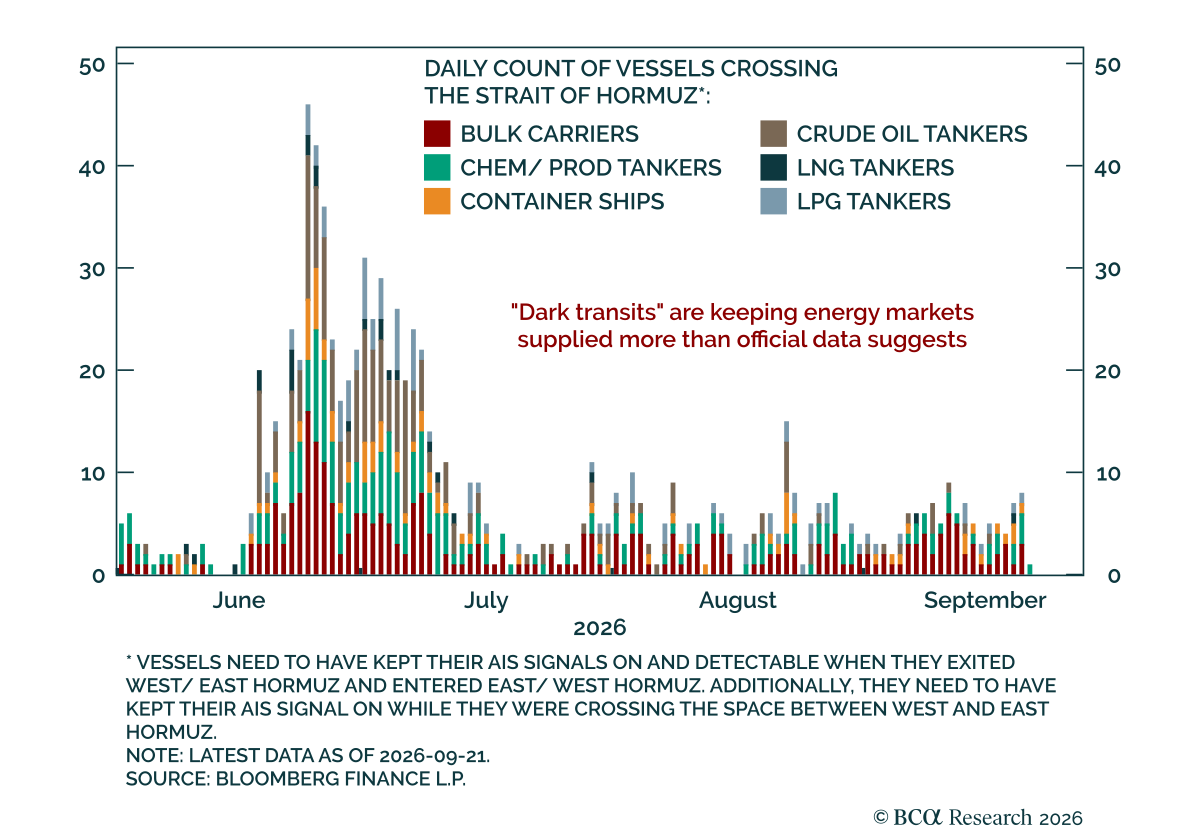
FeatureIn some respects, the Strait of Hormuz disruption is more severe for global LNG markets than for oil. First, although a trickle of oil tankers has exited the Strait since the war began, no laden LNG tankers have left the Persian Gulf (Chart 1). Second, unlike oil, natural gas has no alternative pipeline routes that can be used to bypass the Strait of Hormuz. Third, QatarEnergy’s Ras Laffan LNG facility sustained major damage in an Iranian attack, that will take years to fully restore. Finally, unlike oil, natural gas lacks a mechanism for coordinated global stockpile releases.    Chart 1 No LNG Has Exited The Strait Of Hormuz No LNG Has Exited The Strait Of Hormuz Over the longer term, however, a wave of new LNG export capacity will come online, helping to cushion the impact of Hormuz-related disruptions. In this report, we assess the likely net effect of these forces on LNG markets over both cyclical and structural horizons.Quantifying The 2026 Supply ShortfallIn an optimistic scenario in which the Strait of Hormuz reopens in May, the disruption would reduce global LNG supply by roughly 6% in 2026. Most of that shortfall would be offset by a 5% increase in global LNG liquefaction capacity expected to come online this year. However, if Hormuz remains closed for longer, the disruption to global LNG supplies would considerably worsen.The absence of alternative routes that bypass the Strait of Hormuz and the lack of global emergency gas stockpiles available for a coordinated release mean that the global LNG market has fewer buffers than the oil market to absorb the Hormuz-related supply shock. As a result, the closure of the strait is preventing the full 20% of global LNG trade that normally passes through the chokepoint from reaching the rest of the world. This equates to around 3% of global natural gas consumption being offline.Even if the strait is reopened in May – an optimistic scenario – we estimate that the disruption will lead to a 6% loss of global LNG supply, representing a 1% loss in global natural gas consumption, over 2026. Specifically:By the end of April, around 3% of annual global LNG supply will have already been lost due to the closure of the Strait of Hormuz. As long as the strait remains closed, losses will continue to expand at a monthly rate of 2% of LNG exports.  Even if the Strait is reopened at the start of May, an additional 1% of global annual LNG flows will be lost as Qatar’s Ras Laffan and the UAE’s Das Island gradually restore output.Even though QatarEnergy has started working towards resuming LNG production at its Ras Laffan plants, a full restoration of production at these facilities will take nearly three months. That is because the production ramp-up of the 12 undamaged liquefaction trains will occur in a phased manner. We use a similar ramp-up schedule for the UAE’s liquefaction capacity. True, a reopening of the strait will allow the supplies carried in the 20 loaded LNG tankers currently trapped in the Persian Gulf to become available for global markets. However, these tankers hold only about a week’s worth of pre-war Hormuz exports. Meanwhile, Gulf LNG exporters typically have only a few days’ worth of reserves. So, even if empty tankers were available, they would not be able to immediately ship more supplies.  Around 2% of global LNG supply this year will be lost due to the damage sustained to two of Ras Laffan’s liquefaction trains.It will take at least three years for production at these facilities to be restored. Therefore, even if energy flows through the Strait of Hormuz normalize, these liquefaction trains will remain offline for the remainder of the year.  Moreover, the closure of the UAE’s Shah gas field due to attacks is an added risk to Hormuz LNG exports. While its closure does not directly affect LNG exports, it likely will require the UAE to increase LNG imports – mainly from Qatar.  If this scenario plays out, lost Gulf LNG exports to the world will rise to 8% of global LNG exports. Liquefaction capacity additions in the rest of the world will partially offset the impact of the supply disruption this year. Assuming production at the UAE’s Shah gas field is restored, new global LNG capacity will offset nearly 90% of disrupted supply, especially towards the end of this year. The Structural Supply OutlookGlobal liquefaction capacity additions will significantly ease the 2027 LNG market balance before causing large surpluses from 2028 onwards.When accounting for the Iran war's longer term disruption to global LNG markets, consider the following:It will take three to five years for Qatar Energy to fully restore Ras Laffan’s two damaged liquefaction trains (nearly 3% of global LNG capacity).The UAE may need to rely more on LNG imports from Qatar until production capacity is restored at its damaged Shah gas field. This will delay the full restoration of LNG flows through Hormuz.Planned liquefaction capacity additions in Qatar and the UAE could be delayed. Given the uncertainty about how long it will take to repair damaged infrastructure, we examine the global LNG balance under three supply-side scenarios:1) The optimistic scenario assumes:Production at the first and second damaged trains in Ras Laffan is restored by end-2027 and end-2029, respectively.There is no lingering damage to the Shah gas field. 2) The pessimistic scenario assumes:Production at the first and second damaged trains in Ras Laffan is restored by end-2027 and end-2029, respectively.The UAE will rely more heavily on Qatari LNG into 2027 to offset the loss from the Shah gas field’s outage.  3) The very pessimistic scenario assumes:Production at the first and second damaged trains in Ras Laffan is restored by end-2027 and end-2029, respectively.The UAE will rely more heavily on Qatari LNG into 2027 to offset the loss from the Shah gas field’s outage.Liquefaction capacity additions from Qatar and the UAE are delayed by one year.  For all the supply-side scenarios listed above, we make the following assumptions: The Strait of Hormuz will reopen in May 2026. A longer disruption will deepen the projected 2026 deficit.There are no delays to ex-Middle East liquefaction capacity additions between 2027 and 2030 (Chart 2). By 2030, liquefaction capacity located outside the Gulf will be 50% above its 2025 level. Chart 2 Capacity Additions Will Cushion the LNG Market Structurally Capacity Additions Will Cushion the LNG Market Structurally Higher natural gas prices do not have a lasting impact on the LNG consumption outlook. We use the IEA’s pre-crisis consumption projections based on their Current Policies (CPS) and Stated Policies (STEPS) scenarios. LNG consumption is more aggressive in the CPS scenario, since STEPS assumes higher renewables’ uptake.  The top panel of Chart 3 plots the global LNG market’s balance in the optimistic scenario while the middle panel shows the market balance in the pessimistic scenario. The bottom panel shows the market balance in the very pessimistic scenario.  Chart 3 Global LNG Balances Will Tighten In 2026 Global LNG Balances Will Tighten In 2026 In all scenarios, the LNG market is expected to be tightest this year before significantly easing in 2027. From 2028 onwards, natural gas prices will face significant downward pressure as new global liquefaction capacity comes online. Potential Demand Response In Asia Although the current LNG shortage could lead to some demand destruction over the near term, the hit to consumption will be weaker than during the 2022 shock. Ultimately, the natural gas price spike is less pronounced this time around. Regionally, Asia is most vulnerable to a decline in LNG demand as it accounts for over 80% of total Gulf LNG exports. Within Asia, countries will respond to the LNG shortage by increasing coal power usage, turning to spot LNG and rationing existing natural gas supplies. China and India are the most likely countries to rely on coal as a replacement for natural gas. Additionally, multiple North Asian countries – excluding China – have reportedly turned to the spot market to replace contracted LNG imports. Importantly, the response to the shortage will be multi-faceted. For example, South Korea recently bought spot LNG cargoes and also plans to increase the capacity limit on coal power and delay the retirement of some coal power plants. The availability of alternative power-generating capacity will determine countries’ responses to the LNG supply shock.Ultimately, a reopening of the Strait of Hormuz is needed for Asia’s LNG imports to recover (Chart 4). Chart 4 Asia's LNG Imports Hit A Historic Low Asia's LNG Imports Hit A Historic Low Chart 5 The Natural Gas Injection Season Has Started The Natural Gas Injection Season Has Started Meanwhile, the recent uptick in European natural gas inventories suggests that, for now, the natural gas supply shortage is relatively localized to Asia (Chart 5).Longer term, the energy crisis will incentivize an effort to improve energy security via diversification. This will benefit renewables, coal as well as alternative sources of LNG imports, aided by the global buildout of liquefaction capacity. Investment ImplicationsAlthough new liquefaction capacity will partially offset the impact of the Hormuz supply disruption, LNG markets will remain tight this year. The LNG market is already pricing in this relative tightness. Compared to before the war, the average spread between 2026 and 2027 May to December contracts has increased by nearly 160% and 80% for the JKM and TTF benchmarks, respectively (Chart 6). Nevertheless, if the Strait of Hormuz does not reopen soon, there is scope for this spread to widen for both benchmarks.  Chart 6 Markets Are Pricing A Tighter LNG Balance In 2026 Versus 2027 Markets Are Pricing A Tighter LNG Balance In 2026 Versus 2027 Structurally, the impact of the LNG shortage will fade as new global liquefaction capacity comes online. Ashwin ShyamStrategistashwin.shyam@bcaresearch.com Roukaya IbrahimChief Commodity Strategistroukayai@bcaresearch.comPlease follow me on LinkedIn and X
Weekend developments showed Hormuz traffic has not resumed yet, despite earlier signals that the Strait had reopened. Iran signaled the Strait was closed again, while the US seized an Iranian ship. There were also rumors of a second round of US-Iran…

Red Light. Green Light. So much for the “all clear” in the Hormuz saga. 

The Iran war is deescalating further — against our expectations — setting up an aggressive return to the risk-on rally. 

The dollar’s pullback masks a quiet improvement in its cyclical backdrop, with growth, monetary policy, and flows turning in its favor. As markets fully price out geopolitical risk, the USD should decouple from oil and better reflect these gains, despite lingering structural headwinds.

The April BCA Views discussion centered on whether markets have become too complacent about an Iran conflict that is not yet resolved. We held our monthly BCA Views meeting to assess the global economy and discuss our asset allocation views. The discussion…

Markets may be underpricing a bifurcated political outcome. Unless the Iran deescalation succeeds, the delayed economic fallout from the energy shock could materially worsen Republican prospects and raise the probability of a Democratic Senate victory.

Peak escalation in the US-Iran conflict is likely behind us, with both sides now signaling a preference for a deal rather than renewed escalation. The latest headlines confirm the de-escalation rumors that circulated late Monday, with signs that neither Iran…

When the ceasefire between Iran and the US was announced on April 8, several clients told us that their geopolitical consultants were pitching a bearish narrative. The US had set up the two-week ceasefire to surge more material and troops to the region, so as to set up the next phase of the conflict. One such advisory firm also pointed out that it was unlikely that the US would hold back on further conflict since it had “already amassed ground troops to the region.” 

The failed Islamabad talks and the US blockade of Hormuz point to a more prolonged conflict rather than a quick de-escalation. The weekend’s main developments were the collapse of negotiations in Islamabad and the US announcement of a Hormuz blockade…

BCA's Iran Conflict Dashboard

Real-time charts on the Hormuz crisis, energy, and macro risk.

View Dashboard

Related Topics