Private Equity’s Investment Horizon Is Shorter Than You Think
Our Private Markets & Alternatives strategists laid out a framework for evaluating private equity investments. While fund vehicles often last more than ten years, the assets they contain are held for much shorter periods; and it is those shorter periods that drive returns. Closed-end funds can run a decade or longer, but performance is largely visible by year five, with early 2020 vintages now bringing this lesson home as cash distributions track among the weakest on record.
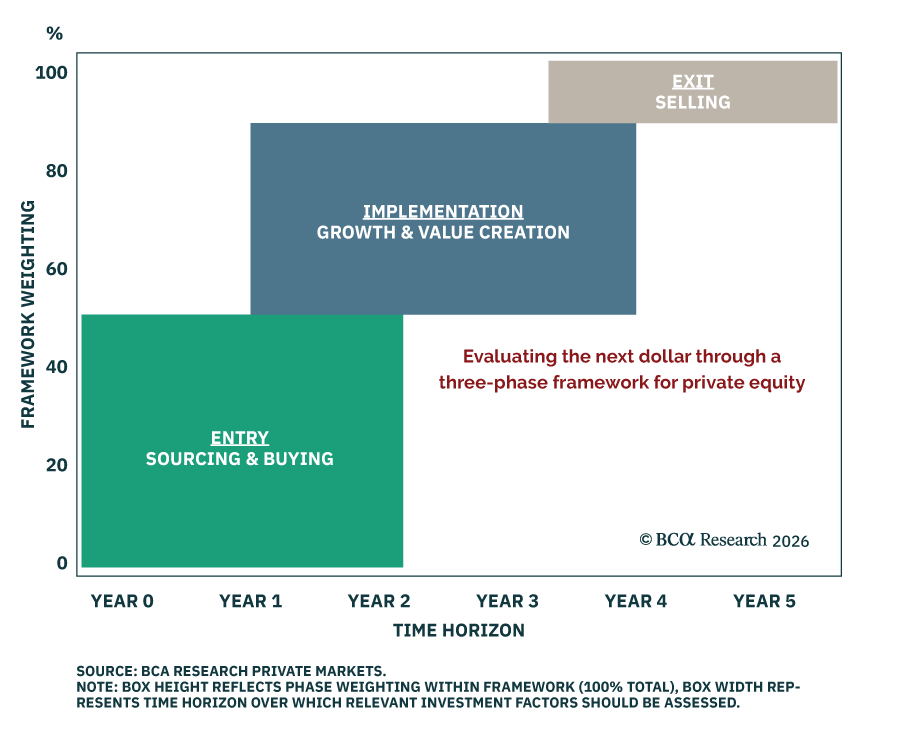
For investors deploying capital today, our colleagues argue the relevant underwriting horizon is five years, not ten or more. Anchoring decisions on extended fund lives risks misjudging where value creation and risk are concentrated, which tends to be earlier in the investment lifecycle. Deal-level data from 2000 to 2025 confirms this, with companies held for three-to-five years delivering the strongest results in traditional buyouts.
Our colleagues offer a three-phase framework. First, entry carries the highest weighting given its immediacy and predictability, making initial valuations, competition, and investor sentiment the most important variables to assess. Second, implementation receives less weight given its longer duration and macro sensitivity. Finally, exit gets the lowest weight given limited visibility. Liquidity planning, however, should still anchor to the full fund life rather than the five-year evaluation window.