インド
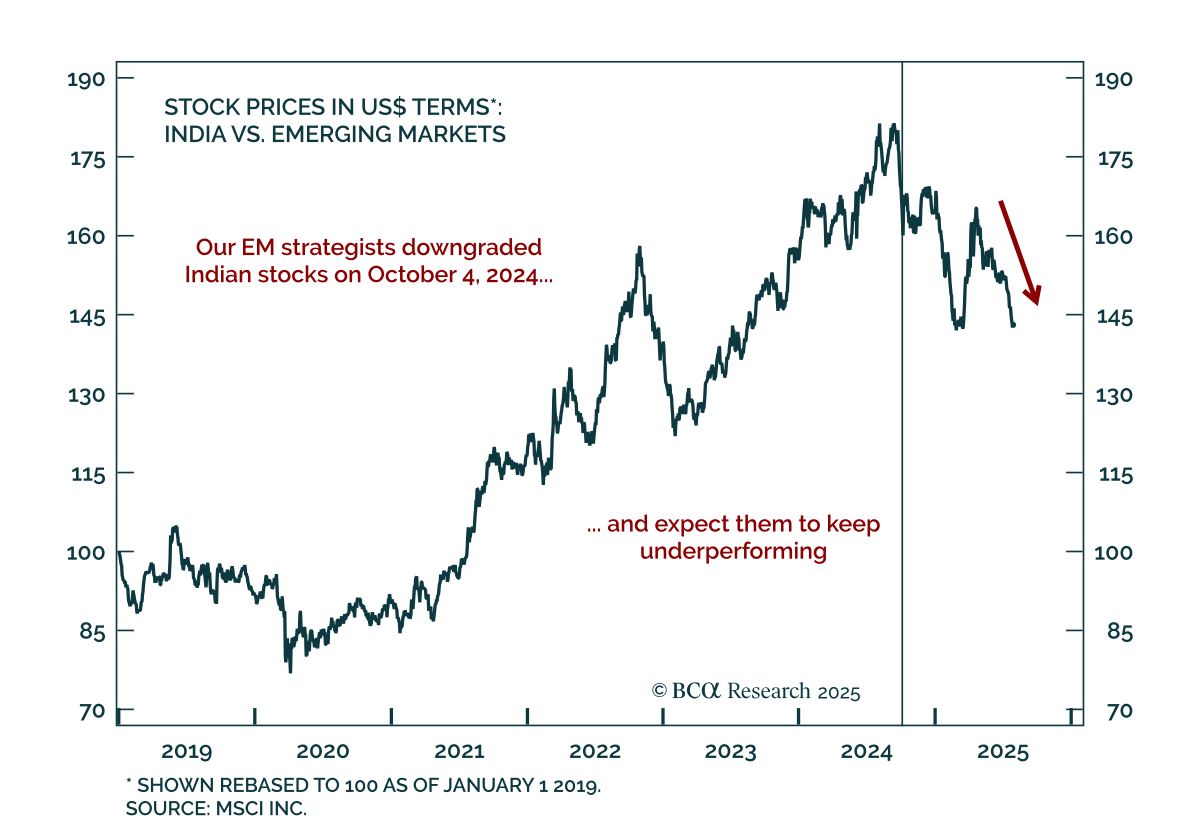
米国のインドへの関税: 最後の一撃か? 米国のインドへの関税: 最後の一撃か? 私たちの新興市場ストラテジストは、EM株式およびアジアポートフォリオにおいてインドをアンダーウェイトにすることを推奨し、一方でEM国内債券配分内でインドをオーバーウェイトに保つことを推奨します。 比較的高い米国の関税率と進行中の貿易協定への不確実性が、インドに対する投資家および事業者のセンチメントに悪影響を及ぼすでしょう。…
トランプ政権は今週、インドに対して25%の関税を課しました。この税率は多くの同業国や競合国(タイ、インドネシア、フィリピン、マレーシア19%;ベトナムとバングラデシュ20%)よりも高く設定されています。この関税がインドの金融市場にどのような影響を与えるのでしょうか? 私たちは、この高い税率自体がインド経済に与える影響はおそらく限定的であると考えています。米国への輸出品はインドのGDPのわずか2.3%に過ぎません。 しかしながら、いくつかの問題に関する不確実性が長引くことで、インドに対する投資家の心理が弱まる可能性があります。 第一に、ロシア産原油の輸入に対する追加的な罰則関税が課される可能性があります。インド(および他国)がロシア産原油を放棄しなければならない場合、世界的な原油価格は大幅に上昇するでしょう。また、ロシア産原油を米国産原油に置き換えることにより、インドの精製業者にとって運送費が増加することになります。言い換えれば、インドの経常収支赤字への悪影響がかなり大きくなる可能性があります。 現在、インドの原油輸入量の約35~40%がロシアからのものであり(つまり、1日あたり約200万バレル)、中国も同様の量をロシアから輸入しています。ロシアの原油輸出量(精製油を含む)は合計で1日あたり約700万バレルに近いです。もし1日あたり約400万バレルの原油需要がロシアから他の原油生産国へシフトした場合、ブレント原油価格は例えば20%上昇する可能性があります。この結果、インドの純原油輸入コストは年間約200億ドル(GDPの0.5%)拡大するでしょう。また、経常赤字も同様に拡大する可能性があります。 第二に、貿易協定の最終的な締結が保留されているため、インドのITセクターの米国への輸出に不確実性があります。ニュース報道によれば、いくつかのITセクターの課題がインドと米国による関税交渉の議題の一部となっています。これは懸念すべき問題です。インドのITサービスセクターの輸出が含まれる場合、米国への輸出はインドのGDPの8%を占めており、これは重要な割合となっています。最後に、関税協定が締結されるまで、インドにおいて政治的に非常に敏感な農業および酪農部門の結果も不透明なままです。インドの労働力の約半数がこれらの部門に従事しており、非常に低い所得水準にあります。米国の農産物がインド市場に大幅にアクセス可能となるいかなる協定も、インドの農家の所得可能性を脅かすことになります。これにより、政府にとって広範囲にわたる負の影響が生じる可能性があります。これらの不確実性の一つ一つが、インドの財政および金融政策がすでに非常に引き締まっている状況下で、さらに同国の経済および投資の見通しを曇らせることになるでしょう。政府の主要財政支出(つまり、利払いを除く)は、過去1年間で実質的にはほとんど増加していません (チャート1)。中央銀行はインフレが大幅に低下しているにもかかわらず、政策金利を十分に引き下げていません。その結果、実質銀行貸出金利5.5%はかなり抑制的です (チャート2)。銀行信用インパルス、つまり銀行信用の二次微分は縮小しています。政府の主要財政支出(つまり、利払いを除く)は、過去1年間で実質的にはほとんど増加していません (チャート1)。中央銀行はインフレが大幅に低下しているにもかかわらず、政策金利を十分に引き下げていません。その結果、実質銀行貸出金利5.5%はかなり抑制的です (チャート2)。銀行信用インパルス、つまり銀行信用の二次微分は縮小しています。
チャート1
インドの財政スタンスは制約的
インドの財政スタンスは制約的
チャート2
実質借入コストは高い
実質借入コストは高い
チャート1
インドの財政スタンスは制約的
インドの財政スタンスは制約的
チャート2
実質借入コストは高い
実質借入コストは高い
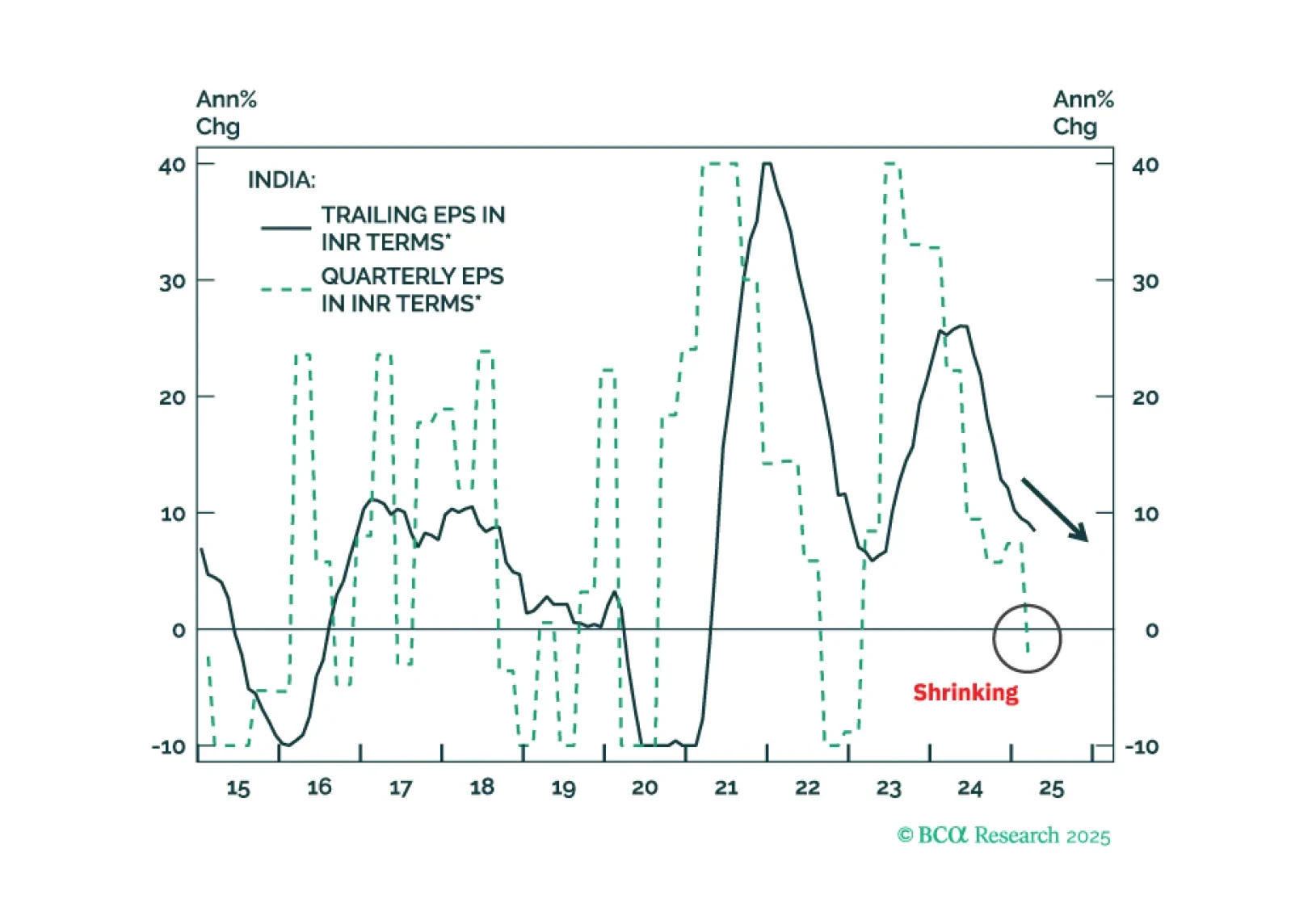
これはインドの設備投資見通しにとって悪い兆候であり、すでに大幅に減速しています(図3)。新しい関税と貿易協定条件に関する不透明さが続くことにより、設備投資の回復がさらに遅れるでしょう。これはインドの設備投資見通しにとって悪い兆候であり、すでに大幅に減速しています(図3)。新しい関税と貿易協定条件に関する不透明さが続くことにより、設備投資の回復がさらに遅れるでしょう。これらすべてが意味するのは、インドの経済成長率が低下に向かっているということです。インド企業のEPS(1株当たり利益)は現地通貨ベースでもすでに縮小しています(図4)。これが起きているのは、株式のバリュエーションが極めて高水準にあるタイミングでのことです。
チャート3
インドの設備投資復活は差し迫っていない可能性
インドの設備投資復活は差し迫っていない可能性
チャート4
インドのEPSは縮小する見込み
インドのEPSは縮小する見込み
チャート3
インドの設備投資復活は差し迫っていない可能性
インドの設備投資復活は差し迫っていない可能性
チャート4
インドのEPSは縮小する見込み
インドのEPSは縮小する見込み
チャート5は、純外国株式ポートフォリオ流入が間もなくマイナスになることを示しています。これは通常、株式市場の売り圧力とルピーの弱体化を引き起こします。特に、インドの経常収支赤字が顕著に縮小したにもかかわらず、過去数年間の間にルピーが弱体化した点が注目されます。その理由は、純資本流入、特に外国直接投資が枯渇したことです(チャート6)。
図5
海外資金流出が株式市場を押し下げる
海外資金流出が株式市場を押し下げる
チャート6
インドのFDIは枯渇した
インドのFDIは枯渇した
図5
海外資金流出が株式市場を押し下げる
海外資金流出が株式市場を押し下げる
チャート6
インドのFDIは枯渇した
インドのFDIは枯渇した
経常収支の悪化が予想され、純資本流入の消失に伴い、ルピーがさらに弱まる可能性があります。 結論: インドの株価は絶対的な水準で下落するでしょう。我々は、専用のEMおよびアジア新興市場の株式ポートフォリオにおいてインドをアンダーウェイトで維持することを推奨します。特に、インドのIT株もインドにおけるグローバル・キャパビリティ・センターの急速な台頭に伴い逆風に直面するでしょう。インドの政府債券利回りについては、同国の経済成長率に密接に連動しており(図7)、共に下落しています。EM国内債券ポートフォリオはインドをオーバーウェイトで維持すべきです。 フィクスト・インカム投資家は、通貨ヘッジをした上で、引き続きインドの10年債をロングで保有するべきです。 ラジーブ・プラマニックシニアEMストラテジストrajeeb.pramanik@bcaresearch.com
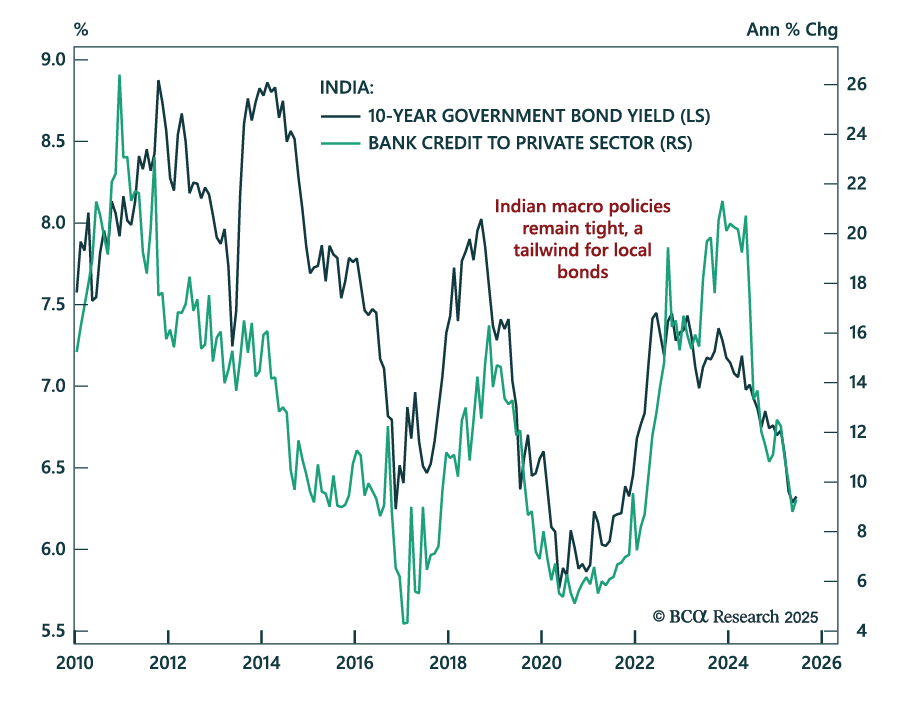
引き締め政策と低下するインフレがインド債券のロングを支援 引き締め政策と低下するインフレがインド債券のロングを支援 インフレ率が6年ぶりの低水準にあり、引き締め的な政策が成長に圧力をかける中、当社のEMストラテジストはインド国債をロング継続し、株式をアンダーウェイトとしています。 ヘッドラインCPIは前年同月比2.1%に低下し、主に食品価格の低下によるもので、インフレはRBIの目標範囲の下限に達しました。これによりさらなる利下げの根拠が強まっています。…
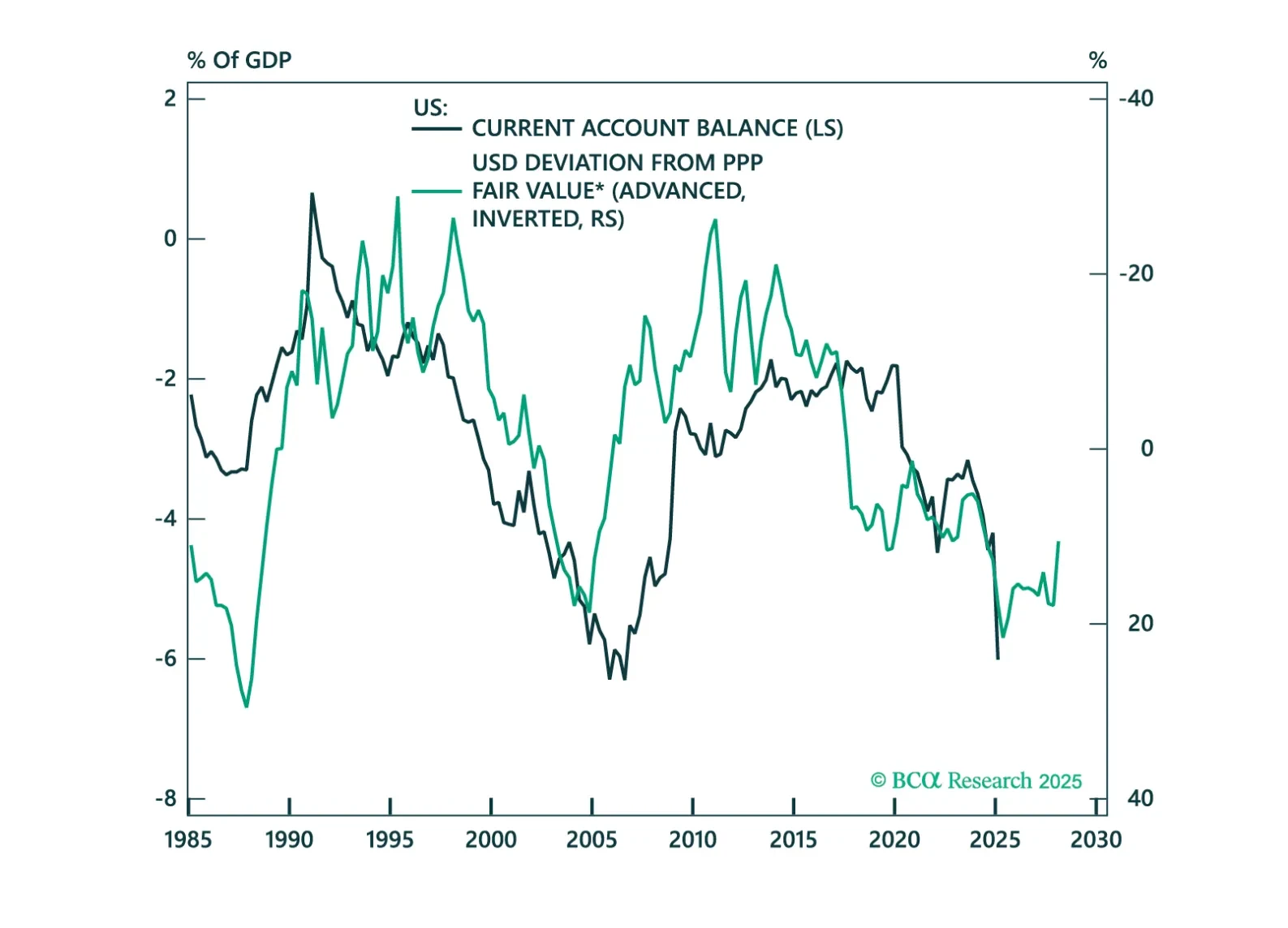
このチャートブックでは、先進国(DM)および新興国(EM)の各国の国際収支を検討します。米国の状況は良くありませんが、他のいくつかの国も同様です。
India's IT service exports have been booming and will continue to do so despite wider AI usage. Indian IT stocks, however, will not benefit from it as the expanding Global Capability Centers (GCCs) in India compete with the nation’s IT companies, driving the latter's profitability down.
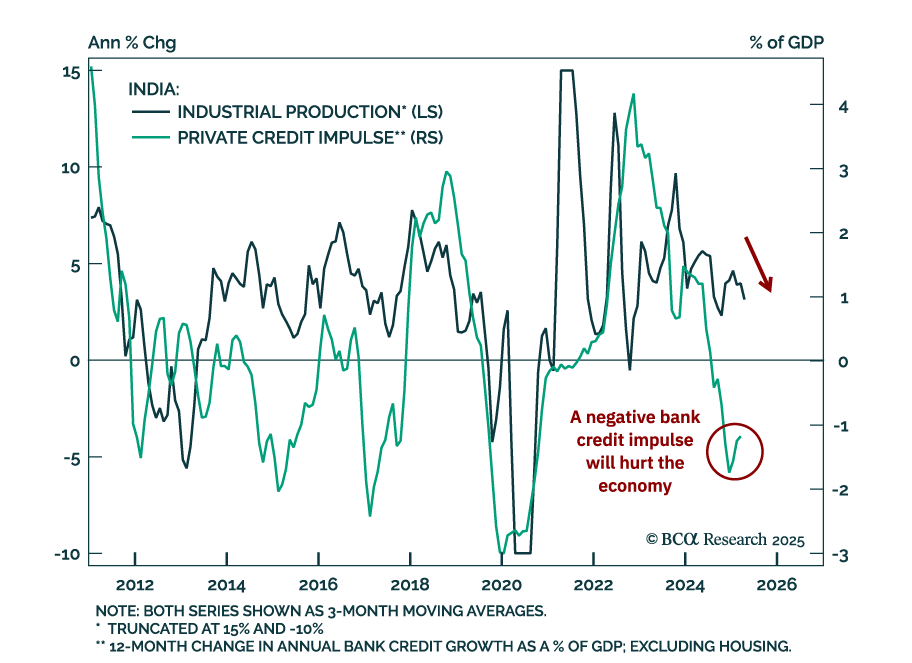
Industrial activity in India is deteriorating, which will weigh on a stock market that’s priced for perfection. Indian industrial production slowed to 2.7% year-on-year in April compared to 3.9% in March. The economic slowdown will gain traction in the coming…
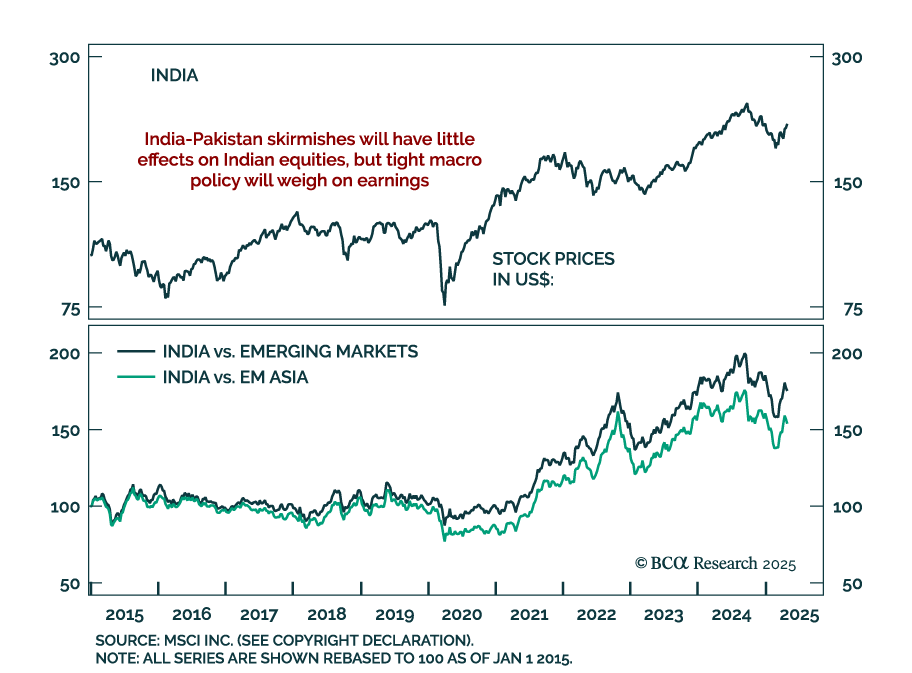
Indian equities remain resilient despite rising India-Pakistan tensions, but BCA’s EM strategists stay underweight India while favoring local-currency bonds. The latest flare-up follows Indian retaliation to last month’s terrorist attack in Kashmir,…

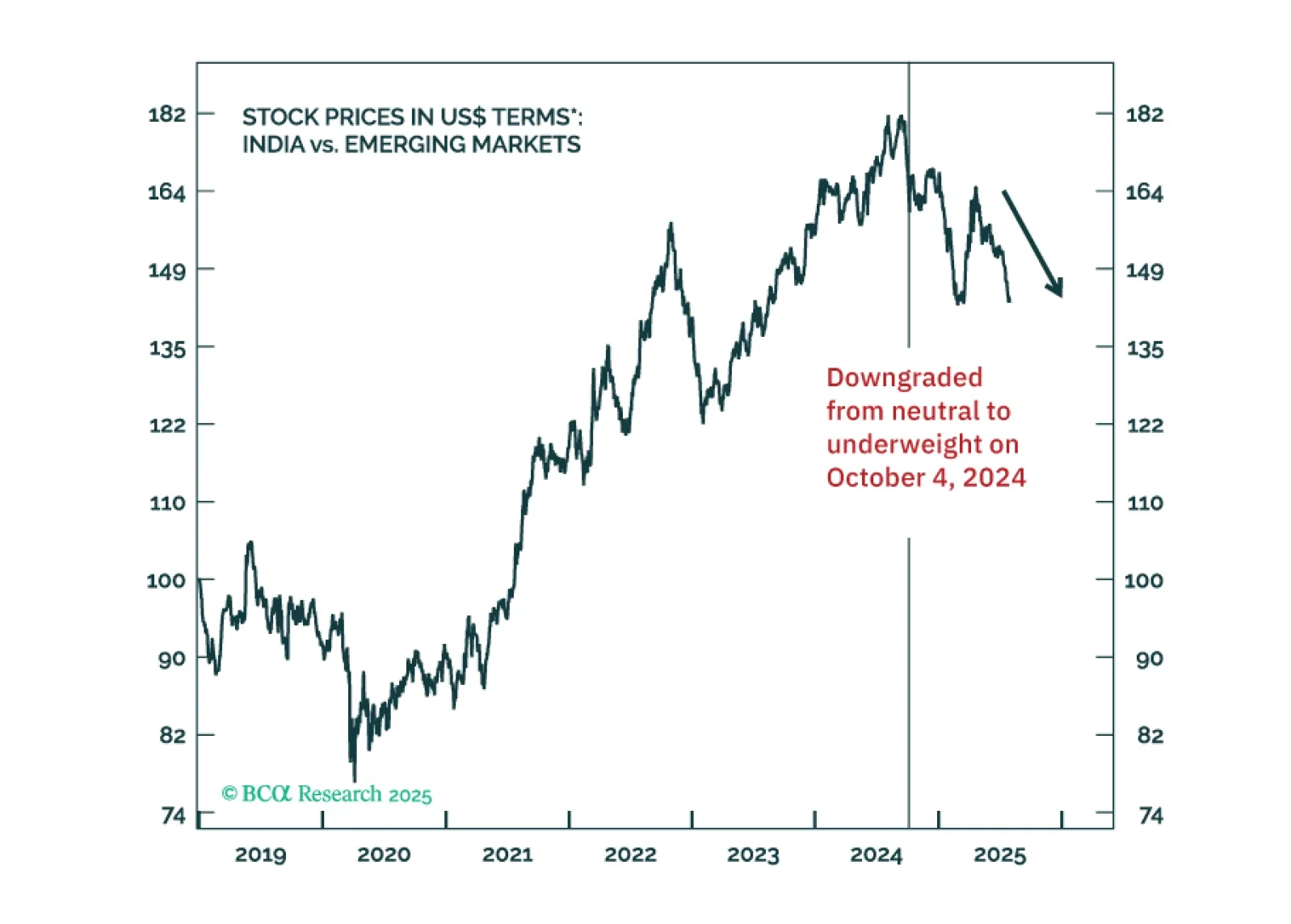
In its budget plans last week, the Indian fiscal authorities announced major tax cuts for households – the equivalent of about US$12 billion, 0.3% of GDP – to boost consumer spending. Soon thereafter, the central bank cut its policy rates by 25 bps – for the first time in five years. Can these stimulus measures put a floor under Indian growth, and hence, stock prices?The short answer is no. This economy and the stock markets are set for more weakness. We downgraded Indian stocks from neutral to underweight in EM and Emerging Asian portfolios on October 4th last year. Since its peak on September 27th, this bourse has corrected by about 18% in US dollar terms and has underperformed the EM equity benchmark by 13% (Chart 1). Investors should brace for further selloff and underperformance. Fiscal Stance: A Change Of TackDuring the past several years, India’s fiscal spending plans focused far more on building infrastructure and other productive capacities than on current expenditures. The government’s capital spending doubled as a share of GDP over the past four years (Chart 2).The new budget plan, however, emphasizes boosting household consumption (via generous income tax cuts) to generate economic growth. There has been no rise in planned government capital spending for the next fiscal year (as a % of GDP). Can this change of fiscal policy help turn the country’s slowing growth around? We believe that an improvement is unlikely. The reasons are as follows.Only about 31 million citizens in India pay personal income tax. That amounts to less than 10% of households. These are the top decile of households in terms of income and usually have a lower propensity to spend their extra income than the less well-off. The bottom 90% of households will not benefit from the tax breaks at all. The upshot is that tax cuts will have little impact on lifting overall consumer spending growth.What’s more, the government plans to reduce the fiscal deficit next year by another 0.4 percentage points of GDP (from 4.8% of GDP this year to 4.4%). This implies that the government will cut fiscal spending elsewhere by 0.8% of GDP (after accounting for 0.3% of GDP for tax cuts and 0.1% of GDP rise in interest payments). In many cases, that spending was intended for the government’s various economic and social welfare schemes aimed at relatively low-income populations. As such, the vast majority of India’s population and almost all low-income households could see their real income from government schemes stagnate or even fall due to the new budgetary plans. That means little or no consumption boost from this cohort. This is at a time when Indian household income growth has already been sluggish for several years. Rural wages have not grown at all in inflation-adjusted terms over the past five years (Chart 3, top panel). Urban households are not doing much better. Less than 20% of respondents in RBI’s latest industrial outlook survey reported a rise in paid salaries or other remunerations – the lowest level in a decade, save the pandemic period (Chart 3, bottom panel).Not surprisingly, consumer durable sales are sluggish. Two-wheeler sales – often a barometer of households’ discretionary spending – have stagnated (Chart 4).The bottom line is that the combined effect of tax breaks for a small sliver of the population and non-trivial budgetary spending cuts will lead to a further slowdown in India’s overall household consumption. Not Much Relief From Monetary Policy In addition to last Friday’s 25-basis point rate cut, the RBI has announced some other measures in the last several weeks. These include cutting the cash reserve ratio by 50 basis points (to 4%), open market operations, and dollar-rupee swaps – all to ease the liquidity crunch. However, collectively these measures will be insufficient to lift the current deeply negative banking sector liquidity into positive territory (Chart 5). The ongoing liquidity crunch is mostly due to RBI’s persistent defense of the rupee. The central bank has been selling foreign currency for months to support the domestic currency (Chart 6). In so doing, it mopped up a vast amount of rupees from the market. Notably, even after the rate cut, the central bank retained the policy stance as “neutral,” and did not change it to “accommodative”. This indicates that the Indian central bank is not planning to embark on a substantial reduction in borrowing costs for now. Therefore, policy rates will remain quite elevated, even though core inflation has eased to well within the RBI’s target bands of 2-6%. As such, real borrowing costs will be hovering near decade-high levels (Chart 7).Given that borrowers will have to contend with elevated real borrowing costs for a while longer, India’s credit deceleration has further to run. The country’s bank credit impulse (excluding mortgage loans), the second derivative of bank loans, is already contracting measurably. This is usually a bad omen for economic activity (Chart 8). The reason for looking at the credit impulse instead of credit growth is that bank credit is a “stock” variable, whereas “GDP” is a flow variable. Since we are trying to ascertain the future GDP growth rate – which is a “change” in a flow variable – the analogous metric for credit that one should use is also the “change in credit flow”, in other words, the credit impulse. The message is similar if we look at the money supply impulse. As of January, India’s broad money supply (M3) impulse has fallen to zero. This has been a good indicator of India’s business cycles and is pointing to continued weakness in nominal growth (Chart 9). This is a cause for concern, as it’s nominal growth, rather than real growth, that determines profits and stock price growth. The bottom line is that persistently tight fiscal and monetary policies are hurting India’s domestic demand, and, hence, the nation’s business cycle. Profits Are Set To ContractIndian corporate earnings will likely contract as persistently tight monetary and fiscal policies will continue to hurt firms’ topline growth and margins. Given the still very high equity valuations, profit disappointments will extend the selloff in this bourse.RBI's compilation of 2900 companies shows that the nominal sales growth rate slowed to 6.6% as of September 2024, the latest figures available. Operating profit growth slowed to 4.5%.Profits have likely slowed further since then – as borne out in corporate income tax payments, which turned negative in the 12 months to December 2024. Historically, corporate tax payments have been a good gauge of firms’ sales and profits. Negative growth in corporate tax payments foreshadows shrinking corporate earnings (Chart 10).Profit margins will fall, as decelerating revenue growth will hurt margins due to operating leverage. Falling margins usually dampen stock multiples (Chart 11). Thus, both drivers of Indian stock prices, corporate earnings growth, and margins, have a negative outlook.Incidentally, bottom-up analysts are currently expecting Indian EPS to grow at a lofty 15.7% in nominal rupee terms over the coming year – as opposed to 7% growth in the past 12 months. Given that corporate sales growth is now down to single digits and will likely downshift further, profits will likely shrink in nominal local currency terms (Chart 12, top panel). Meanwhile, net earnings revisions have become increasingly negative in recent months. Stock multiples will also de-rate in tandem (Chart 12, bottom panel). In sum, this market is in for major disappointments. Contracting corporate profits will feed into broader economic weakness. Firms typically restrain their capital expenditure (capex) and hiring plans when profits fall (Chart 13). In India, capex, rather than household consumption, has been the mainstay of its growth post-pandemic. Any setback therein will dent the economy’s outlook. In another indication of dwindling capex plans, inbound FDI has largely dried up. In the 12 months to September, net inbound FDI into India (after subtracting repatriations of past FDI), has fallen to a paltry $32 billion (0.9% of GDP) – the lowest amount in a decade (Chart 14). A likely global tariff war in the coming months will not help either. Any uncertainty regarding the sales outlook usually discourages firms from making new capital expenditure plans, and tariff-related worries will do just that. Indeed, India itself could well face new tariffs from the Trump administration. India’s own import tariffs for certain items have been quite high. Last week, the government slashed many of them. For example, some items like luxury cars saw a tariff rate reduction from 70% to 40% and used vehicles from 40% to 20%. Average tariffs are now down from 13% to 11%, which is still high by global standards. If the new US government ends up imposing tariffs on India, that will be a major blow to the Indian economy.Indian companies will also be apprehensive that China, facing tariff and non-tariff barriers in US markets, might redirect some of its exports elsewhere – including to India. That will make them even more cautious regarding new investment expenditures. In sum, sliding profits and tariff uncertainties will lead to weaker capex and employment. That, in turn, will further hurt domestic demand, firms’ sales, and profits. Investment ConclusionsEquities: Despite the recent sell-off, Indian stocks remain extremely expensive. Our composite valuation measure shows this bourse to be overvalued by two standard deviations. The same is true for India’s relative valuation vis-à-vis its EM peers (Chart 15).The combination of potential profit contraction and expensive equity valuations makes a toxic cocktail for this equity market. This market needs to correct much further before it becomes attractive again.Absolute-return investors should stay away from this bourse. EM and Emerging Asian equity portfolios should stay underweight India. We reiterate our short Indian stocks / long Chinese A-shares trade, which was initiated on September 27, 2024.Currency: India’s currency outlook remains poor. Despite RBI’s repeated interventions to support the currency, the rupee has depreciated by over 4% versus the US dollar in the past four months – a trend that will likely continue. As a country with a current account deficit, India needs persistent and adequate net capital inflows to finance this deficit. In the absence thereof, the rupee fails to hold its value. Given the ongoing large portfolio outflows, the rupee is likely to depreciate further in the coming months (Chart 16).Domestic Bonds: Indian bond yields track the country’s economic growth closely (Chart 17). They are headed lower as the RBI has fallen behind in terms of monetary policy easing. The longer the RBI delays in initiating a sizable easing, the lower the yields will fall.Fixed-income investors should stay long Indian domestic bonds but hedge the currency risk - we recommended hedging it on October 4, 2024. Dedicated EM bond portfolios should stay overweight India because in common currency terms on a total return basis, Indian domestic bonds will outperform their EM peers. Indian local currency bonds also offer one of the best long-term opportunities within the EM fixed-income space.Rajeeb PramanikSenior EM Strategistrajeeb.pramanik@bcaresearch.com

Indian equities reached new highs in late September. Our Emerging Market strategists recommend dedicated EM investors use these gains as an opportunity to reduce Indian equity allocations from neutral to underweight. They expect both profits and multiples to…
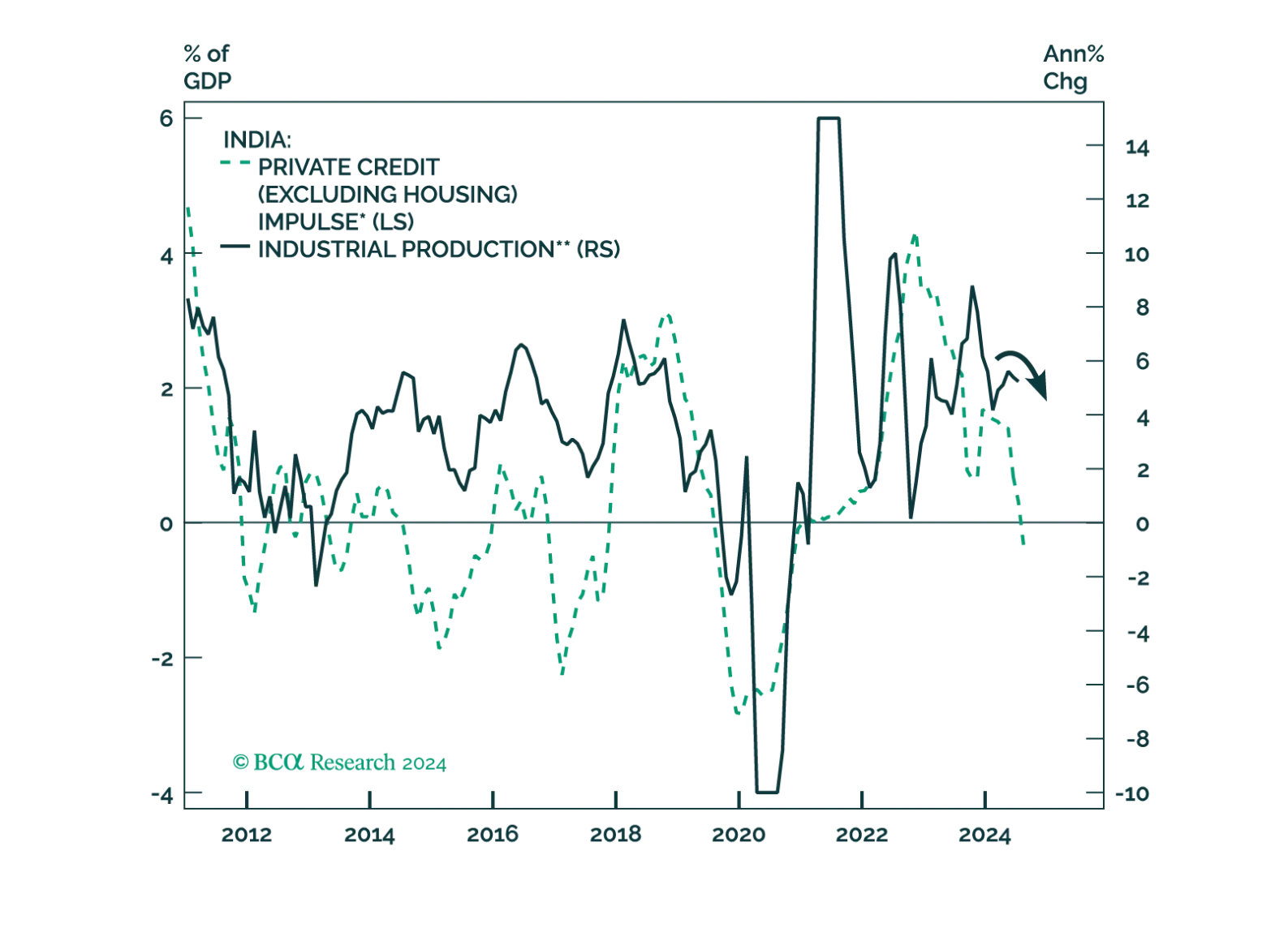
India’s credit impulse has turned negative. Government spending is contracting. The country’s growth will remain subdued; and both drivers of stock prices – profits and multiples – are headed lower at a time when equity valuations are at a record high.