Wheat

The annual Prospective Plantings report released by the US Department of Agriculture (USDA) last week was slightly bullish for corn, neutral for soybeans, and slightly bearish for wheat. It forecasts a 5% drop in corn acreage, a 3% increase in soybean…
Prices of agricultural commodities have come under intensified downward pressure this year. Corn, soybean, and wheat prices have fallen by 8.6%, 8.3%, and 4.9% respectively so far this year. Multiple factors are behind the selloff. First, ag prices…
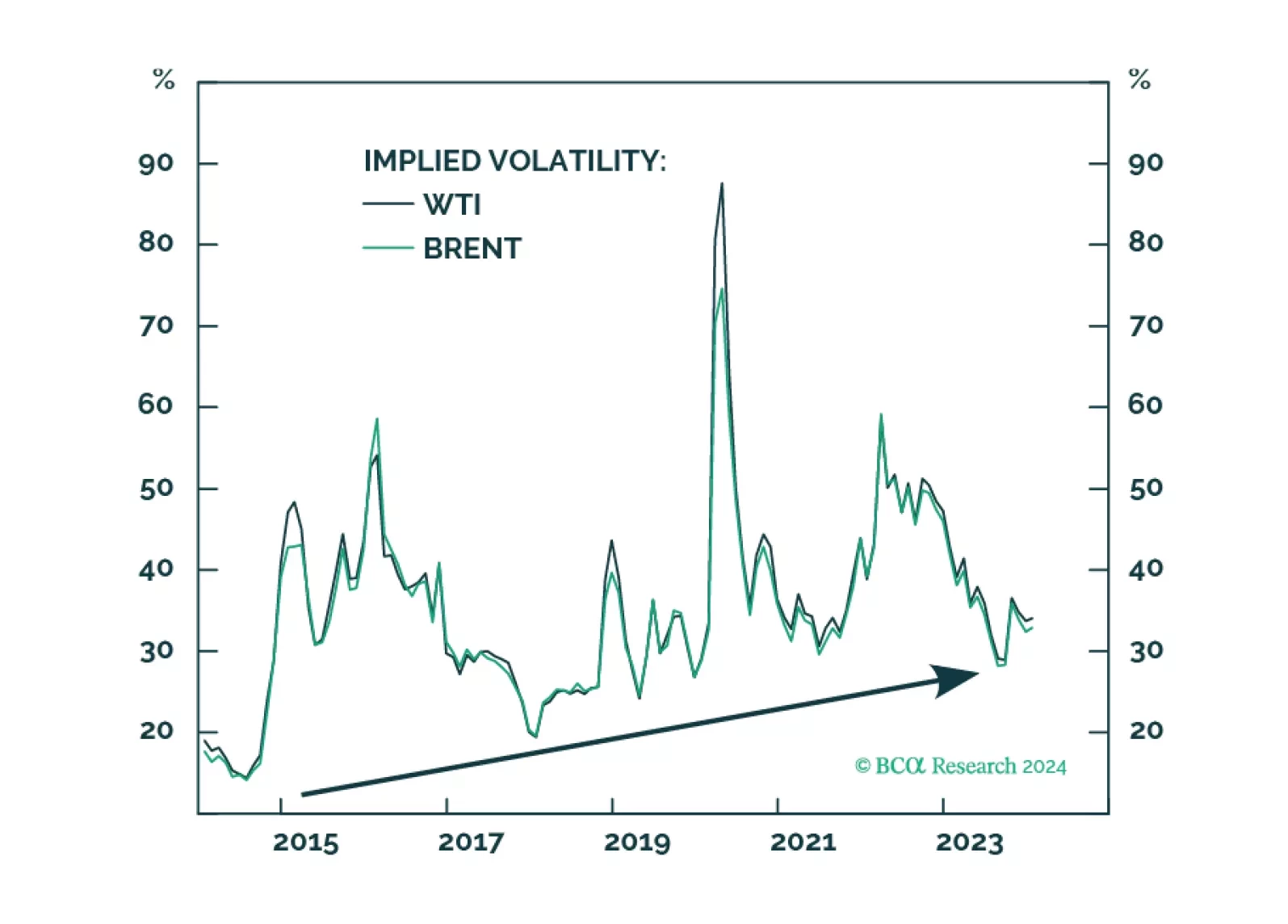
Commodity volatility will continue its rising trend since 2014. The US is on the brink of a major election, the outcome of which could reduce its willingness to engage with the outside world. So, states seeking to carve out their own spheres of influence are incentivized to raise the economic costs to the US and discourage its influence in their regions. These states can do this by interfering in key trading routes in their regions. As a result, geopolitical threats to maritime chokepoints are a structural as well as cyclical problem and will persist due to the revival of superpower competition.
Wheat, corn, and soybean all traded lower at the Chicago Board of Trade on Wednesday following the US Department of Agriculture’s latest release of its monthly World Agricultural Supply and Demand Estimates (WASDE) – down 4.2%, 3.5%, and 2.4%, respectively. …

Executive Summary The surge in food prices following Russia's invasion of Ukraine will drive EM headline inflation higher, given more of individuals' incomes in these economies are spent on food. Economies in the MENA will remain at risk for higher food prices, given their reliance on wheat imports from Ukraine and Russia, which together comprise ~ 30% of global wheat exports. Wheat is the most widely traded grain in the world; its production is second only to that of corn. Higher shipping and input costs – especially for fertilizers – will exacerbate the upside price pressure on grains, particularly wheat. Tenuous social contracts raise the risk of social unrest in MENA reminiscent of the Arab Spring unrest of 2011, which was fueled by food scarcity, economic stagnation and popular anger at autocratic governments. A strong USD will continue to raise the local-currency cost of grains and food, which also will fuel EM inflation. The War Increased Food Prices… Bottom Line: Wheat prices will remain volatile with a bias to the upside for as long as the Russia-Ukraine war persists. The uncertain evolution of this war means EM states will be more exposed to grain-price volatility and higher inflation. This could prove to be destabilizing to MENA states in particular. Separately, we update our recommendations below. Feature High food prices will drive EM headline inflation, owing to the fact a higher proportion of individuals’ incomes in these economies are spent on food. These pressures are particularly acute for wheat following Russia's invasion of Ukraine. Related Report Commodity & Energy StrategyCopper Demand Will Ignore Recession Wheat is the most widely traded grain in the world, according to the World Population Review (WPR).1 In terms of global production, it is second only to corn, totaling 760mm tons in 2020. In order, the top three wheat producers in the world are China, India, and Russia, which account for 41% of global output. The US is the fourth-largest producer. The WPR notes that if the EU were to be counted as a single country, its wheat production would be second only to China (Chart 1). Within emerging markets, the Middle East and North African (MENA) nations will be worst hit by rising wheat prices.2 This is because the bulk of their wheat imports are sourced from Russia and Ukraine, and shipped from Black Sea ports, which are literally caught in the crosshairs of the Russia-Ukraine war. Many of these states do not have sufficient grain reserves to tide themselves over this crisis, and will be forced to import food at elevated prices. A strong USD, which this past week hit a 19-year high, will add to the price of USD-denominated commodity imports, particularly wheat. Russia’s invasion of Ukraine will continue to exacerbate EM food scarcity and drive input costs – e.g., fertilizers – and shipping rates higher. This will keep food and wheat prices volatile with a strong bias to the upside (Chart 2). Chart 1Wheat Production Faces Concentration Risk Chart 2The War Increased Food Prices… In addition to the inflation risk from high food and energy prices, the tenuous social contracts in many states again raises the risk of social unrest in MENA, as occurred in the 2011 Arab Spring protests against food scarcity, economic stagnation and autocratic government.3 War Disruptions Will Continue Russia’s invasion of Ukraine jeopardized wheat supply from two countries which together constitute nearly 30% of total global wheat exports. The invasion will continue to keep wheat prices volatile and biased to the upside (Chart 3). The UN Food and Agriculture Organization (FAO) forecasts Ukraine’s 2021/22 wheat output will drop below its 5-year average, since at least 20% of total arable land cannot be used due to the war. While nearly 60% lower than this time last year, Ukrainian wheat exports in March were not completely shut down. However, they were re-routed around the direct routes from the Black Sea.4 In March, Ukraine managed to export 309k tons of wheat. Chart 3...Particularly Wheat Ukraine will need to rely on these convoluted routes until port services are either restored or unblocked. Exports through more circuitous routes will delay distribution and increase transport costs. This, of course, also adds to the delivered cost of wheat that is being rerouted and slows the overall distribution of grains globally. Additionally, Ukrainian exports via other countries will be disrupted by those countries’ own trade slowdowns, since global bottlenecks affects all trade. Thus far, Russia has been able to maintain wheat exports. Russia continued to supply wheat to global markets in March and April. The USDA estimates that during the 2021/22 crop year, which ends in June, Russian wheat exports will total 33mm tons, which is just 2mm tons lower than the USDA's pre-crisis estimate.5 Because of high carryover stocks and record production, Russia's exports in the 2022/23 crop year are expected to be more than 40mm tons. Sourcing Alternative Wheat Supplies With a sizable portion of global wheat supply at risk – primarily from Ukraine – other exporting countries will need to increase output to fill this gap (Chart 4). This production, however, is not guaranteed, as it depends primarily on weather and fertilizer prices. New trade routes will also need to be created. This will tax existing export infrastructures as shipping dynamics are reconfigured. Particularly important will be how far the new-found sources of supply have to travel to deliver grain, shipping availability, and, of course, the incremental costs incurred to move supplies. As of 2021, the EU – the Black Sea states’ principle competitor in the wheat-export market – and 48% of total wheat exports to Middle East and African countries (Chart 5). The EU's ability to increase exports for the remainder of the 2021/22 crop year will depend on its production, since demand for exports will be guaranteed given the crisis in the Black Sea. Chart 4Other Exporters Will Need To Ramp Up Chart 5MENA Is EU’s Primary Wheat Export Market The European Commission expects the EU to export a record 40mm tons of wheat for the 2022/23 market year, 6mm tons higher than its expected 2021/22 exports. Based on past trade patterns, these excesses will go to the Middle East, Northern and Sub-Saharan Africa. Strong USD Favors LatAm Exports US wheat exports will not be competitive this year or next, given the strong USD and relatively high prices (Chart 6). Additionally, this year’s winter-wheat crop will be affected by current drought conditions in the key Hard Red Winter wheat growing regions of Western Kansas, Colorado, Oklahoma and Texas. Canada faces a similar issue to its North American neighbor. Compared to other major wheat exporting states, it exports wheat at the second highest price, after the US. Furthermore, in 2021/22 Canadian wheat output is expected to be the lowest in 14 years following a warm and dry summer. The USDA expects strong Argentinian and Brazilian wheat exports in 2021/22. Compared to exports from the EU, US, Australia and Canada, wheat from these two sources is cheaper and hence will attract price sensitive bids from the Middle East and Africa. Chart 6US Wheat Remains Non-Competitive A strong USD will incentivize the LatAm giants’ wheat exports since their input costs are in local-currency terms and their revenues are in USD. While some countries have taken advantage of high wheat and food prices to increase exports, others have imposed restrictions or outright bans on exports, which will continue to drive prices higher. Kazakhstan, which constitutes nearly 5% of global wheat exports, now has a quota on such exports, which will affect Central Asian import markets. India was expected to constitute an uncharacteristically large share of wheat exports this year and next. However, the country is experiencing its hottest March in 122 years, which most likely will reduce its harvest this year and incentivize it to keep wheat stocks at home. The world’s second largest wheat producing and consuming nation expects a 6% drop in production this year.6 Fertilizer Costs Will Remain High … Countries’ abilities to increase production will depend on fertilizer availability and costs. The USDA cited high fertilizer prices as one of the causes for lower expected Australian wheat output in 2022/23. Prices of natural gas – the primary feedstock for fertilizers – took off like a rocket following Russia's invasion of Ukraine. High natgas prices feed directly into fertilizer costs (Chart 7). The EU's proposal to ban Russian oil imports could see Russia embargo natgas supply in retaliation, which would further spike natgas and fertilizer costs. This will have knock-on effects on all ags markets. Fertilizer export bans announced by Russia and China are another factor driving fertilizer prices higher (Chart 8). High fertilizer costs most likely will dissuade farmers from using fertilizers in volumes associated with more normal market conditions, and likely will cause them to wait on planting and treating acreage, which will lower crop quality or delay planting. Both scenarios will lead to higher crop prices (Chart 9). Chart 7High Natgas Prices Feeds Right Into Fertilizers Chart 8Russia, China Are Big Fertilizer Exporters Chart 9Nitrogen Fertilizer Prices Continue To Rise …As Do Shipping Costs Redrawing trade routes – i.e., finding new supplies and new shippers to compensate for the loss of Ukrainian wheat exports – will be expensive. For example, US grain shipping costs soared to an 8-year high after countries, led by China, dramatically increased soybean imports from the US due to a drought in Brazil.7 In 2021, high shipping costs led directly to higher food prices (Chart 10).8 Shipping, like any other commodity, is a function of supply and demand for different types of vessels capable of carrying grain from one part of the world to another. On the supply-side, port closures in China and the Black Sea are increasing port congestion, and making ships available for moving grains scarce. The Ukraine war has stranded ships in the Black Sea and forced merchants to re-route their shipments. This increases sailing times, which has the effect of contributing to supply scarcity in shipping markets. Fewer available ships, coupled with high fuel prices are keeping freight rates elevated. A low orderbook of expected new-vessel additions to the global shipping fleet in 2022 and 2023, along with guidance for ships to reduce speeds to increase fuel efficiency, will exacerbate current ship supply scarcity.9 On the demand side, the major international economic organizations have reduced 2022 GDP estimates due to lower economic activity. Lower economic activity will translate into lower ship demand and hence reduce prices (Chart 11). Chart 10Shipping Prices Remain Elevated Chart 11Shipping Demand Driven By Economic Activity Shipping prices will drop meaningfully once port congestion clears. This will depend on the duration of COVID-19 in China and the evolution of the Russia-Ukraine war. A recession – the probability of which will increase if the EU bans Russian oil imports and Russia retaliates with its own natgas ban – acts as a downside risk to shipping costs. Investment Implications The gap in Black Sea wheat exports produced by the Russia-Ukraine war will require a ramp-up in other countries’ supply. Higher production is contingent on weather conditions and input costs. Changing weather patterns, due to climate change, will increase food insecurity, and make it more difficult to predict how ag markets – particularly grain trading – will handle this shock and other shocks down the road. We remain neutral agricultural commodities but will follow wheat and food market developments closely. Ashwin Shyam Research Analyst Commodity & Energy Strategy ashwin.shyam@bcaresearch.com Paula Struk Research Associate Commodity & Energy Strategy paula.struk@bcaresearch.com Robert P. Ryan Chief Commodity & Energy Strategist rryan@bcaresearch.com Commodity Round-Up Energy: Bullish Going into the Northern Hemisphere's summer driving season, US retail gasoline prices are trading at record levels -- $4.328/gal ($181.78/bbl) as of 9 May 2022, according to the US Energy Information Administration (Chart 12). Regular gasoline (RBOB specification traded on the NYMEX) for delivery in the NY Harbor settled at $144.27/bbl ($3.4349/gal) on Tuesday, giving refiners a rough wholesale margin (versus Brent crude oil) of $41.81/bbl. Retail diesel fuel prices also have been extremely well bid, posting record highs as well of $5.623/gal ($236.17/bbl) on 9 May 2022 (Chart 13). On the NYMEX, the ultra-low sulfur diesel fuel contract for July delivery settled at $3.6793/gal ($154.53/bbl). Jet fuel prices also are extremely well bid, as demand increases against a backdrop of lower refinery output pushed NY Harbor prices to $7.61/gal ($319.62/bbl) on 4 April 2022. NY Harbor jet-fuel prices have been much stronger than US Gulf prices and European prices seen in the Amsterdam-Rotterdam-Antwerp (ARA) markets, which were averaging ~ $3.60/gal, according to the EIA. This is accounted for by robust demand – evident since mid-2021, when it recovered pandemic-induced losses – and lower-than-normal output of jet by refiners. Assuming the US does not go into a profound recession, refined-product markets likely will remain tight during the summer-driving season and into the rest of this year, in our estimation. As is the case with the Exploration & Production companies, refiners also have been parsimonious with their capex, which translates into lower capacity to meet demand. Base Metals: Bullish Per the latest US CFTC data, we believe hedge funds and speculators investing in copper are dismissing bullish micro fundamentals and are focusing on bearish macroeconomic factors, such as the probability of an economic slow down increases. This would explain why funds’ short positions have exceeded long positions for the first time since end-May 2020. We have written about medium-to-long-term bullish micro fundamentals at length in previous reports.10 On micro fundamentals, the Chilean constitutional assembly passed articles expanding environmental protection from mining over the weekend. These will be added to the draft constitution to be voted on in September. The article expanding state control in Chilean mining activity did not pass and will be renegotiated before being sent back to the constitutional assembly for a second vote. Uncertain governance will affect mining investment in the state, as BHP recently highlighted. Chart 12 Chart 13 Footnotes 1 Please see Wheat Production by Country 2022, published by worldpopulationreview.com. 2 Awika (2011) notes, "… cereal grains are the single most important source of calories to a majority of the world population. Developing countries depend more on cereal grains for their nutritional needs than the developed world. Close to 60% of calories in developing countries are derived directly from cereals, with values exceeding 80% in the poorest countries." Please see Joseph M. Awika (2011), "Major Cereal Grains Production and Use around the World," published by the American Chemical Society. The three most important grains in this regard are rice, corn and wheat. 3 Please see Egypt's Arab Spring: The bleak reality 10 years after the uprising, published by dw.com on January 25, 2021. 4 Please see First Ukrainian corn cargo leaves Romanian Black Sea port, published by Reuters on April 29, 2022. 5 All USDA estimates mentioned in this report are taken from the USDA’s Grain and Feed Annual for each country. 6 Please refer to After five record crops, heat wave threatens India’s wheat output, export plans, published by Reuters on May 2, 2022. 7 Please refer to U.S. Grain Shipping Costs Soar With War and Drought Swinging Demand, published by Bloomberg on March 18, 2022. 8 For a more detailed discussion, please refer to Risk of Persistent Food-Price Inflation, which we published on November 11, 2021. 9 For estimates of orderbook vessels in 2022/23 please see Shipping market outlook 2022 Container vs Dry bulk, published by IHS Markit on November 30, 2021; slower speeds could reduce effective shipping capacity by 3-5%, according to S&P Global (see Shipping efficiency targets could prompt slower speeds and reduced capacity: market sources). 10 For the latest on this, please see Copper Demand Will Ignore Recession, which we published on April 14, 2022. Investment Views and Themes Recommendations Recommendations: We are re-establishing our positions in XME, PICK and XOP, which were stopped out APRIL 22, 2022 with gains of 42.42%, 9.77% and 20.91%, respectively, at tonight's close. We also will be adding the VanEck Oil Refiners ETF (CRAK) to our recommendations, given our bullish view of the global refining sector. Strategic Recommendations Trades Closed in 2022
Highlights Going into the new crop year, we expect the course of the broad trade-weighted USD to dictate the path taken by grain and bean prices (Chart of the Week). Higher corn stocks in the coming crop year, flat wheat stocks and lower rice stocks will leave grain markets mostly balanced vs the current crop year. Soybean stocks and carryover estimates from the USDA and International Grains Council (IGC) are essentially unchanged year-on-year (y/y). In the IGC's estimates, changes in production, trade, and consumption for the major grains and beans largely offset each other, leaving carryovers unchanged. Supply-demand fundamentals leave our outlook for grains and beans neutral. This does not weaken our conviction that continued global weather volatility will tip the balance of price risk in grains and beans over the coming year to the upside. Our strategically bearish USD view also tips the balance of price risk in grains – and commodities generally – to the upside. We believe positioning for higher-volatility weather events and a lower US dollar is best done with index products like the S&P GSCI and the COMT ETF, which tracks a version of the GSCI optimized for backwardation. Feature Chart of the WeekUSD Will Drive Global Grain Markets Chart 2Opening, Closing Grain Stocks Will Be Largely Unchanged Going into the new crop year, opening and closing stocks are expected to remain flat overall vs the current crop years, with changes in production and consumption largely offsetting each other in grain and bean markets (Chart 2).1 This will leave overall prices a function of weather – which no one can predict – and the path taken by the USD over the coming year. The IGC's forecast calls for mostly unchanged production and consumption for grains and beans globally, with trade volumes mostly flat y/y. This leaves global end-of-crop-year carryover stocks essentially unchanged at 594mm tons. The USDA expects wheat ending stocks at the end of the '21/22 crop year up a slight 0.5%; rice down ~ 4.5%, and corn up ~ 4%. Below we go through each of the grain and bean fundamentals, and assess the impact of COVID-19 on global trade in these commodities. We then summarize our overall view for the grain and bean complex, and our positioning recommendations. Rice The IGC forecasts higher global rice production and consumption, and, since they expect both to change roughly by the same amount, ending stocks are projected to remain unchanged in the '21/22 crop year relative to the current year (Chart 3). The USDA, on the other hand, is expecting global production to increase by ~ 1mm MT in the new crop year, with consumption increasing by ~ 8mm MT. This leaves ending inventories for the new crop year just under 8mm MT below '20/21 ending stocks, or 4.5%. Chart 3Global Rice Balances Roughly Unchanged Corn The IGC forecasts global corn production will rise 6.5% to a record high in the '21/22 crop year, while global consumption is expected to increase 3.6%. Trade volumes are expected to fall ~ 4.2%, leaving global carryover stocks roughly unchanged (Chart 4). In the USDA's modelling, global production is expected to rise 6.6% in the '21/22 crop year to 1,195mm MT, while consumption is projected to rise ~ 2.4% to 1,172mm MT. The Department expects ending balances to increase ~ 11mm MT, ending next year at 291.2mm MT, or just over 4% higher. Chart 4Corn Balances Y/Y Remain Flat Wheat The IGC forecasts global wheat production in the current crop year will increase by ~ 16mm MT y/y, which will be a record if realized. Consumption is expected to rise 17mm MT, with trade roughly unchanged. This leaves expected carryover largely unchanged at ~ 280mm MT globally (Chart 5). The USDA's forecast largely agrees with the IGC's in its ending-stocks assessment for the new crop year. Global wheat production is expected to increase 16.6mm MT y/y in '21/22, and consumption will rise ~ 13mm MT, or 1.7% y/y. Ending stocks for the new crop year are expected to come in at just under 292mm MT, or 0.5% higher. Chart 5Ending Wheat Stocks Mostly Unchanged Soybeans Both the IGC and USDA expect increases in soybean ending stocks for the '21/22 crop year. However, the USDA’s estimates for ending stocks are nearly double the IGC projections.2 We use the IGC's estimates in Chart 6 to depicts balances. USDA - 2021/22 global soybean ending stocks are set to increase by ~3 mm MT to 94.5 mm MT, as higher stocks from Brazil and Argentina are partly offset by lower Chinese inventories. US production is expected to make up more than 30% of total production, rising 6% year-on-year. Chart 6Higher Bean Production Meets Higher Consumption Impact Of COVID-19 On Ags Trade Global agricultural trade was mostly stable throughout the COVID-19 pandemic. China was the main driver for this resilience, accounting for most of the increase in agricultural imports from 2019 to 2020. Ex-China, global agricultural trade growth was nearly zero. During this period, China was rebuilding its hog stocks after an outbreak of the African Swine Flu, which prompted the government to grant waivers on tariffs in key import sectors, which increased trade under the US-China Phase One agreement. As a result, apart from COVID-19, other factors were influencing trade. Arita et. al. (2021) attempted to isolate the impact of COVID on global agricultural trade.3 Their report found that COVID-19 – through infections and deaths – had a small impact on global agricultural trade. Government policy restrictions and reduced mobility in response to the pandemic were more detrimental to agricultural trade flows than the virus itself in terms of reducing aggregate demand. Policy restrictions and lower mobility reduced trade by ~ 10% and ~ 6% on average over the course of the year. Monthly USDA data shows that the pandemic was not as detrimental to agricultural trade as past events. Rates of decline in global merchandise trade were sharper during the Great Recession of 2007 – 2009 (Chart 7). Many agricultural commodities are necessities, which are income inelastic. Furthermore, shipping channels for these types of commodities did not require substantial human interactions, which reduced the chances of this trade being a transmission vector for the virus, when governments declared many industries using and producing agricultural commodities as necessities. This could explain why agricultural trade was spared by the pandemic. Amongst agricultural commodities, the impact of the pandemic was heterogenous. For necessities such as grains or oilseeds, there was a relatively small effect, and in few instances, trade actually grew. For example, trade in rice increased by ~4%. The value of trade in higher-end items, such as hides, Chart 7COVID-19 Spares Ag Trade Chart 8Grains Rallied During Pandemic tobacco, wine, and beer fell during the pandemic. This was further proof of the income inelasticity of many agricultural products which kept global trade in this sector resilient. Indeed, the UNCTAD estimates global trade for agriculture foods increased 18% in 1Q21 relative to 1Q19. Over this period, Bloomberg's spot grains index was up 47.08% (Chart 8). Investment Implications We remain neutral grains and beans based on our assessment of the new crop-year fundamentals. That said, we have a strong-conviction view global weather volatility will tip the balance of price risk in grains over the coming year to the upside. Our strategically bearish USD view also tips the balance of price risk in grains – and commodities generally – to the upside. Weather-induced grain and bean prices volatility is supportive for our recommendations in the S&P GSCI and the COMT ETF, which tracks a version of the GSCI optimized for backwardation. These positions are up 5.8% and 7.9% since inception, and are strategic holdings for us. Robert P. Ryan Chief Commodity & Energy Strategist rryan@bcaresearch.com Ashwin Shyam Research Associate Commodity & Energy Strategy ashwin.shyam@bcaresearch.com Commodities Round-Up Energy: Bullish US natural gas prices remain well supported by increased power-generation demand due to heat waves rolling through East and West coasts, lower domestic production and rising exports. The US EIA estimates natgas demand for July rose 3.9 bcf/d vs June, taking demand for the month to 75.8 bcf/d. Exports – pipeline and LNG – rose 0.4 bcf/d to 18.2 bcf/d, while US domestic production fell to 92.7 bcf/d, down 0.2 bcf/d from June's levels. As US and European distribution companies and industrials continue to scramble for gas to fill inventories, we expect natgas to remain well bid as the storage-injection season winds down. We remain long 1Q22 call spreads, which are up ~214% since the position was recommended April 8, 2021 (Chart 9). Base Metals: Bullish Labor and management at BHP's Escondida copper mine – the largest in the world – have a tentative agreement to avoid a strike that would have crippled an already-tight market. The proposed contract likely will be voted on by workers over the next two days, according to reuters.com. Separately, the head of a trade group representing Chile's copper miners said prices likely will remain high over the next 2-3 years as demand from renewables and electric vehicles continues to grow. Diego Hernández, president of the National Society of Mining (SONAMI), urged caution against expecting a more extended period of higher prices, however, mining.com reported (Chart 10). We remain bullish base metals generally, copper in particular, which we expect to remain well-bid over the next five years. Precious Metals: Bullish US CPI for July rose 0.5% month-over-month, suggesting the inflation spike in June was transitory. While lower inflation may reduce demand for gold, it will allow the Fed to continue its expansionary monetary policy. The strong jobs report released on Friday prompted markets and some Fed officials to consider tapering asset purchases sooner than previously expected. The jobs report also boosted an increasing US dollar. A strong USD and an increase in employment were negative for gold prices on Monday. There also were media reports of a brief “flash crash” caused by an attempt to sell a large quantity of gold early in the Asian trading day, which swamped available liquidity at the time. This also was believed to trigger stops and algorithmic trading programs, which exacerbated the move. The potential economic impact of the COVID-19 Delta variant is the only unequivocally supportive development for gold prices. Not only will this increase safe-have demand for gold, but it will also prevent the Fed from being too hasty in tapering its asset purchases and subsequently raising interest rates. Chart 9 Chart 10 Footnotes 1 The wheat crop year in the US begins in June; the rice crop year begins this month; and the corn and bean crop years begin in September. 2 Historical data indicate this difference is persistent, suggesting different methods of calculating ending stocks. The USDA estimates ending stocks for the '21/22 crop year will be 94.5mm tons, while the IGC is projecting a level of 53.8mm. 3 Please refer to ‘Has Global Agricultural Trade Been Resilient Under Coronavirus (COVID-19)? Findings from an Econometric Assessment. This is a working paper published by Shawn Arita, Jason Grant, Sharon Sydow, and Jayson Beckman in May 2021. Investment Views and Themes Strategic Recommendations Tactical Trades Commodity Prices and Plays Reference Table Trades Closed in 2021 Summary of Closed Trades
Highlights Entering 2H21, oil and metals' price volatility will rise as inventories are drawn down to cover physical supply deficits brought about by the re-opening of major economies ex-China. As demand increases and oil and metals supply become more inelastic, forward curves will backwardate further. This will weaken commodity-price correlations with the USD and boost commodity-index returns. Going into next week's OPEC 2.0 meeting, the Kingdom of Saudi Arabia (KSA) and Russia likely will hold off on further production increases, until greater clarity around US-Iran negotiations and the return of Iran as a bona fide exporter is available. Chinese authorities will release 100k MT of copper, aluminum and zinc into tight domestic markets in July. A two-day rally followed the news. Since bottoming in March 2020, the XOP and XME ETFs covering oil and gas producers and metals miners are up ~ 218% and ~ 196%, respectively, following the ~ 230% move in crude oil and the ~ 100% rise copper prices. Higher volatility will present buying opportunities for these ETFs (Chart of the Week). We remain long commodity index exposure – S&P GSCI and COMT ETF – expecting steeper backwardations. We will go long the PICK ETF at tonight's close again, after being stopped out last week with a 23.9% return. Feature Heading into 2H21, industrial commodity markets will continue to tighten. In the case of oil, this is caused by OPEC 2.0's production-management strategy – i.e., keeping supply below demand – and capital discipline among producers in the price-taking cohort.1 Base metals, on the other hand, are tightening because demand is recovering much faster than supply.2 Re-opening of major economies will boost refined-product demand in oil markets – e.g., gasoline and jet fuel – which will leave refiners little choice but to continue drawing on inventories to cover supply shortfalls in the near term (Chart 2). Chart of the WeekResources ETFs Follow Prices Higher Chart 2Refiners Will Continue Drawing Crude Investments Base metals – particularly copper and aluminum – will remain well bid in the face of constrained supply and higher consumption ex-China. Despite China's widely anticipated decision to release strategic stockpiles of copper, aluminum and zinc next month into a tight domestic market – which we flagged last month – continued inventory draws will be required to cover physical deficits in these markets, particularly in copper (Chart 3).3 Chart 3Copper Inventories Will Draw As Demand Ex-China Rises Chart 4Steeper Backwardation, Higher Volatility Higher Vol On The Way As demand for industrial commodities increases and inventories continue to draw, forward curves will become more backwardated – i.e., material delivered promptly (next day or next week) will command a higher price than commodities delivered next month or next year: Consumers value current supply above deferred supply, and producers and merchants have to charge more to cover inventory replacement costs, which increase when prompt demand outstrips supply. The steepening of forward curves for industrial commodities will lead to higher price volatility in oil and metals markets, particularly copper: Demand will confront increasingly inelastic supply. In this evolution, prices will be forced to allocate inelastic supply as demand increases. Sometimes-sharp changes in price are required to equilibrate available supply with demand when this happens. This can be seen clearly in oil markets, but it holds true for all storable commodities (Chart 4).4 Investment Implications Industrial commodity markets are entering a more volatile phase, which will be characterized by sharp price movements up and down over the short term, as demand continues to outpace supply. Our analysis suggests this is the beginning of a more volatile phase in industrial commodity markets. The balance of risk in industrial commodity prices will remain to the upside as volatility increases. In the short term, fundamental imbalances can be addressed over a relatively short months-long horizon – i.e., OPEC 2.0 can release spare capacity over a 3-4 month interval to accommodate rising demand – so that price increases do not destroy demand as oil-exporters are rebuilding their fiscal balance sheets. Base metals markets will have a tougher time in the short run finding the supply to meet surging demand, but it can be done over the next year or so without prices getting to the point where demand-destruction sets in. Over the medium to long term, investor-owned oil and gas producers literally are being directed by policymakers, shareholders and courts toward an extended wind-down of production and investment in future production. Markets have been pricing through just such a situation in the post-COVID-19 world, with OPEC 2.0 managing supply against falling demand and still managing to reduce inventories significantly. If the world follows the IEA's pathway to a decarbonized future – in which no investment in new oil or gas production is required after 2025 – this will become the status quo for these markets going forward.5 Metals producers, on the other hand, are being encouraged to increase marketable supply at a rapid pace to accommodate demand driven by the build-out of renewable energy – chiefly wind and solar – and the grids that will be required to move this energy. Producers, however, remain reluctant to do so, fearing their capex investment to build out supply will produce physical surpluses that depress returns, similar to the last China-led commodity super-cycle. Supplying the necessary base metals to make this happen will be difficult at best, according to Ivan Glasenberg, CEO at Glencore. At this week's Qatar Economic Forum, he said copper supply will have to double between now and 2050 to meet expected demand for this critical metal. “Today, the world consumes 30 million tonnes of copper per year and by the year 2050, following this trajectory, we’ve got to produce 60 million tonnes of copper per year,” he said. “If you look at the historical past 10 years, we’ve only added 500,000 tonnes per year … Do we have the projects? I don’t think so. I think it will be extremely difficult.”6 The volatility we are expecting in oil, gas and base metals prices, will present buy-the-dip opportunities in related equities vehicles. Since bottoming in March 2020, the XOP and XME ETFs covering oil and gas producers and metals miners are up ~ 218% and ~ 196%, respectively, matching the ~ 230% move in crude oil and the ~ 100% rise in copper prices. We remain long commodity index exposure – S&P GSCI, which is up 5.9% and the COMT ETF, which is up 7.6% – expecting steeper backwardations. The trailing stop on our MSCI Global Metals & Mining Producers ETF (PICK) position recommended 10 December 2020 was elected, which stopped us out with a gain of 23.9%. We are getting long the PICK again at tonight's close. Robert P. Ryan Chief Commodity & Energy Strategist rryan@bcaresearch.com Ashwin Shyam Research Associate Commodity & Energy Strategy ashwin.shyam@bcaresearch.com Commodities Round-Up Energy: Bullish Commercial crude oil stocks in the US (ex-SPR barrels) fell 7.6mm barrels w/w in the week ended 18 June 2021, according to the US EIA. Including products, US crude and product inventories were down 5.8mm barrels. US domestic crude oil production was down 100k b/d, ending the week at 11.1mm b/d. Overall product supplied, the EIA's proxy for refined-product demand, was up 180k b/d at 20.75mm b/d, which is 129k b/d below 2019 demand for the same period. At 9.44mm b/d, gasoline demand was just below comparable 2019 consumption of 9.47mm b/d, while jet-fuel demand remains severely depressed vs. comparable 2019 consumption at 1.58mm b/d (vs. 1.92mm b/d). Distillate demand (e.g., diesel fuel) for the week ended 18 June 2021 was 3.95mm b/d vs. 3.97mm b/d for the comparable 2019 period. Base Metals: Bullish Benchmark spot iron ore (62% Fe) prices are holding above $210/MT in trading this week, as demand for the steel input remains strong in China (Chart 5). The Chinese Communist Party (CCP) increased its level of intervention in the iron ore market this week, launching investigations into “malicious speculation,” vowing to “severely punish” anyone found to be engaged in such behavior, according to ft.com.7 Benchmark iron ore prices hit $230/MT in May. We continue to expect exports from Brazil to pick up in 2H21, which will push prices lower in 2H21. Precious Metals: Bullish In the aftermath of last Wednesday’s FOMC meeting gold prices lost nearly $86/oz (Chart 6). Our colleagues at BCA Research's USBS believe markets are paying too much attention to the Fed’s dot plots, and not to the central bank’s verbal guidance.8 Originally, the Fed stated that it will only start raising interest rates once a checklist of three conditions have been met. This checklist includes guidance on actual and expected inflation rates and the labor market. Gold prices did not react to Chair Powell's testimony before the House Select Subcommittee on the Coronavirus Crisis. Ags/Softs: Neutral US spring wheat prices are rallying on the back of dry weather in the northern Plains, while forecasts for benign crop weather in the Midwest pressured soybeans lower this week, according to successfulfarming.com. Chart 5 Chart 6 Footnotes 1 Please see our most recent oil price forecasts published last week in Balance Of Risks Tilts To Higher Oil Prices. It is available at ces.bcaresearch.com. 2 Please see A Perfect Energy Storm On The Way published on June 3, 2021 for further discussion. 3 Please see Less Metal, More Jawboning published on May 27, 2021, which flagged China's likely decision to release strategic stockpiles of base metals. 4 Chart 4 shows implied volatility as a function of the slope of the forward curve, i.e., the difference between the 1st- and 13th-nearby futures divided by the 1st-nearby future vs implied volatilities for Brent and WTI options. This modeling extends Kogan et al (2009), mapping realized volatilities calculated using historical settlements of crude oil futures against the slope of crude oil futures conditioned on 6th- vs. 3rd-nearby futures returns (in %). Please see Kogan, L., Livdan, D., & Yaron, A. (2009), "Oil Futures Prices in a Production Economy With Investment Constraints." The Journal of Finance, 64:3, pp. 1345-1375. 5 Please see fn 2's discussion of the IEA's Net Zero by 2050, A Roadmap for the Global Energy Sector beginning on p. 5 under The Case For A Carbon Tax. 6 Please see Copper supply needs to double by 2050, Glencore CEO says published on June 23, 2021 by reuters.com. Of course, being a copper producer with large-scale base-metals projects due to come on line in the next year or so, Mr. Glasenberg could be talking his book, but as Chart 3 shows, copper has been and likely will be in physical deficits for years. 7 Please see China cracks down on iron ore market, published by ft.com on June 21, 2021. 8 Please see How To Re-Shape The Yield Curve Without Really Trying, published on June 22, 2021. Investment Views and Themes Strategic Recommendations Tactical Trades Commodity Prices and Plays Reference Table Trades Closed in 2021 Summary of Closed Trades