 Previous


Foreword
The World Cup: A Metaphor For Macro
In late 2017, a few young analysts and I decided to launch BCA’s very first World Cup forecast. We did so in secret, barricading ourselves in the conference room after hours and working on the weekends. Why the secrecy?
Ours is a firm built on tradition and serious macro frameworks employed by serious men and women. Since 1949, we have helped shape investors’ convictions on the markets with little time for frivolous endeavors outside the scope of our mandate. I did not want to test my superiors' patience, fearful that they would scold me for wasting precious resources – our bright young analysts – on essentially a “joke analysis.”
Fast forward to today, and the World Cup report is the most anticipated analysis of the year, both for many of our clients (some of whom have tried to get me to “front run” the results of the study!) and for everyone at the firm. But success goes beyond the mere PR value of yet another glossy World Cup report!
What my colleagues did not know back in 2017 was that this was all part of an elaborate ploy to change the culture at BCA and prepare us for today’s highly evolved macro environment. I have never said this to anyone; this introductory missive is the first time I have revealed the conspiracy!
To produce something as ambitious as a World Cup forecast, one must harness analysts from multiple teams with a variety of frameworks and skill sets. Somebody on the team needs to know how to elegantly model the inherently ephemeral. Someone must craft usable data out of a cacophony of nonsense. Someone to apply the tragedy of history and geopolitics to matchups that just never seem to go in favor of certain teams. And, finally, somebody needs to know something about the actual game of football! There are no heroes in this endeavor. No “superstars.” Just teammates trying to shape a forecast.
Of all the sporting events, the World Cup is the most difficult to predict, the one endeavor that requires teamwork. Baseball’s “Fall Classic” comes down to cash (as such, good luck to all the non-Los Angeles Dodgers teams in the MLB!). Of the past 26 MLB World Series champions, 19 were in the top ten in terms of salary. In baseball, 92% of champions have come from the top half of payrolls, compared to 65% for the NBA and just 30% in the other “foot”ball, the NFL.
The NBA’s playoff format, particularly its grueling seven-game series, leaves zero chance for the underdogs to surprise. And with just five players on each side sharing a small geography, elite talent matters. Allen Iverson could, one year, singlehandedly bring the 76ers to the NBA Finals the way that Cristiano Ronaldo never could at the World Cup stage.
The World Cup is a forecasting nightmare. Historical data is scant. The event is held once every four years, and the teams assembled are crafted by the national federations out of thin air. The analyst's job is to predict the behavior of 11 men on a pitch, based on zero precedent of them working together (save for some meaningless warm-up matches). While France may have contested 17 World Cups in the past, this France has never played in this upcoming tournament. The N equals 1.
Very soon, upon embarking on our original endeavor in 2017-2018, we realized that the scope of the analysis was massive. That we bit off perhaps more than we could chew. That forecasting the World Cup required coordination across teams, something that our industry had lost in the decades of over-professionalization into a single-asset expertise model that became dominant on Wall Street. Coming up with heuristics, research design, and modeling took nearly six months. We burned the midnight oil while my older colleagues wondered where I took their star analysts on the weekends.
A context where historical precedent matters little, the data sample is poor, and a mechanical focus on individual “dots” does not help make sense of the “whole” is precisely where we are today in the world of macro, geopolitics, and the markets. In my humble view, I think that nothing has prepared BCA for the world of macro in the twenty-first century quite like these World Cup forecasts. Predicting the markets may have been, in the past, more conducive to classical economics and parsimonious theories. That allowed us, as a firm, to silo into specialized units that—with few resources—were able to deliver value to clients.
But today, when a commodity analyst has to connect strategic inventory demand in China with the lethality of Iranian Shahed drones and the domestic politics of the US to make a call on the price of an oil barrel, the intellectual silos are no longer a viable model for adding value. The macro environment has evolved. It is more complex. There are no “silver bullets” of analysis, like money in baseball, talent in basketball, or quarterbacks in football. Today, the macro environment is more akin to the World Cup. Lots of variance, poor data, and an absolute wallop of geopolitics.
I am very proud to hint—not quite yet announce—that the skills we acquired as a firm in producing these reports now underpin some very important changes our clients will soon see at BCA. More collaboration, more joint research endeavors, and more tackling of the essentially ephemeral dynamics that are often the most lucrative investment themes. I am also proud to see some of those “star analysts” who participated in the very first World Cup analysis have now become some of our firm’s “star strategists.”
At the end of the day, we at BCA are analysts. Our brains cannot just watch a geopolitical event, the markets, or a sporting match without trying to dissect them into first principles and then reconstitute them all into a macro trend. This is how we are wired. The reason we do World Cup forecasts every four years is because it is fun. And there is nothing better for brain development than play. In this case, it has proven to be quite useful for corporate evolution as well.
I sincerely hope you enjoy our collective endeavor, the first-ever product of BCA’s Hive Mind approach to macro, as much as we enjoy producing them every four years.
Yours,
Marko Papic
Chief Investment Strategist
The Most Important Of All Unimportant Forecasts 3rd Edition: 2026 World Cup
"Amongst all unimportant subjects, football is by far the most important."
- Pope John Paul II
The 2026 FIFA World Cup is set to be "the first" and "the most" in almost every measurable category – from the number of teams and attendance to the geographical distances and revenues. Yet it is also at risk of becoming the least affordable and most politically charged edition ever, with implications that could shape the future editions of the tournament.
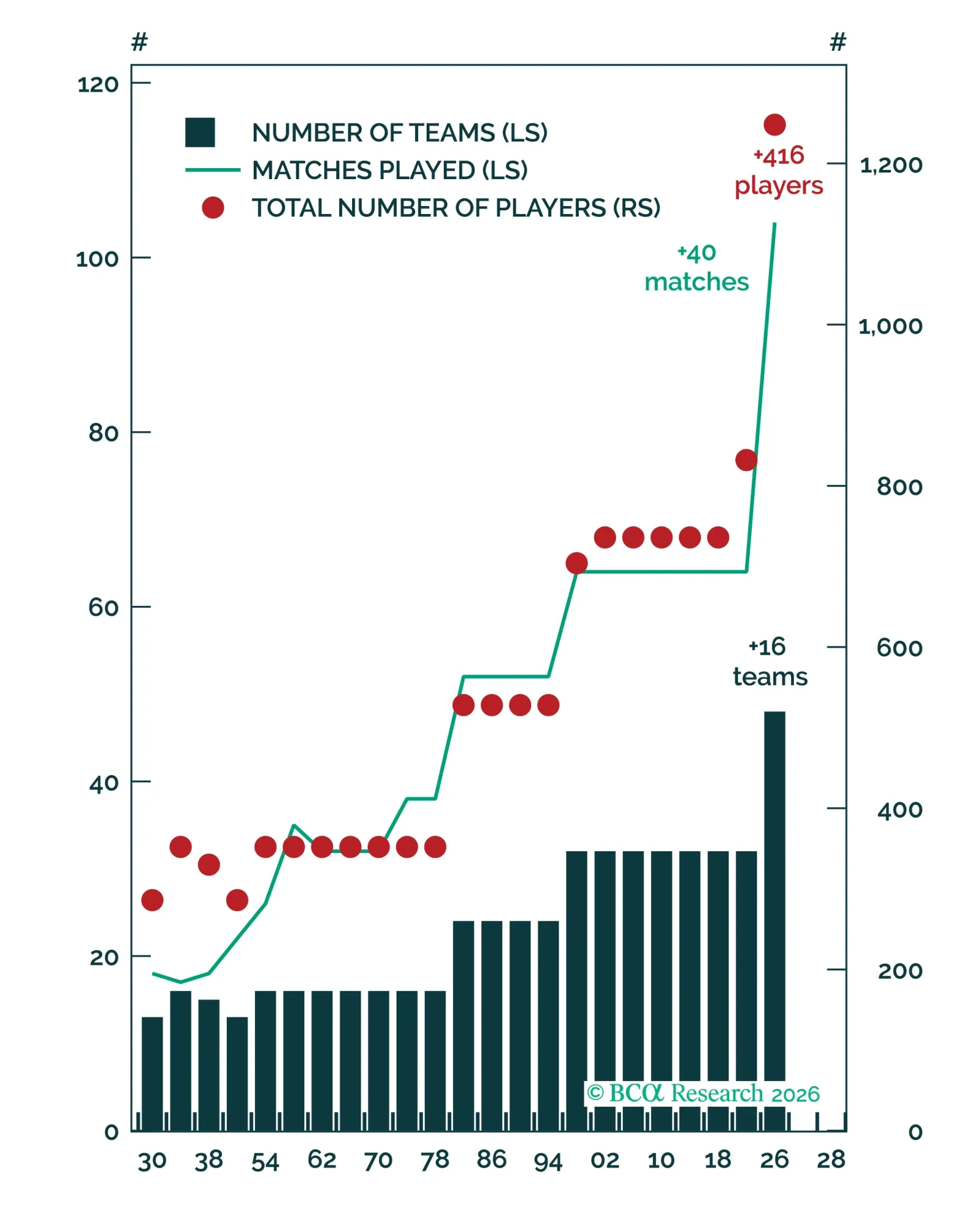
The expanded group stage, combined with the introduction of a new knockout Round of 32, will increase the total number of matches from 64 to 104 and extend the tournament by an additional week (Chart 1). That’s a lot of football—156 hours in regulation time.1
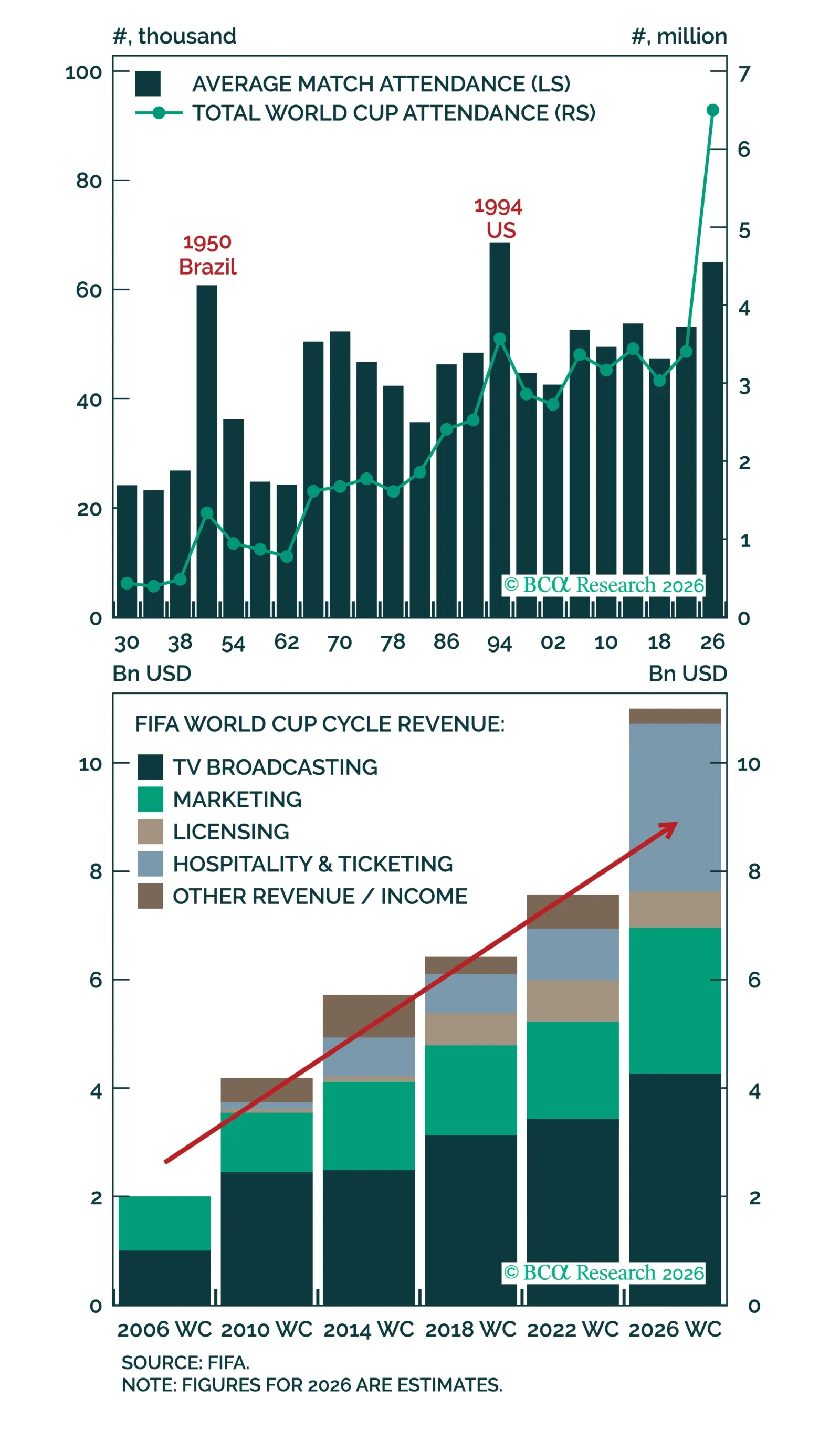
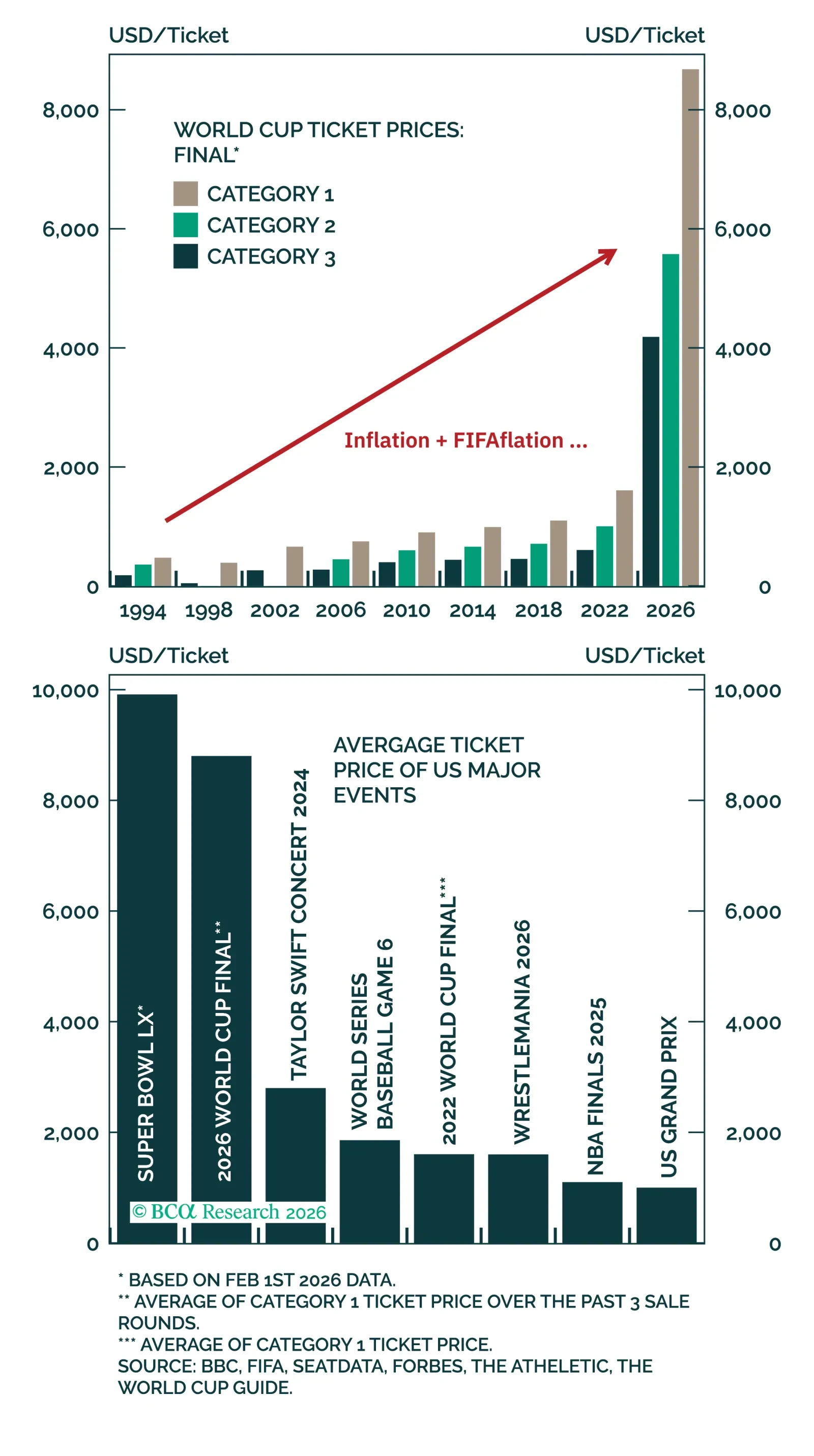
Is this expansion all about more revenues for FIFA? Undoubtedly. Prices and revenues have emerged as the leitmotif of the tournament. FIFA has been rather explicit about its governing principle: maximizing commercial returns and leveraging the world’s most developed sports and entertainment market. With the expanded format, the 2026 World Cup is certain to set a new total attendance record. FIFA projects 6-7.5 million fans across the tournament, nearly double the record still held by the 1994 World Cup in the US (Chart 2, top panel). Tournament revenues are expected to approach $11bn, up from $7.5bn generated in Qatar just four years ago (Chart 2, bottom panel). The increase is driven by higher broadcasting and sponsorship income, but the largest jump comes from tickets and hospitality, which are projected to generate close to $3bn. Ticket pricing has already sparked controversy over how expensive initial ticket prices are, set well above those of previous World Cups and other sporting events (Chart 3).2
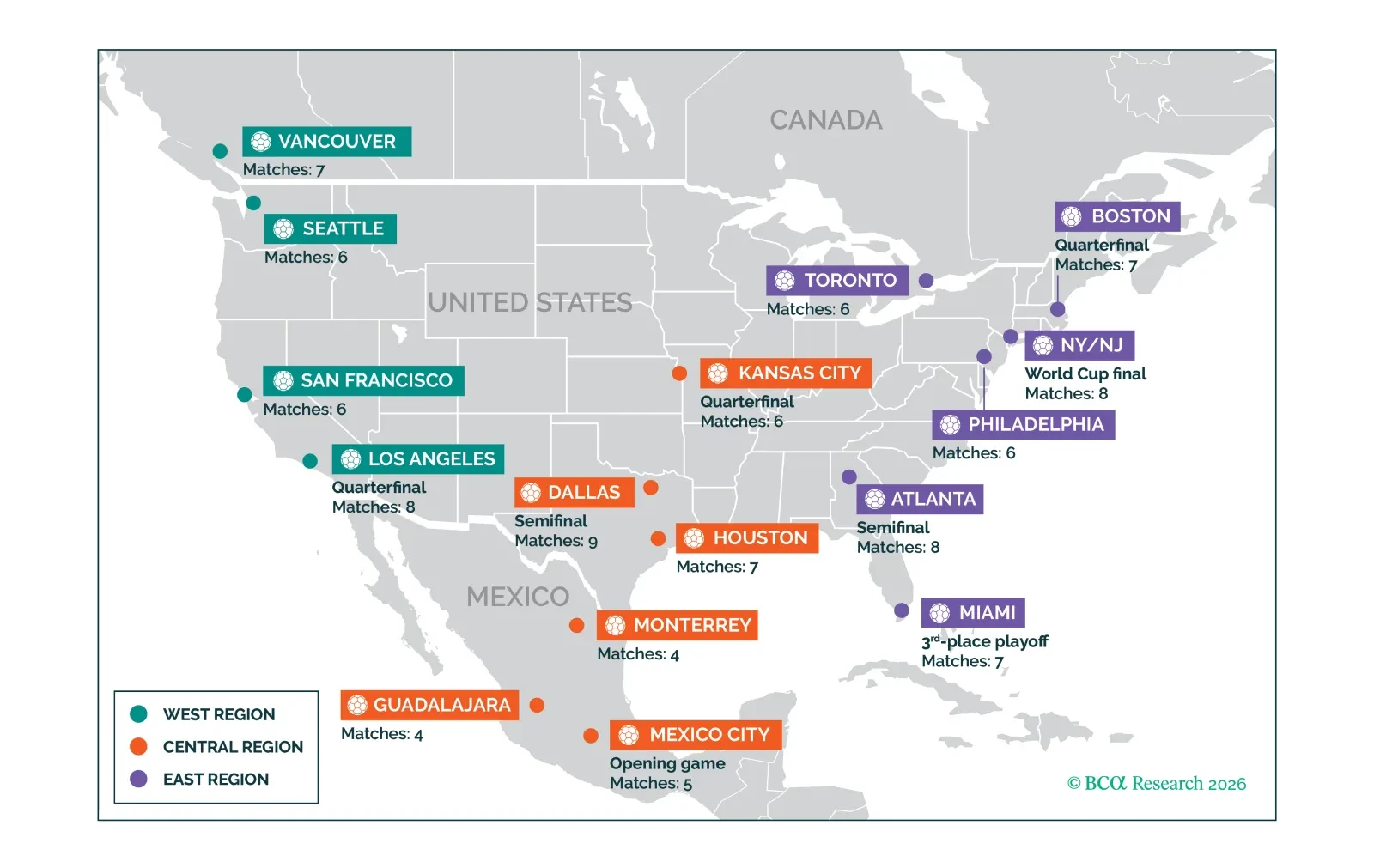
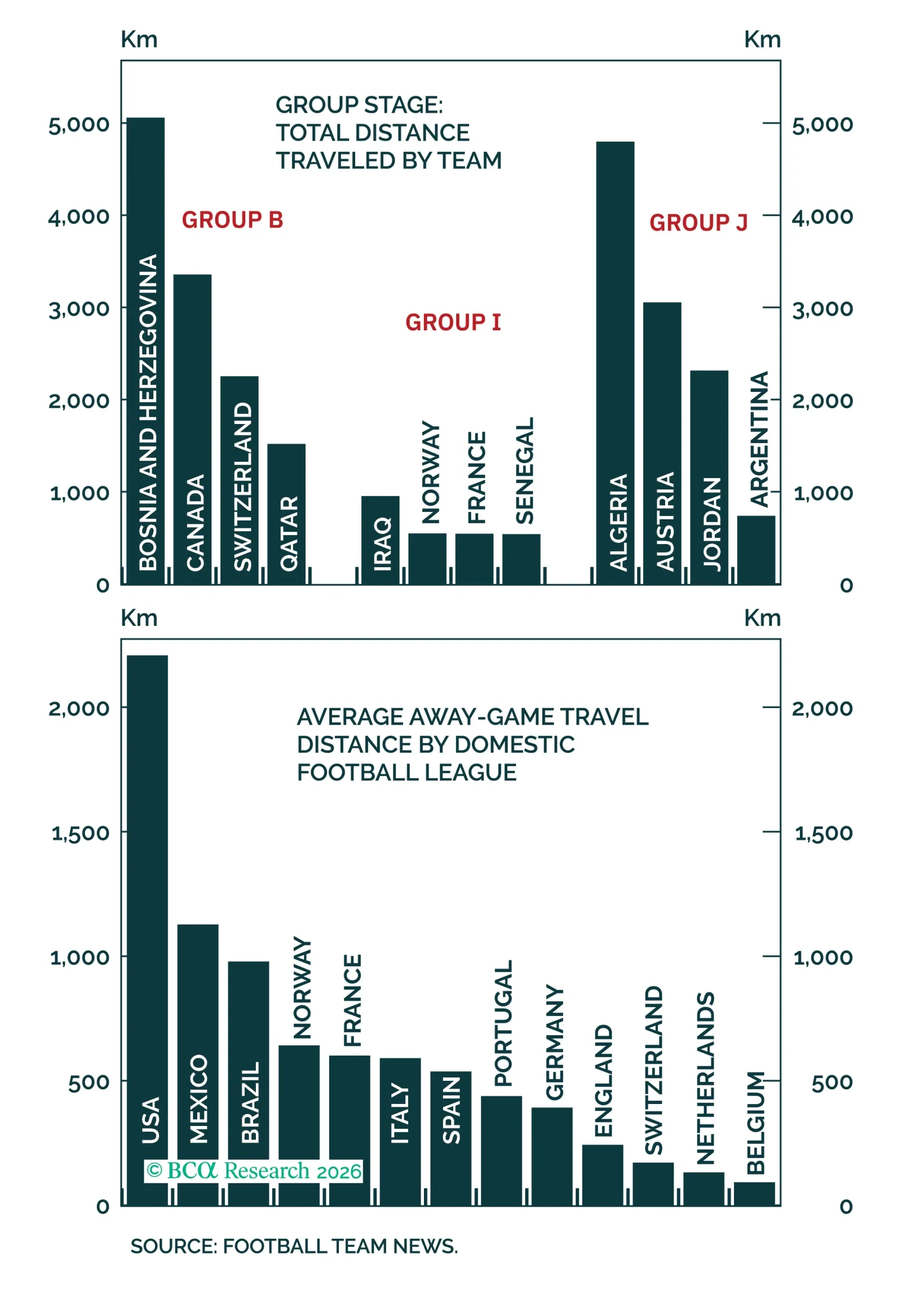
Filling some of the less commercially attractive fixtures—say Cabo Verde versus Saudi Arabia in Houston—may prove difficult despite FIFA’s best efforts. With 16 host venues and 48 team base camps spread across the continent, the 2026 edition will be the most geographically dispersed tournament in the competition’s history, which might prove disastrous if jet fuel shortages start emerging (Map 1). As a result, some sides will begin the tournament at a genuine logistical disadvantage compared to their group rivals (Chart 4, top panel). Nations such as Bosnia and Herzegovina, Algeria, and Czechia will have to travel close to 5,000km within two weeks. While such distances are rookie numbers to veteran BCA strategists traversing the globe to meet clients, many players – especially those from European leagues – are far less accustomed to this scale of regular domestic travel (Chart 4, bottom panel).
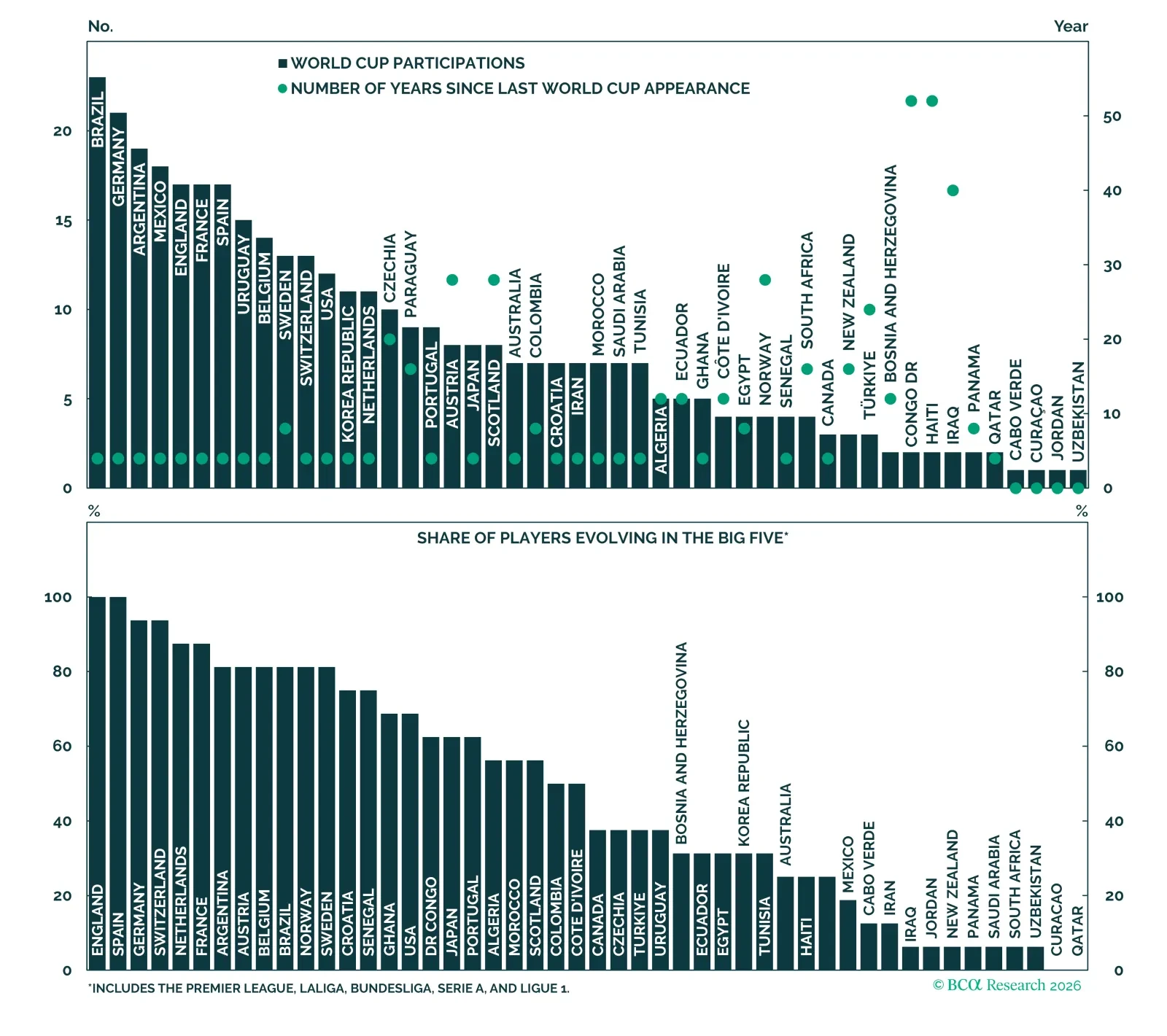
Interestingly, and against our expectations, the average team rating based on the latest players’ data has not decreased meaningfully despite the inclusion of 16 additional teams, including four nations qualified for a maiden World Cup (Cabo Verde, Curacao, Jordan, and Uzbekistan) as well as a few teams that haven’t made an appearance in over 40 years (Chart 5, top panel). Football is more international now. Many teams have players evolving in the best leagues in the world (Chart 5, bottom panel). Even nations without players in the big five, such as Qatar, have shown improvement. Through investments at home and the development of the Saudi Pro League, where a majority of Qatari players play, the average team rating increased from 65 to 70 over the past four years.
Rest assured—despite all the FIFA and Trump shenanigans, the World Cup will offer a great display of football to all the fans out there. We hope this report offers a nice break from counting ships leaving the Strait of Hormuz.
I. Two-Step Model: Forecasting The 2026 FIFA World Cup
Given our past successes, we stick to a two-step model and our BCA principles for this year’s World Cup model. We resist the temptation to rely on a fancy new AI model with no track record.3 That would be too easy. Or consume too many tokens.
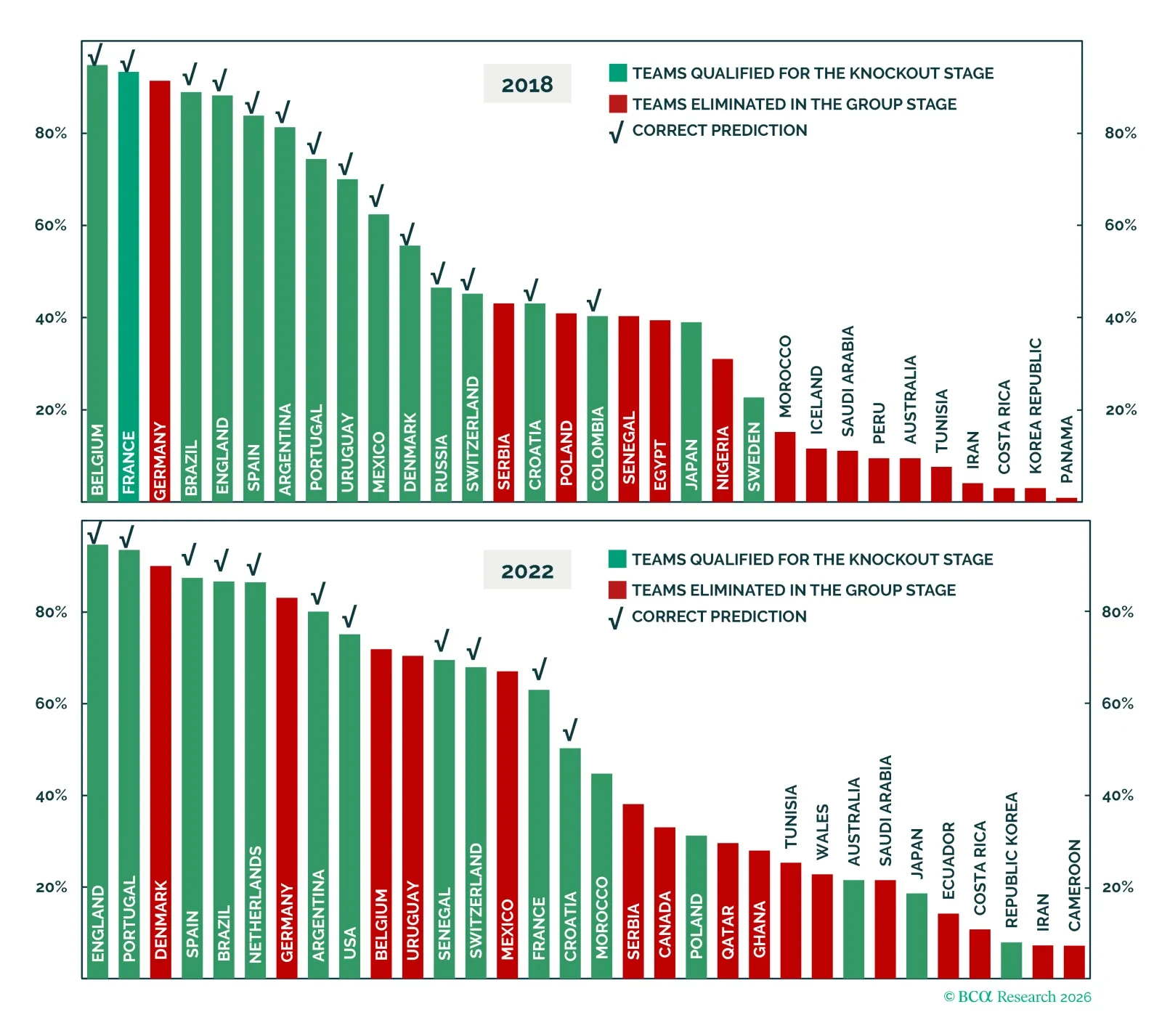
In 2018, our model correctly forecasted 60% of the group-stage games and predicted 14 of the 16 teams to advance to the knockout stage (Chart 6, top panel). The 2022 World Cup featured more surprises than previous editions, and as a result, our model’s predictive ability decreased—only 54% of the group-stage games were correctly forecasted, and 11 of the 16 teams advancing to the knockout stage (Chart 6, bottom panel). What the model lost in accuracy in the group stage, it made up for in the knockout stage: BCA's Two-Step World Cup model predicted that Argentina, led by Lionel Messi, would win the 2022 World Cup.
We continue to rely on the player statistics database used in the video game simulation EA Sports FC (known as FIFA until 2023). Our sample now includes all matches from the last five FIFA World Cups, totaling 240 group-stage games and 80 knockout-stage games. With the expansion to 48 teams, we collected data for 1,248 players.
Step One: The Group Stage Model
To simulate the 2026 group-stage matches, we use an Ordered Probit (OP) model estimated from past World Cup group-stage games. Ordered Probit models are powerful when modeling an ordinal outcome (i.e., the response value has a strictly increasing ordering known prior to the estimation).
For this 3rd edition, we rely on the same variables for the group-stage games, as they continue to display the most explanatory power after the inclusion of the 2022 games in our sample:
- Team Average Player Rating
- Average Age - Forwards
- Average Number of Caps - Defenders
- Speed Positions Average Rating
Redefining the Forward Position
When we first created the model in 2018, most teams were playing in a 4-4-2 formation. However, today, a 4-3-3 or 4-2-3-1 is a more common formation, typically featuring 3-4 offensive players who are not necessarily tied to one position. Back-to-back Champions League winner PSG is a prime example with Khvicha Kvaratskhelia, Ousmane Dembélé, and Désiré Doué roaming freely. With positions much more fluid at the front, forwards today are not only strikers and wingers but are often classified as CAMs (Central Attacking Midfielder). We have therefore included this category in the Forward Position definition.
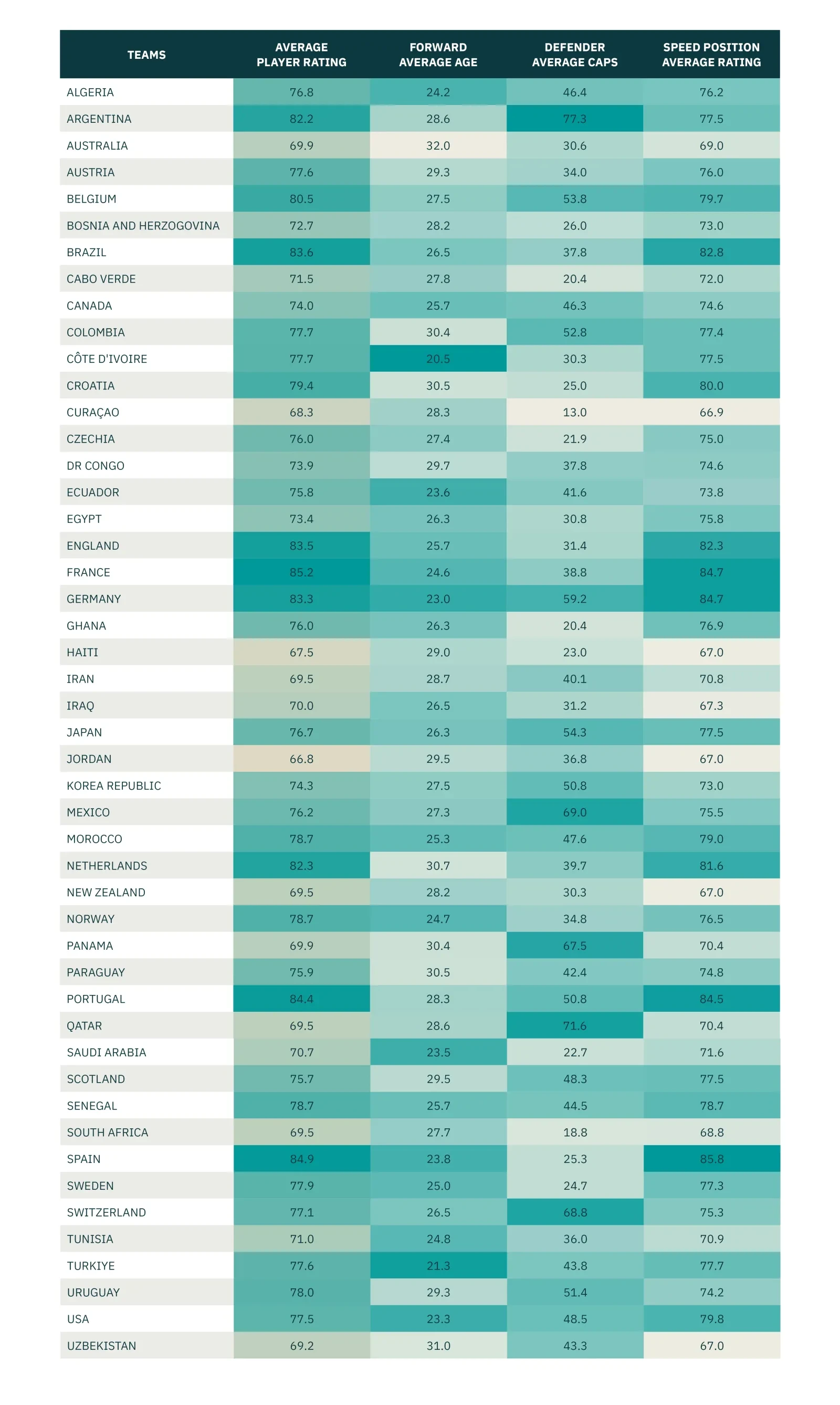
Table 1 lists all 48 teams and their descriptive statistics on the four explanatory variables.
Home Advantage Dummy
History tells us that hosting the World Cup provides a clear advantage to almost any team (Table 2). One in three hosts has won the competition since the first tournament in 1930, and 59% of all hosts have reached the semifinals—including South Korea in 2002!
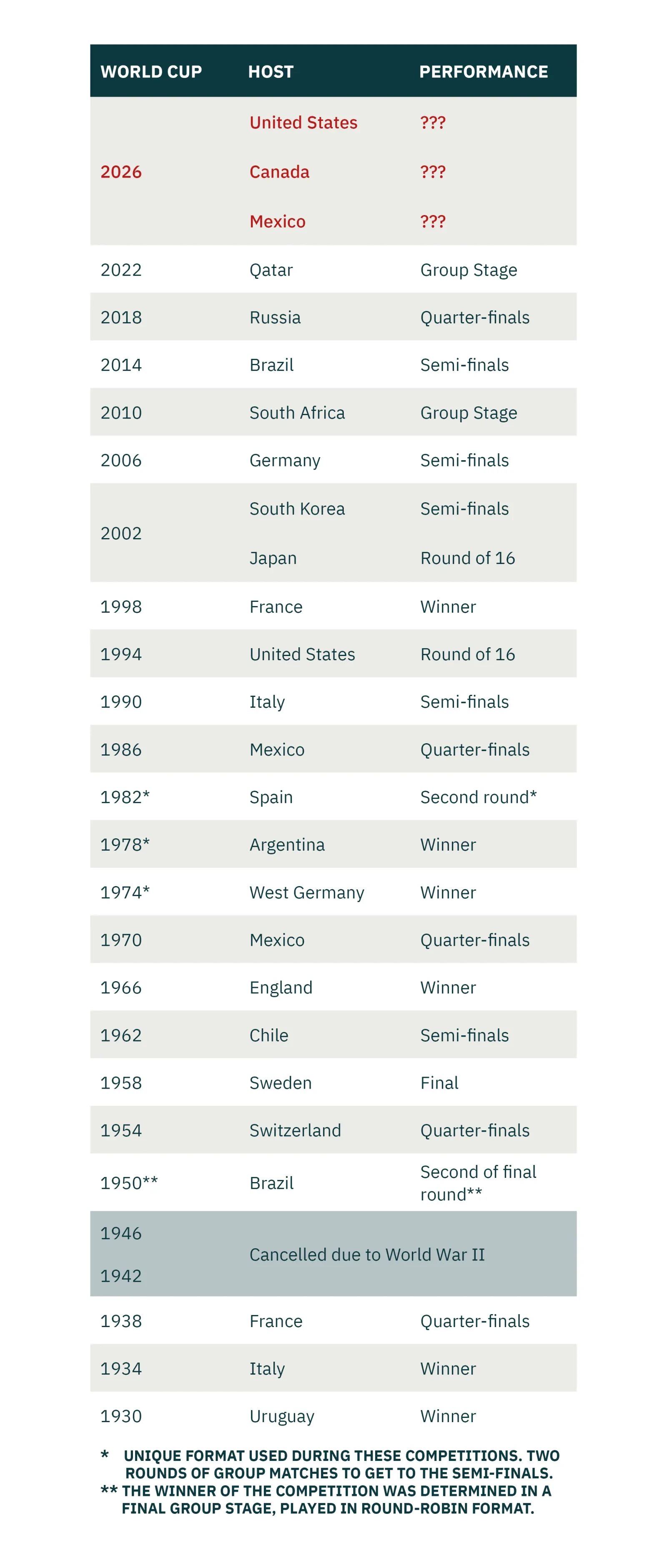
The Home Advantage Dummy is estimated from past data. It continues to amaze us how statistically significant this variable is, even though it did not help the 2022 host, Qatar, advance past the group stage. The estimated marginal effect is a whopping 24% increase in the host team’s winning probability in each game.
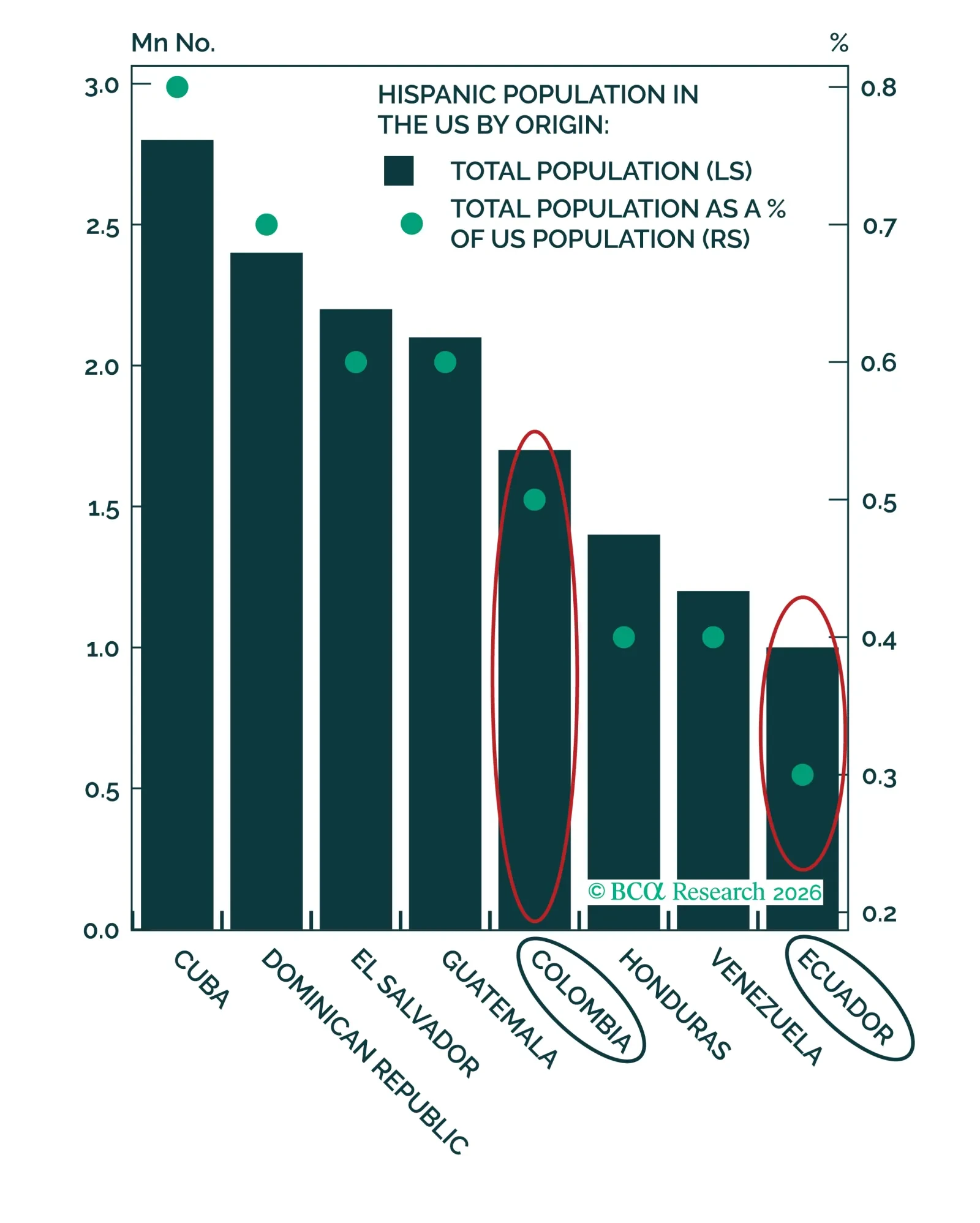
Since “home advantage” has more to do with crowd support than a physical location, we decided to assign a half-home advantage bonus to Colombia and Ecuador. They have a large “local” fan base due to the high share of (legal) immigrants from both countries in the US (Chart 7). Applying a similar logic to Saudi Arabia in 2022 proved prescient.
Winner’s Curse Dummy
The Winner’s Curse takes its roots in the complacency of the reigning champions. Glorified managers—think the Marcelo Lippi, Vicente Del Bosque, and Joachim Löw—are deemed “untouchable” out of a sense of misguided gratitude. They also face the challenge of making the successful transition from one generation of players to the next. The experiences of Italy (2010), Spain (2014), and Germany (2018) highlight the fragile balance of preserving the magic of a golden generation while simultaneously injecting youth into a team to avoid aging and stagnation.
Heading to the 2026 World Cup, reigning champion Argentina fits the description of a team that will succumb to the Winner’s Curse. Except for Ángel Di María, the team still features the same starting 11 as in 2022. Argentina still heavily relies on 38-year-old Lionel Messi,4 who has been playing in the much less competitive MLS for the past two seasons. Lionel Scaloni’s masterplan to “give-the-ball-to-Messi-and-pray” is unlikely to work a second time.
Based on the group-stage data from the five World Cups in our sample, this dummy imposes a 20% penalty on Argentina's probability of winning each game it plays as the reigning champions.
Group Stage: Model Results
Group A: Mexico, South Africa, South Korea, Czechia
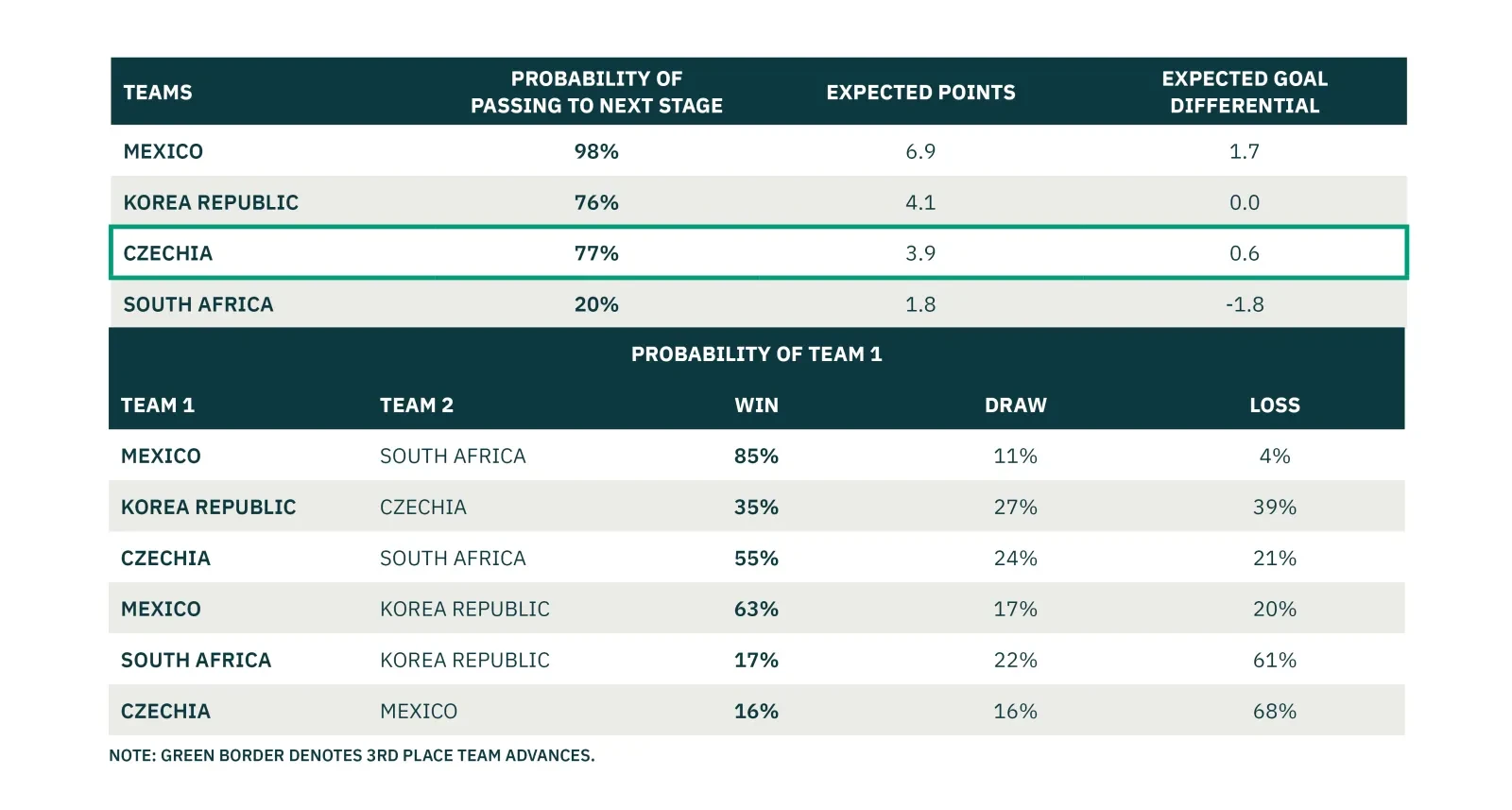
Mexico will kick off the World Cup on June 11th. As we touched on, historically, host countries have done very well, often surpassing expectations. Their last World Cup appearance on home soil was in 1986, when they reached the quarterfinals. This host advantage is reflected in our model, which sees El Tricolor finish at the top of Group A (Table Group A).
In this first game, they will play against South Africa, one of the weakest sides in the tournament according to aggregate player data (Table 1). The Bafana Bafana last appeared at a WC as hosts in 2010, when they failed to advance past the group stage despite beating France 2-1.5 Unsurprisingly, our model sees little chance of them advancing.
The fight for second place will be fierce between South Korea and Czechia. The Taegeuk Warriors, captained by former Tottenham and current MLS player Son Heung-min, were the only team to go unbeaten throughout the Asian qualifiers. Our model sees them advancing to the next stage, as they did four years ago, when they arguably faced a stronger opposition (Portugal, Uruguay, and Ghana).
Czechia is returning to the World Cup following a 20-year absence. Perhaps US fans will remember them. In 2006, the team then known as the Czech Republic and led by legends Petr Čech and Pavel Nedved failed to advance but clinched one win against... the USA. Today, and under the new format, a similar outcome should be enough to see them advance to the Round of 32 according to our model.
Group B: Canada, Bosnia & Herzegovina, Qatar, Switzerland
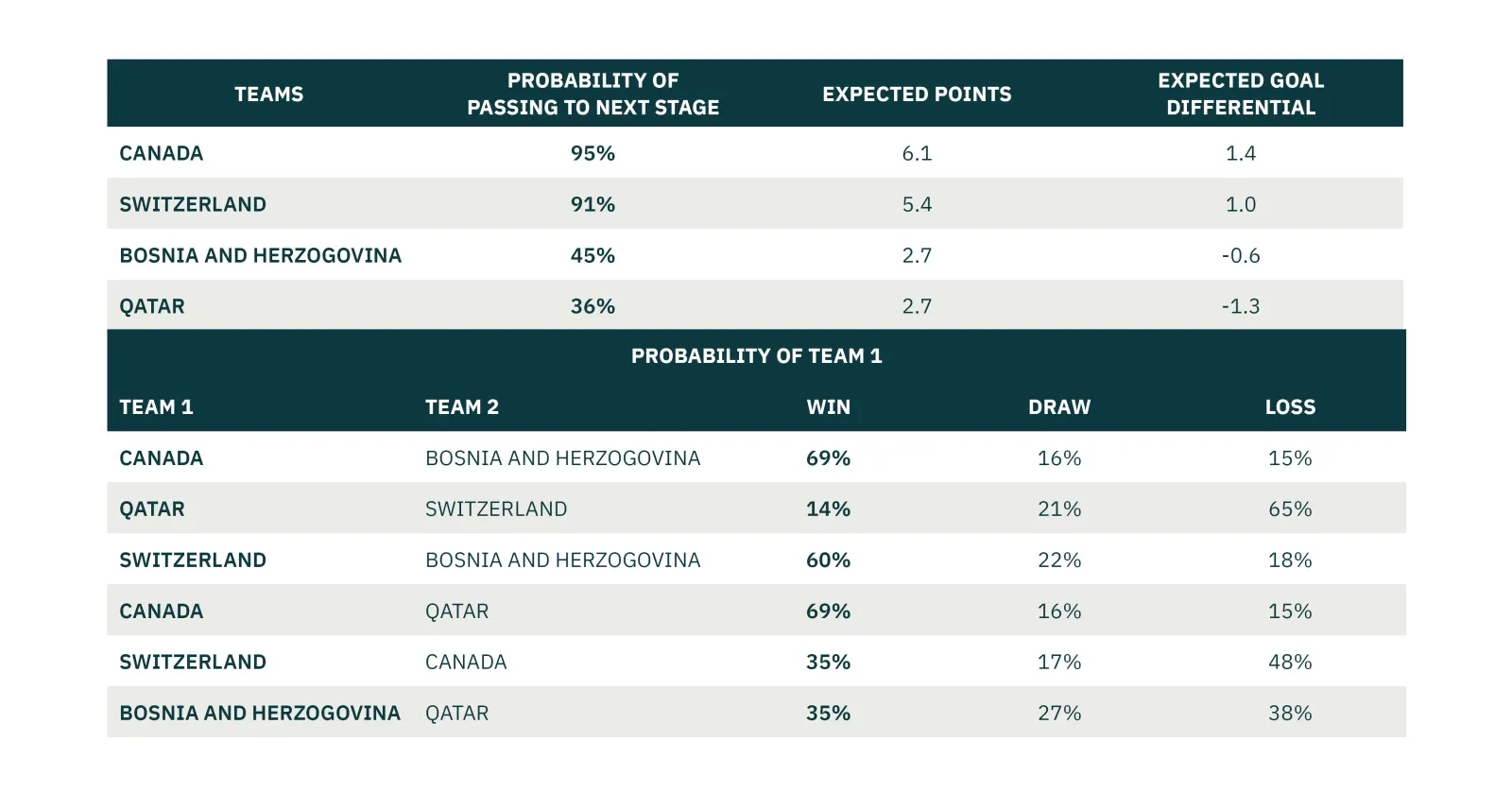
For their third World Cup, and as one of the host countries, Canada can set its hopes high. The Canucks have been building momentum. In 2024, they reached the semifinals of the Copa América, losing to Argentina, which went on to win the tournament. Last year, Canada took third place in the Concacaf Nations League. And if momentum and the talent from Jonathan David and Alphonso Davies (also watch out for Marcelo Flores!) are not enough, then Canada can still rely on home advantage. With the help of their fans, they are not only expected to secure their first World Cup game win but to finish first in Group B (Table Group B). Being based in Montreal since 1949, at BCA Research, we cannot wait to see how far this momentum and home advantage can take them in this tournament.
Interestingly, 2026 will be the first time a host nation faces the previous World Cup host in the group stage. Qatar now wants to prove to the world that it possesses not only the ability to host major sporting events, but also the footballing quality to compete on the biggest stage. Since the arrival of Julen Lopetegui, the national team has embraced a distinctly Spanish style of play, built on patient possession and ball control. Our model deems it insufficient to avoid the same fate as four years ago.
Switzerland has made a name for itself as the defending champion bane. So far, this has mostly shown up at the Euros. They won against the World Cup winners at the time, France, in 2021 on penalties, and after knocking out defending champions Italy in the 2024 Euros. Now, however, the squad has aged—although some might say that Granit Xhaka has never played better, helping Sunderland qualify for the Europa League for the first time in 53 years. They could get their chance, though, as the model sees them finishing in 2nd place and advancing to the Round of 32.
Bosnia and Herzegovina does not suffer the same aging problem, despite the presence of 40-year-old Edin Džeko. The team secured their place at the World Cup by beating a pitiful Italian team in the play-off final on penalties, where fans sang “I am from Bosnia, take me to America.” In 2014, they finished third in a more challenging group, including a 3-1 win against another Middle Eastern nation, Iran, and a goal from the evergreen Džeko.
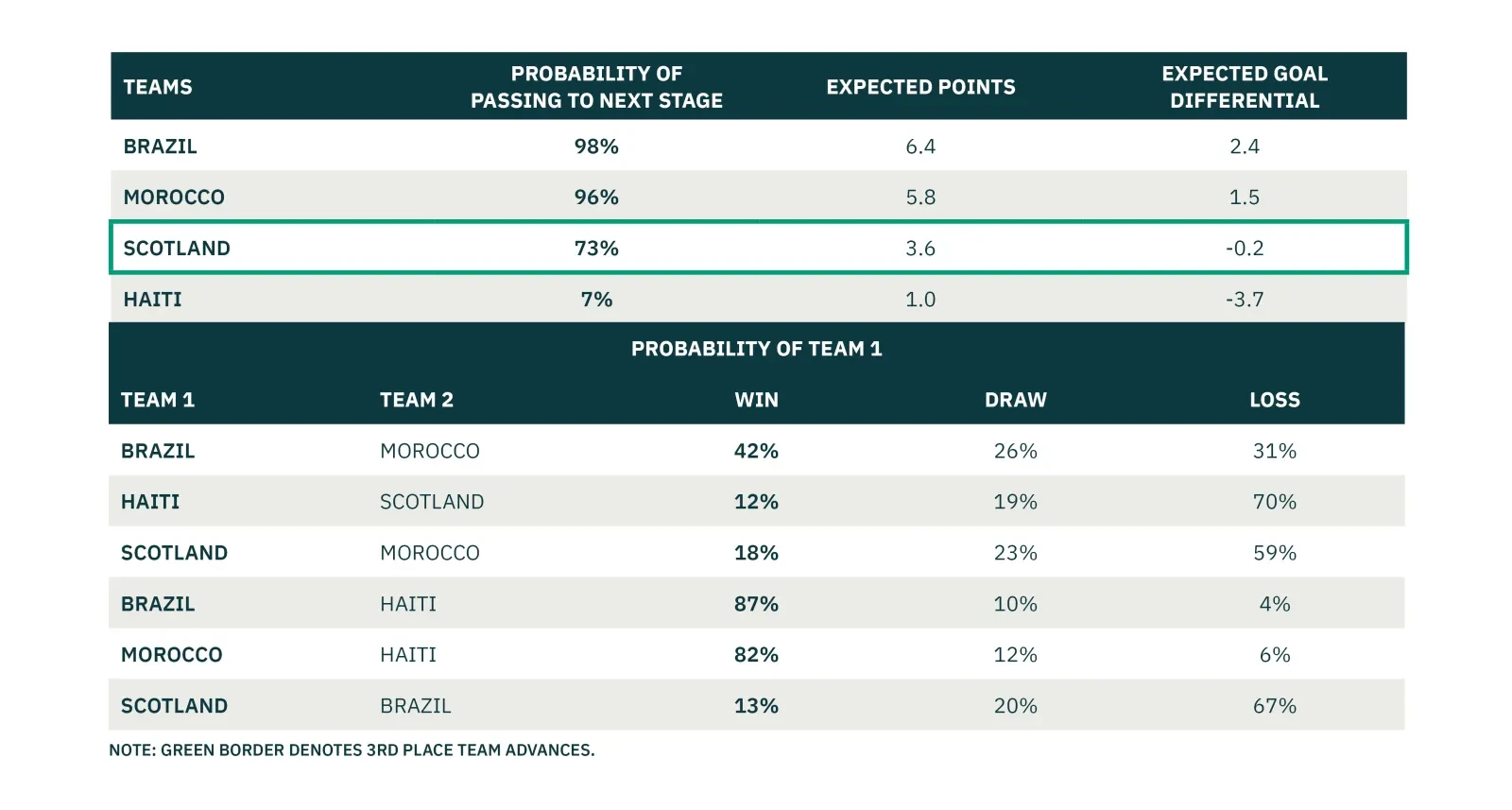
Group C: Brazil, Morocco, Haiti, Scotland
Brazil enters under renewed optimism following the arrival of “Don Carlo” at the helm in May 2025, and the surprise presence of Neymar Jr. The Seleção endured one of the most painful qualification campaigns in its history, finishing only fifth in the South American standings and cycling through managerial changes—a situation reminiscent of the turmoil preceding the 2002 World Cup, when Luiz Felipe Scolari steadied the ship before leading Brazil to the title. Our model still sees Brazil comfortably topping the group, but questions remain over consistency and defensive stability (Table Group C).
Scotland returns to the World Cup for the first time in 28 years after directly qualifying in dramatic fashion, with McKallaster’s commentary of the decisive win over Denmark already etched into Scottish football folklore. History now repeats itself, as Steve Clarke’s side once again finds itself drawn alongside the Seleção. While our model projects Scotland to finish third, it also suggests the Scots are likely to collect enough points to advance as one of the best third-place teams. Their physicality, organization, and emotional momentum could make them one of the tournament’s trickiest dark horses, akin to Iceland’s feat in the 2016 Euros.
Morocco once again looks poised to challenge expectations. After stunning the football world in 2022 by topping the group and reaching the semifinals, the Atlas Lions return with another high-quality squad and renewed ambitions under a new head coach promoted from the U-20 setup. Our model gives Morocco a 96% probability of reaching the Round of 32, most likely as group runners-up behind Brazil, setting the (official) reigning African champions up for another potentially deep run.
For Haiti, qualification alone is historic — their first World Cup appearance in half a century. Their journey carries added emotional weight given the country’s economic hardship and ongoing violence, which forced the national team to play all qualifying matches away from home. Haiti enters as the group outsider but arrives in 2026 having already written one of the tournament’s most inspiring stories.
Group D: USA, Paraguay, Australia, Türkiye
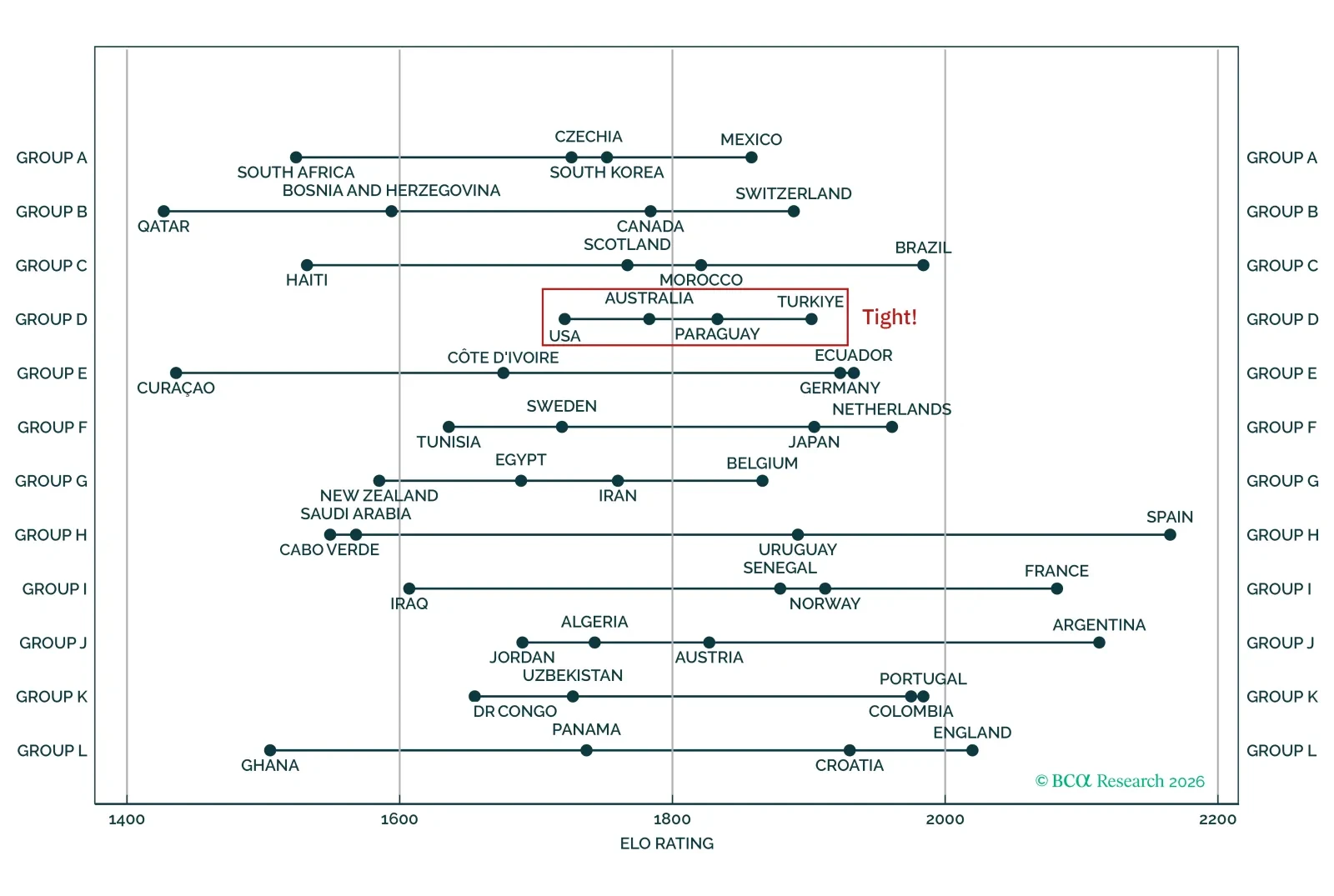
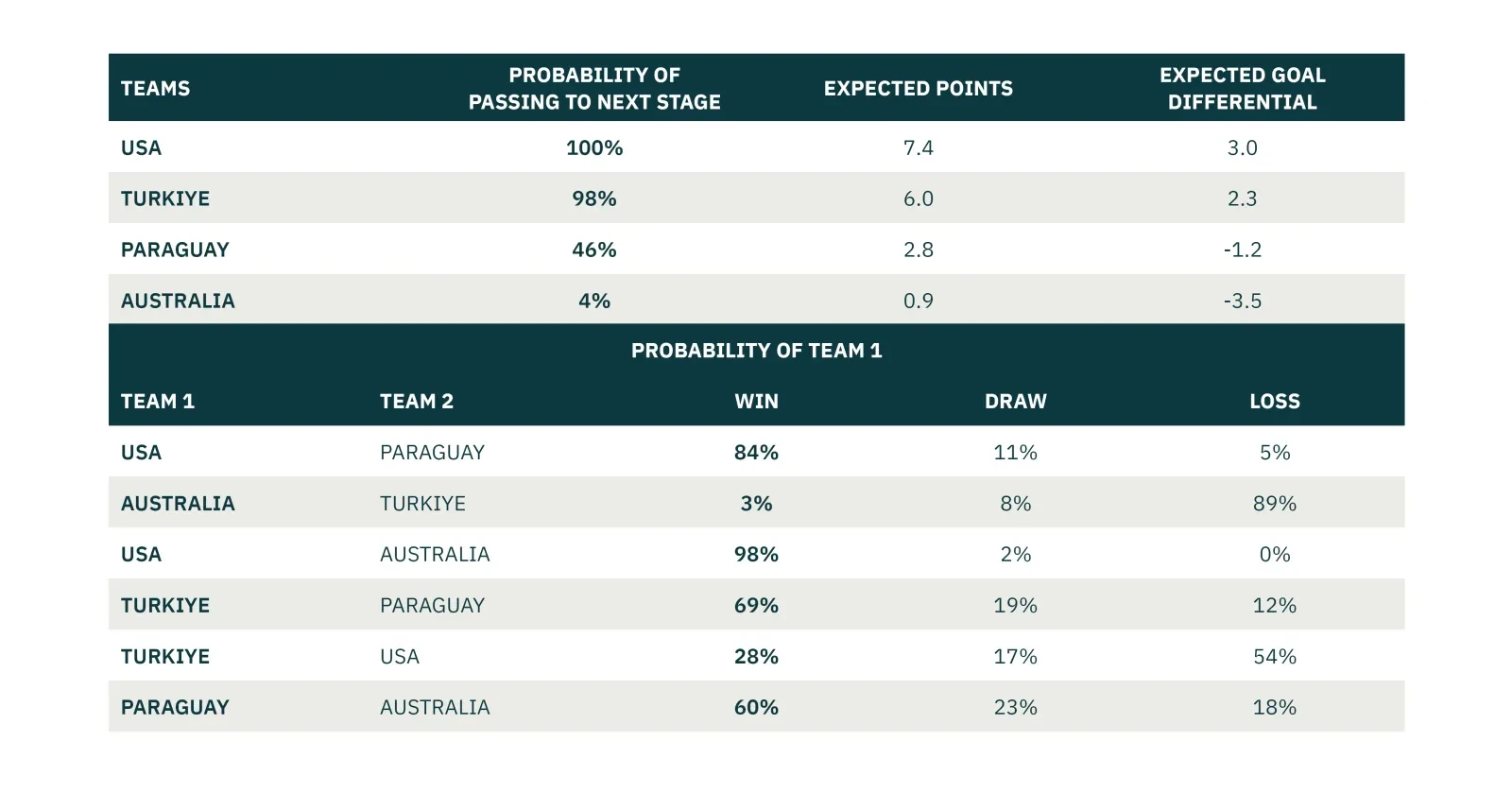
Group D appears tightly contested on paper, with relatively little difference in Elo points among the four teams (Chart 8). However, our model identifies two clear favorites to advance, led by host nation USA, which is expected to benefit significantly from home-field advantage and comfortably progressing to the knockout stage (Table Group D).
Still, questions linger around Mauricio Pochettino’s tenure with the USMNT. His appointment surprised many observers. While Pochettino arrives with an extensive European pedigree from spells at Tottenham and PSG, his trophy cabinet remains relatively thin given the expectations attached to the clubs he managed. More concerningly, he has yet to settle on a consistent starting 11. Defensive concerns also persist, with the squad continuing to rely on 38-year-old Tim Ream at the back. At the same time, this may be the most talented American attacking generation in decades. Christian Pulisic no longer carries the burden alone, with players such as Folarin Balogun and Tim Weah entering the tournament following good seasons in French Ligue 1 with Monaco and Olympique de Marseille. Combined with home support and depth in the squad, the USMNT should arguably have too much firepower for most of their opponents in this group.
Türkiye returns to the World Cup after a lengthy absence and could emerge as one of the tournament’s more entertaining dark horses. The squad blends exciting young talent — including Real Madrid’s Arda Güler and Juventus starlet Kenan Yildiz — with the experience and leadership of captain Hakan Çalhanoğlu, who largely contributed to Inter’s historic 21st Scudetto. Our model sees Türkiye as the strongest challenger to the USMNT for top spot in the group and comfortably favors them to advance.
Paraguay once again enters the tournament with its traditional strengths: defensive discipline, physicality, and tactical organization. While lacking the attacking depth of the group favorites, Paraguay’s compact style could make them difficult to break down and dangerous in low-scoring matches.
Australia, meanwhile, faces an uphill battle. Despite its reputation as a resilient tournament team, our model assigns the Socceroos the second-lowest probability of advancing among all qualified nations, only slightly ahead of Curaçao. Australia’s physicality and work rate should keep matches competitive, but the talent gap versus the group’s leading sides may ultimately prove too large.
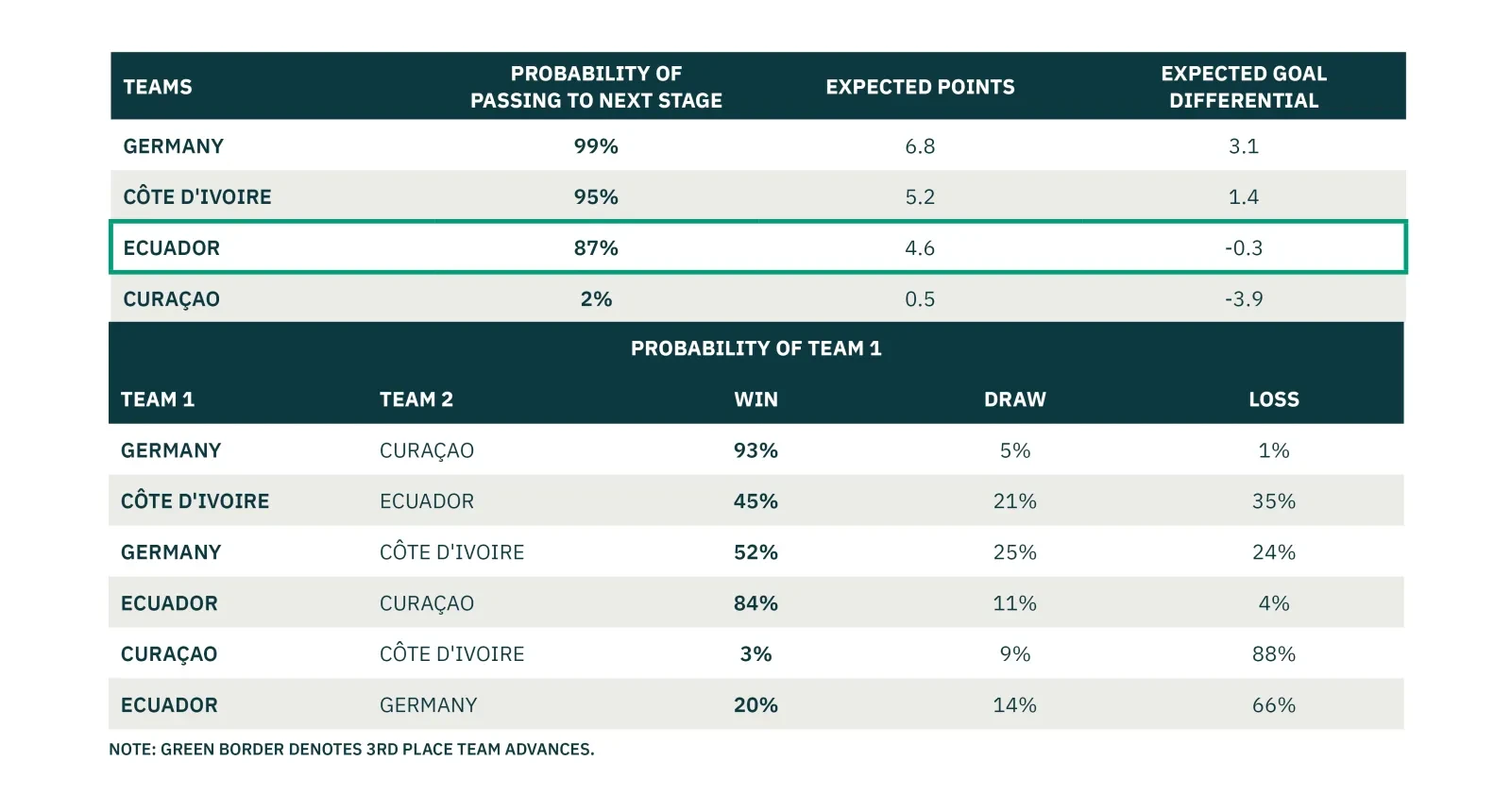
Group E: Germany, Curaçao, Côte d'Ivoire, Ecuador
Germany enters with the clearest mandate: Restore its reputation. After failing to get out of the group stage in each of the last two World Cups, Die Mannschaft is looking to reconnect with its glory days under Julian Nagelsmann. Much of the optimism rests on the young attacking duo of Florian Wirtz and Jamal Musiala, whose creativity gives Germany the kind of unpredictability it has lacked in recent tournaments. Just as importantly, the team’s Bayern Munich core arrives after a strong season under Vincent Kompany, including the return of the evergreen Manuel Neuer!6
Côte d’Ivoire returns to the World Cup for the first time since 2014, making only its fourth appearance despite its strong African pedigree. That absence is striking given that the Elephants have won the Africa Cup of Nations twice since their last World Cup appearance. Their previous golden generation — led by Didier Drogba and Salomon Kalou — was often unlucky, landing in brutal groups across three straight tournaments. This edition arrives with less global star power but perhaps a better chance to finally translate continental strength into World Cup progress. Our model gives them a 95% chance of advancing (Table Group E).
With a population of just 156,000, Curaçao became the smallest nation in history to qualify for a FIFA World Cup. While baseball remains the island’s most popular sport, football has now delivered its greatest achievement. The former Dutch colony can thank its footballing identity, deeply shaped by Dutch influence: Virtually every player in the squad was born and developed in the Netherlands, coming through the academies of Eredivisie clubs. Fittingly, the team is led by Dutch manager Dick Advocaat. The influence will not be enough according to our model, which assigns Curaçao only a 2% chance of advancing—the lowest in this group stage.
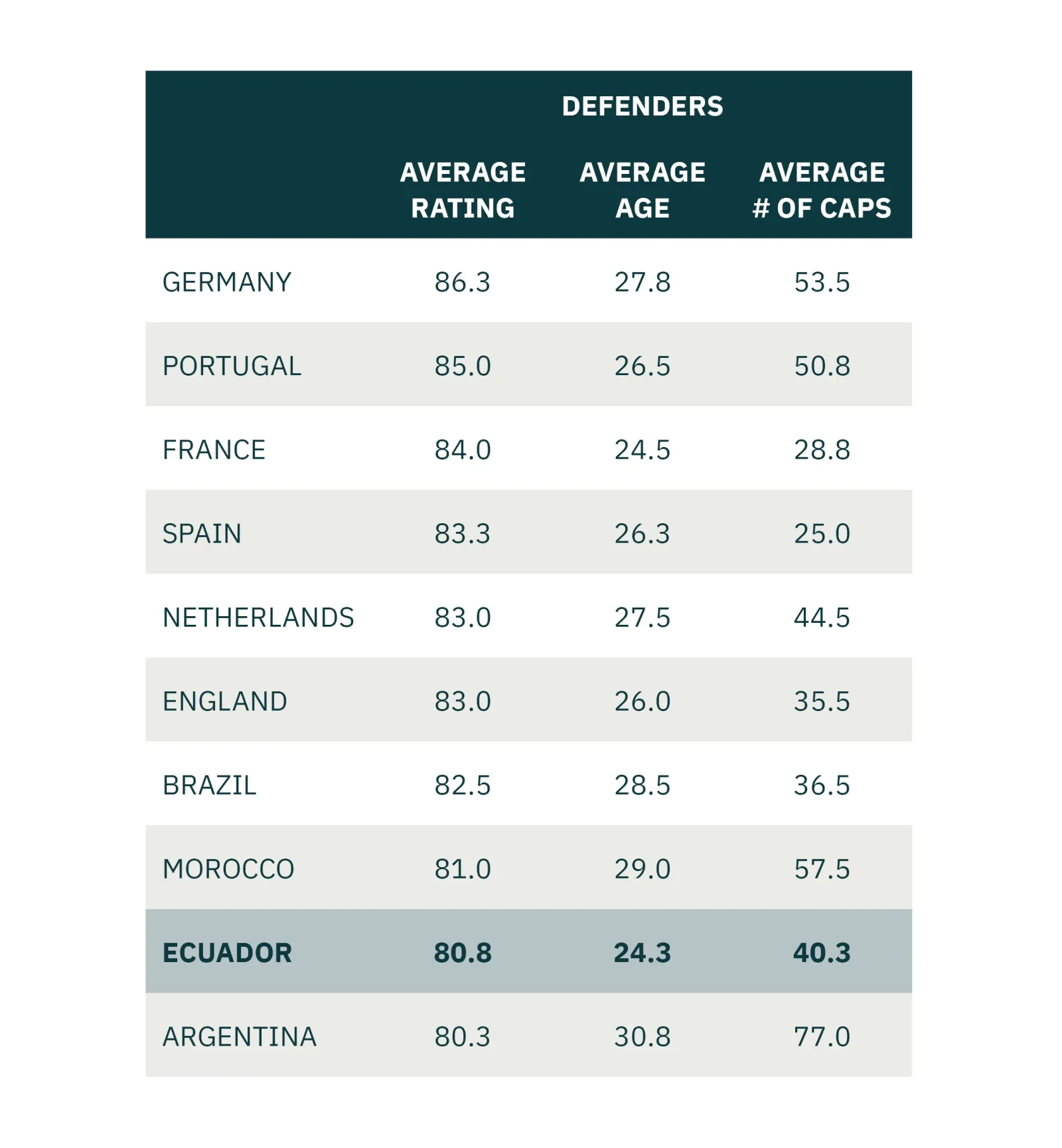
Ecuador may be the team nobody wants to face. This is one of the best defensive sides in the tournament (Table 3), and the personnel make it easy to see why: Willian Pacho (PSG), Piero Hincapié (Arsenal), Pervis Estupiñán (AC Milan), and the promising Joel Ordóñez (Club Brugge) form an elite back line. Ecuador finished second in South American qualifying while conceding only five goals in 18 matches, an extraordinary record in one of the world’s toughest regions. Veteran striker Enner Valencia, the country’s all-time top scorer, gives them enough attacking threat to be more than just a defensive wall.
Group F: Netherlands, Japan, Sweden, Tunisia
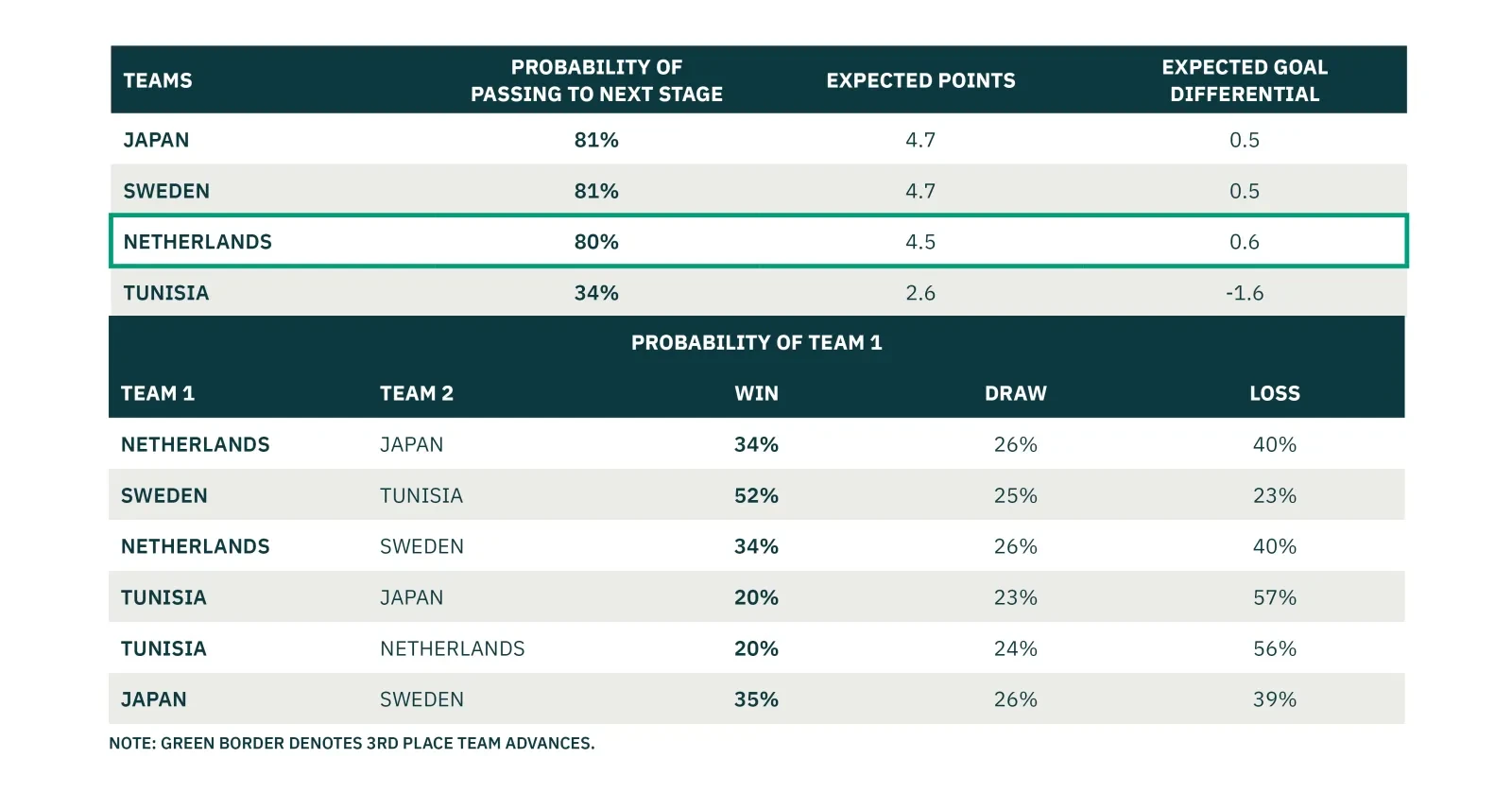
This is the most difficult group to forecast, with three teams clustered around a similar E (points) value (Table Group F).
It can be explained by the fact that the Netherlands heads into the tournament facing several important absences. While Ronald Koeman has welcomed back Memphis Depay and Jurriën Timber from injury, the team will be without several key players, including Xavi Simons, Matthijs de Ligt, and Stefan de Vrij. Those losses significantly impact our model: The Dutch are predicted to finish 3rd in Group F but advance as one of the best third-place teams—meaning it’s all gouda for the Oranje.
Japan enters the tournament determined to forget the heartbreak of 2022, when the Samurai Blue were eliminated by Croatia on penalties in the Round of 16 after producing one of the greatest shocks in World Cup history, defeating both Germany and Spain by identical 2–1 scorelines in the group stage. Japan does not mind tight conditions—ask the Bank of Japan. Our model likes Japan's chances of advancing and makes the SamuraiBlue favorites to progress from the group. Gambatte!
Sweden booked its place at the World Cup with no victories in the group stage, qualifying via the playoffs. The Swedes will be hoping to recapture memories of 1994, when they reached the semifinals and produced one of the country's greatest World Cup runs. Head coach Graham Potter, who spent seven seasons managing Swedish club Östersunds FK, has built a disciplined 5-3-2 system around one of the tournament’s most dangerous duos: Arsenal forward and newly crowned Premier League champion Viktor Gyökeres, alongside Liverpool’s €150 million star Alexander Isak. Our model likes Sweden’s chances to make a surprise run.
Tunisia faces an uphill battle in one of the tournament’s tougher groups. While the Eagles of Carthage possess a number of talented individuals, they lack depth and consistency. They could also have done with more managerial stability. Sabri Lamouchi has been in charge for only a few months, having taken over in January. Whether that has been enough time to establish his ideas and build cohesion within the squad remains doubtful. Our model is not optimistic.
Group G: Belgium, Egypt, Iran, New Zealand
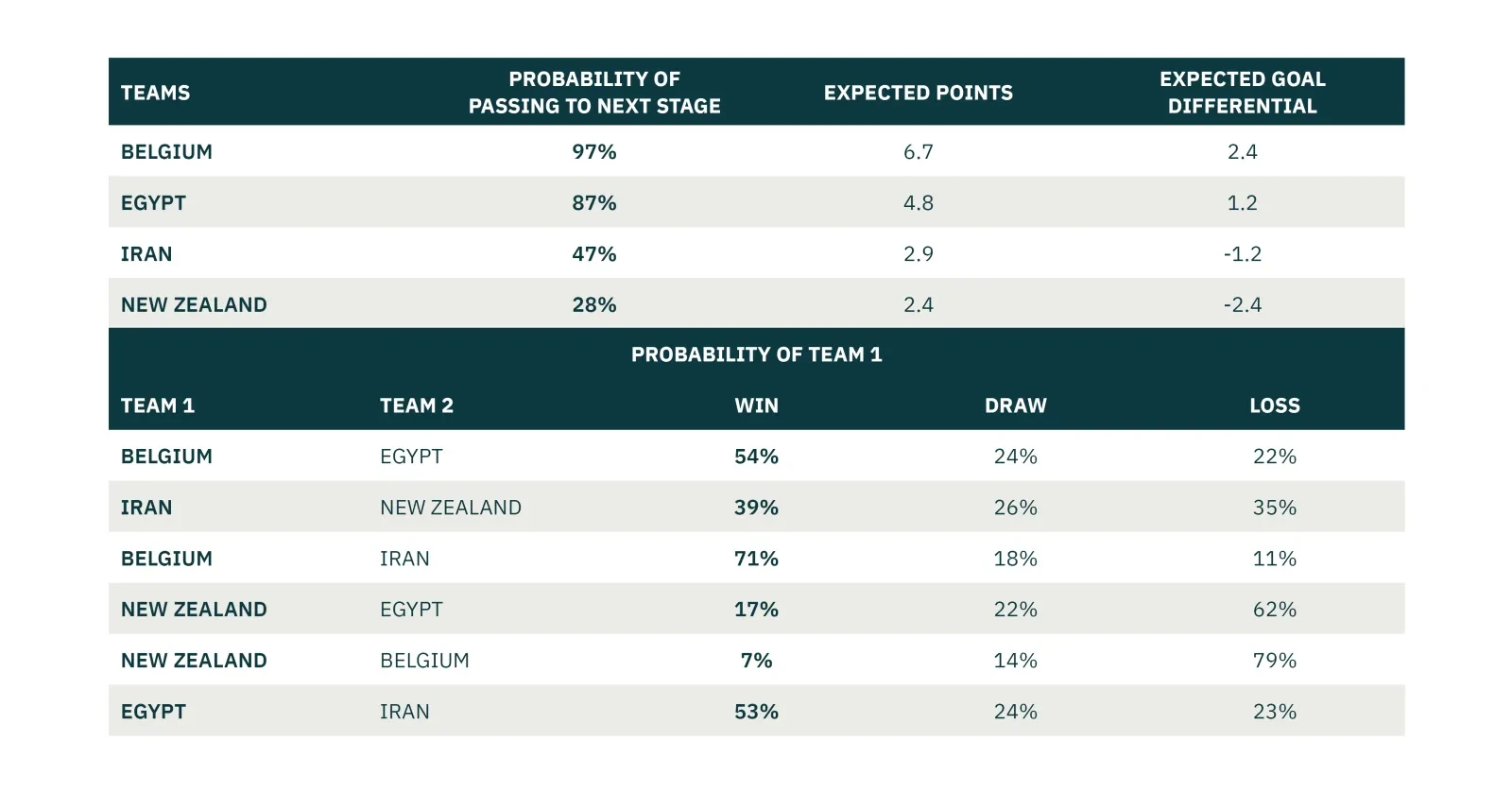
Belgium will also be looking to restore momentum after two disappointing major tournaments: a group-stage exit at the 2022 World Cup and an underwhelming Round of 16 elimination at Euro 2024. For veterans Kevin De Bruyne, Thibaut Courtois, and Romelu Lukaku, this may represent one final opportunity to shine on football’s biggest stage while guiding a new generation of Belgian talent. The challenge is that what’s left of Belgium’s golden generation is not aging particularly well. Lukaku arrives after an injury-riddled season in which he managed just one goal in five appearances for Napoli, while De Bruyne’s influence has also waned, although he still contributed five goals and two assists in roughly half of Napoli’s league matches. The Red Devils hope lower expectations can help fuel an unexpected run. Our model predicts they will finish first (Table Group G).
For its fourth World Cup appearance, Egypt will be eager to solve a mystery even deeper than the construction of the pyramids: Despite boasting Africa’s most decorated football résumé, with seven AFCON titles, Egypt has still never won a World Cup match. Mohamed Salah may no longer be at his absolute peak, but the Pharaohs can still rely on their collective strength and on Omar Marmoush, the Manchester City winger, to provide attacking spark. This should be enough to secure not one but two victories over Iran and New Zealand.
Sadly, Iran's presence at the World Cup will not draw the media’s attention for its football prowess. The political situation regarding the US-Iran conflict remains unresolved. The lead-up has been quite dramatic, with rumors that Iran would not participate and Iran's request to move its games to Mexico. Just two weeks ago, they announced the team would set up camp in Tijuana instead of Arizona, after US authorities said they did not want Iran to remain in the country during the June 11-July 19 competition.
Is our model underestimating New Zealand’s chances? It seems so. After going unbeaten at the 2010 World Cup in South Africa, the Kiwis are hoping to spring another surprise following a comfortable and successful qualifying campaign. Head coach Darren Bazeley will be able to rely on his star striker and captain, Chris Wood. Also keep an eye on New Zealand international Ben Old of AS Saint-Étienne (French Ligue 2).
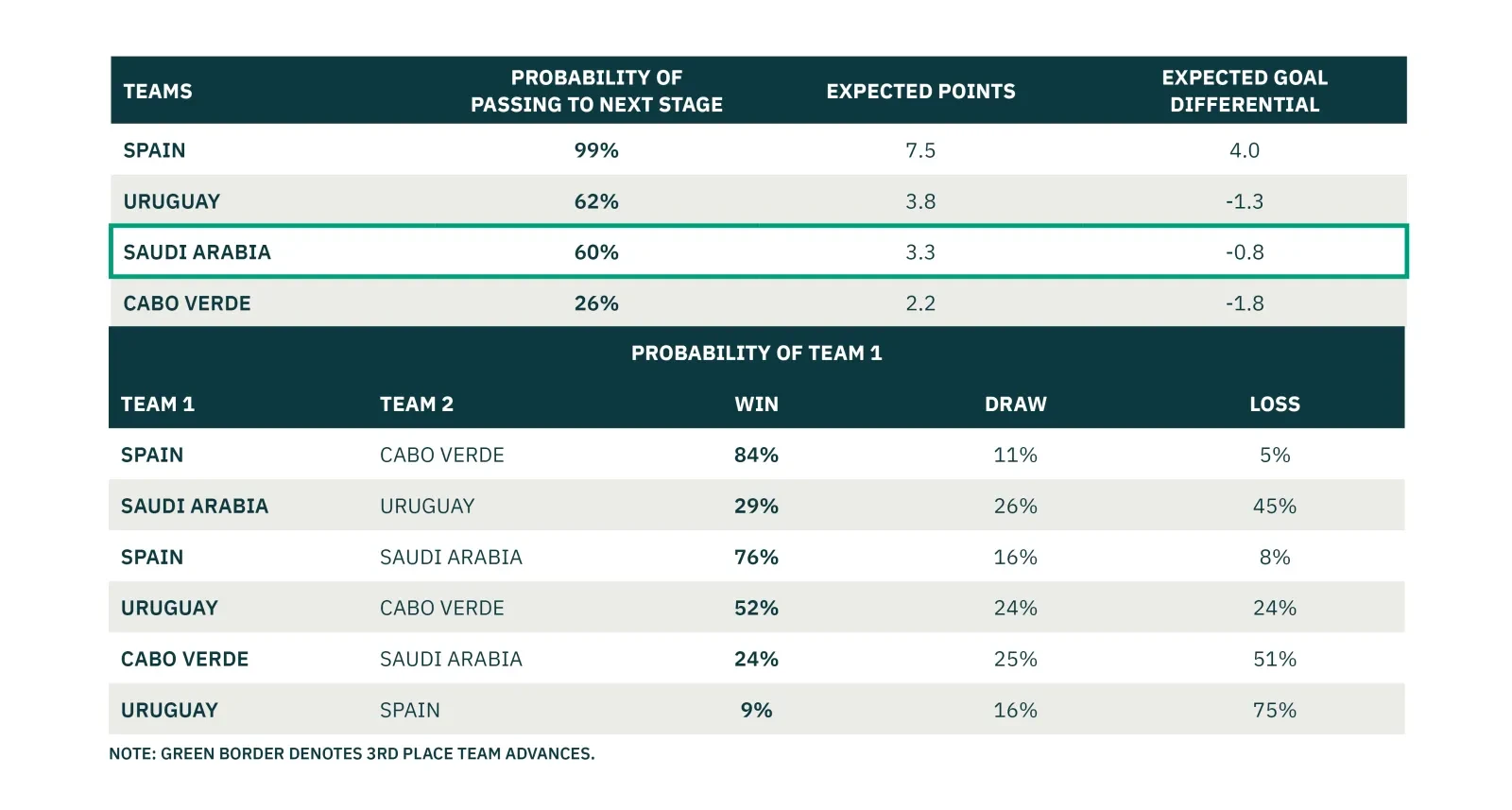
Group H: Spain, Cabo Verde, Saudi Arabia, Uruguay
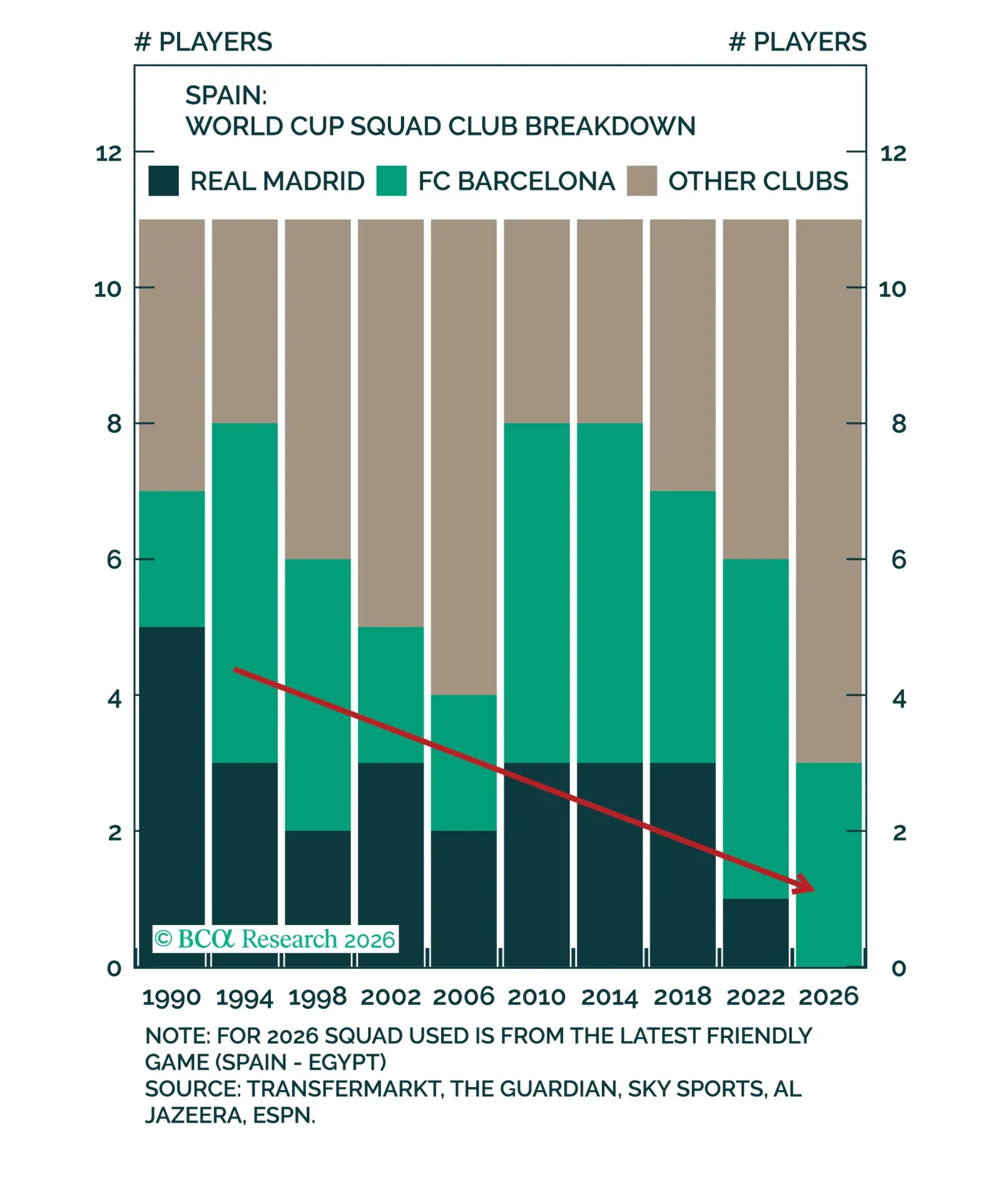
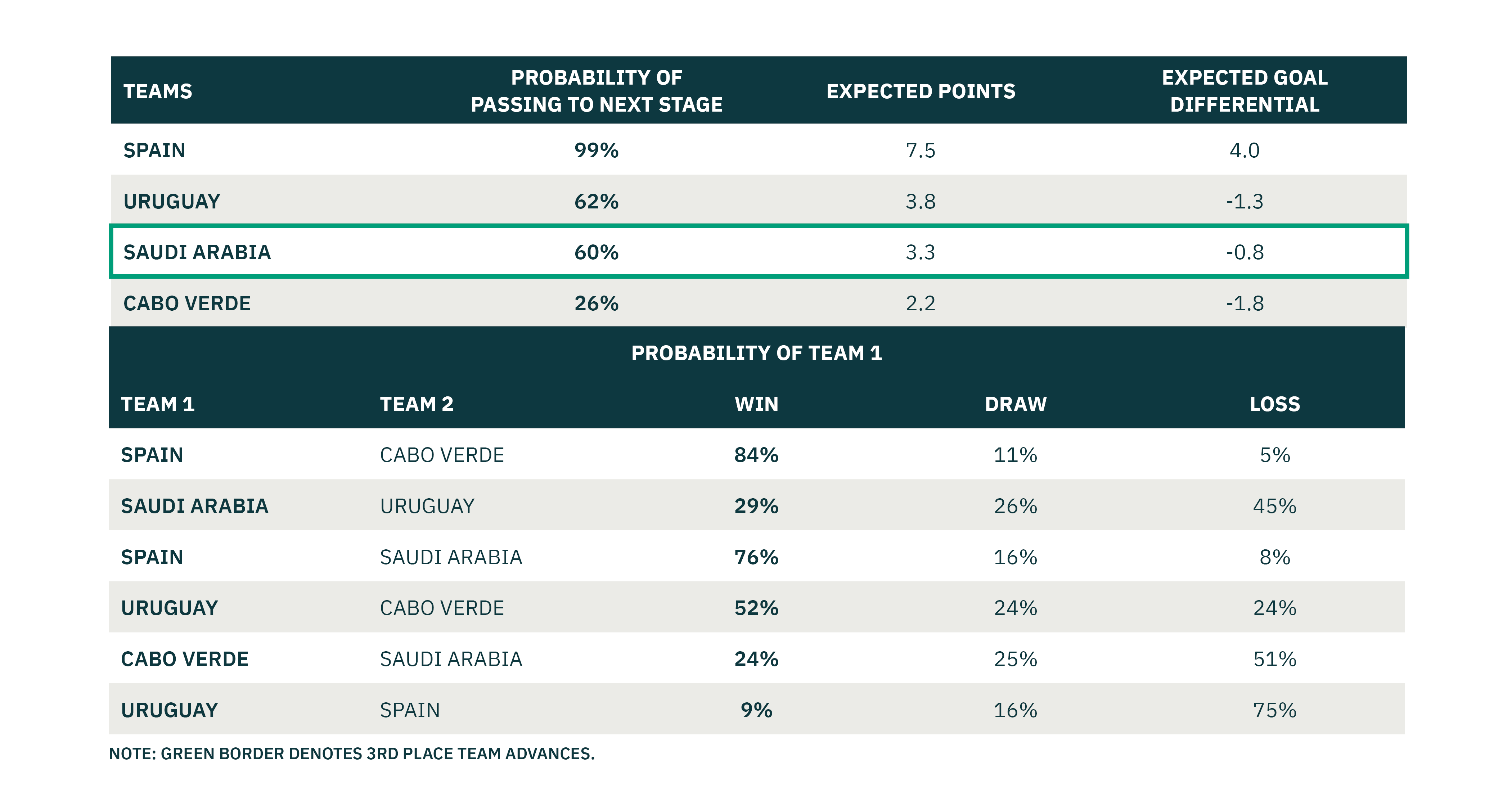
Spain, the defending European champion, is one of the favorites to win the World Cup. Unbeaten throughout qualifying and dominant from start to finish, La Roja continues to thrive under Luis de la Fuente, whose ability to build a cohesive and disciplined collective was already on full display at Euro 2024. Riding an impressive unbeaten streak and backed by one of the deepest squads in the competition, Spain looks stronger than ever. This squad also marks a symbolic turning point: For the first time in World Cup history, Spain's roster does not include a single Real Madrid player (Chart 9). Barcelona fans will probably say it’s for the best. Our model expects Spain to make quick work of the group stage. In fact, La Roja should be in a position to secure qualification for the Round of 32 before its final group match against Uruguay (Table Group H). Anything less than a deep run would be considered a huge disappointment.
The game against Cabo Verde will feel like David versus Goliath. A small archipelago of just 4,033 square kilometers off the coast of Senegal, Cabo Verde punched above its weight by topping its African qualifying group ahead of none other than Cameroon. That success is the product of remarkable stability under head coach Pedro Leitão Brito, better known as Bubista, who has steadily improved the team since taking charge in January 2020. Our model assigns a 26% chance of advancing to the next stage—not the lowest odds.
Will Saudi Arabia repeat the unthinkable by taking down one of the favorites? That’s probably what everyone hoped for when veteran coach Hervé Renard was called back in October 2024. And the unthinkable happened—but not on the pitch: The French manager was fired two months before the start of the competition. This is clearly not something our model can capture. With most of the squad playing in the Saudi Pro League, Saudi Arabia's World Cup campaign has become a test of the country's broader football project. The league's ambitions are clear; the question is whether the national team can match them.
Uruguay will try to avoid a repeat of 2022, when it suffered the humiliation of a group-stage exit. Our model expects LaCeleste to advance this time, though that says as much about the opposition's level as it does about Uruguay itself. Marcelo Bielsa - El Loco - was brought in to revitalize the team, but his tenure has received mixed reviews. While Uruguay remains competitive, disappointing results and Bielsa’s often abrasive communication style have generated criticism.7 Questions have also been raised about his squad selection. Uruguay's U-23 side won the U-20 World Cup two years ago, yet few members of that promising generation have become central figures in the senior team. Instead, the squad remains relatively experienced, with an average age of around 28.
Group I: France, Senegal, Iraq, Norway
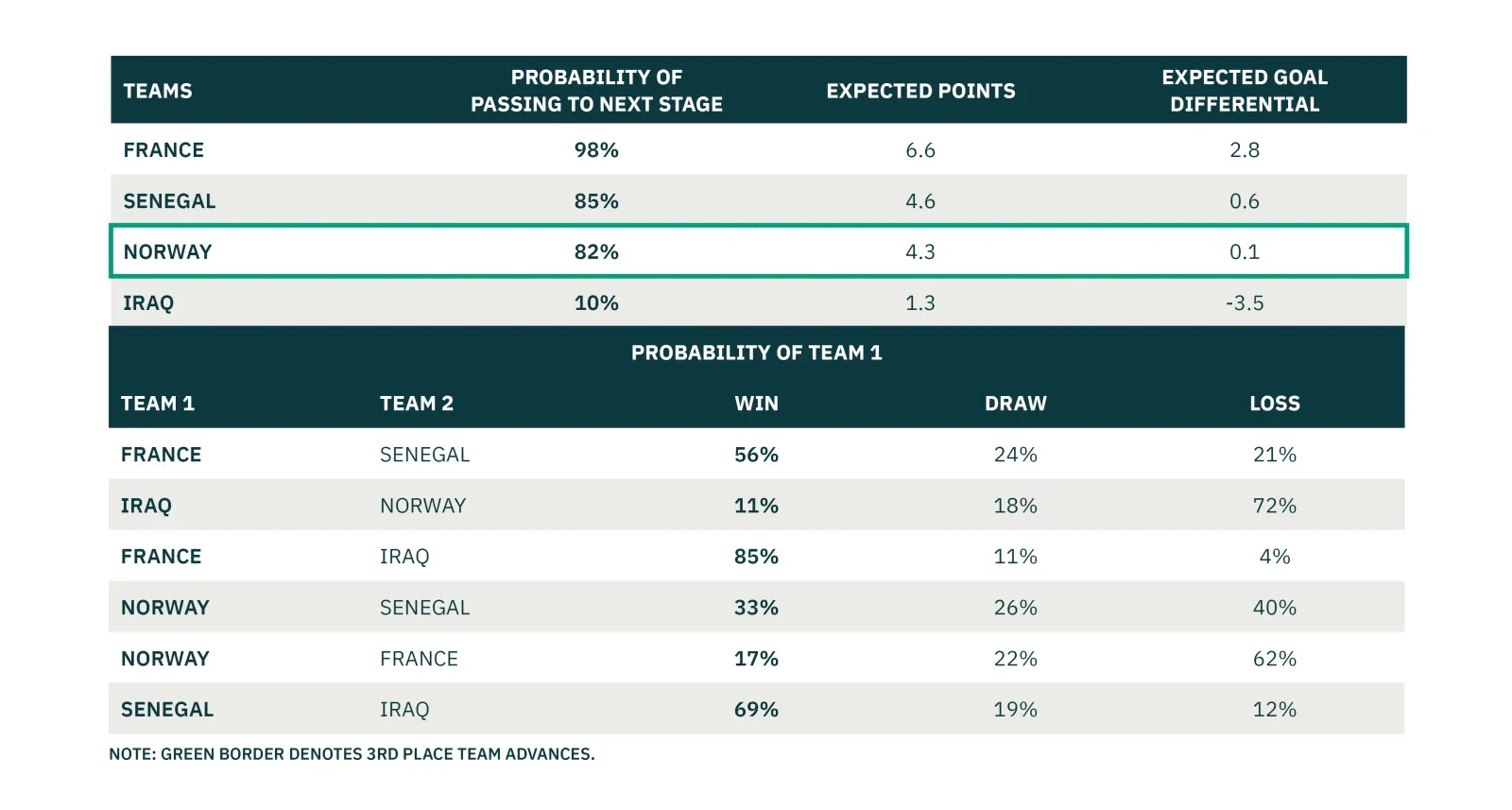
France enters as a favorite. It also marks the end of an era, with Didier Deschamps set to oversee his final World Cup after 14 years in charge of Les Bleus. His record speaks for itself: a World Cup triumph in 2018, a runner-up finish in 2022, and a place in the Euro 2016 final. Few national team coaches have matched that level of sustained success. France arguably possesses enough depth to field two highly competitive starting lineups, with quality and experience at virtually every position. Our model captures this: France is expected to finish in first place (Table Group I). The attacking trio of Kylian Mbappé, Ousmane Dembélé, and Michael Olise attracts most of the attention, but the strength of this squad extends far beyond its star forwards. Finding weaknesses in this French side is no easy task. Yet history offers a note of caution. Senegal's presence in the group is a reminder of France's infamous 2002 title defense, when the reigning world champions crashed out in the group stage after losing their opening match to the Lions of Teranga. Eight years later, after finishing as runner-up in the 2006 World Cup, a star-studded French squad imploded at the 2010 World Cup in South Africa. Those disappointments underline a simple truth: Talent alone is never enough. That’s where Deschamps' greatest contribution may lie. His ability to maintain stability, manage egos, and keep the squad focused has been the foundation of France's success for more than a decade. Can Les Bleus send him off with une troisième étoile?
Chaos seems to follow Senegal into this World Cup. It began with the surreal aftermath of the Africa Cup of Nations final against host nation Morocco—the title was ultimately awarded to Morocco weeks later, leaving a bitter taste and lingering controversy. The turmoil has continued off the field. Contract disputes involving the manager and reports of restricted access to training facilities due to unpaid debts have created an atmosphere far from ideal ahead of the tournament. Despite boasting one of Africa’s deepest and most talented squads, Senegal arrives under a cloud of uncertainty. The question is whether the Lions of Teranga can channel adversity into motivation. At the very least, our model sees them finishing 2nd of Group I, assuming they do not leave the pitch.
After four decades of waiting, Iraq returns to the World Cup for only the second time in its history, following its lone previous appearance in Mexico in 1986. The objective is clear: improve on that debut campaign, which ended with three defeats. That will be no easy feat, given the group's strength. One of Iraq’s biggest challenges is its lack of exposure to elite international competition. The national team has played very few official or friendly matches against European opponents, and the squad is composed largely of domestically based players. Consequently, our model assigns only a 10% chance of advancing and predicts they will finish last in the group.
Norway will no doubt welcome being in the same group as France, as their last appearance came in France in 1998, a tournament that remains the high-water mark in the nation's footballing history. Norway comes to North America in impressive form. It was one of only four teams to record a perfect qualifying campaign, scoring 37 goals while conceding just five. Norway can rely on the most prolific goalscorer in its history: Erling Haaland, whose remarkable tally of 55 goals in just 49 international appearances makes him one of the tournament's most feared strikers. Alongside him is Martin Ødegaard, fresh off a Premier League title with Arsenal, and Atlético Madrid forward Alexander Sørloth. The squad also benefits from the rise of domestic football, with three players coming from Bodø/Glimt, the surprise team that reached the Champions League Round of 16 this season. Our model gives this blend of elite talent and growing depth an 82% chance of passing to the next stage.
Group J: Argentina, Algeria, Austria, Jordan
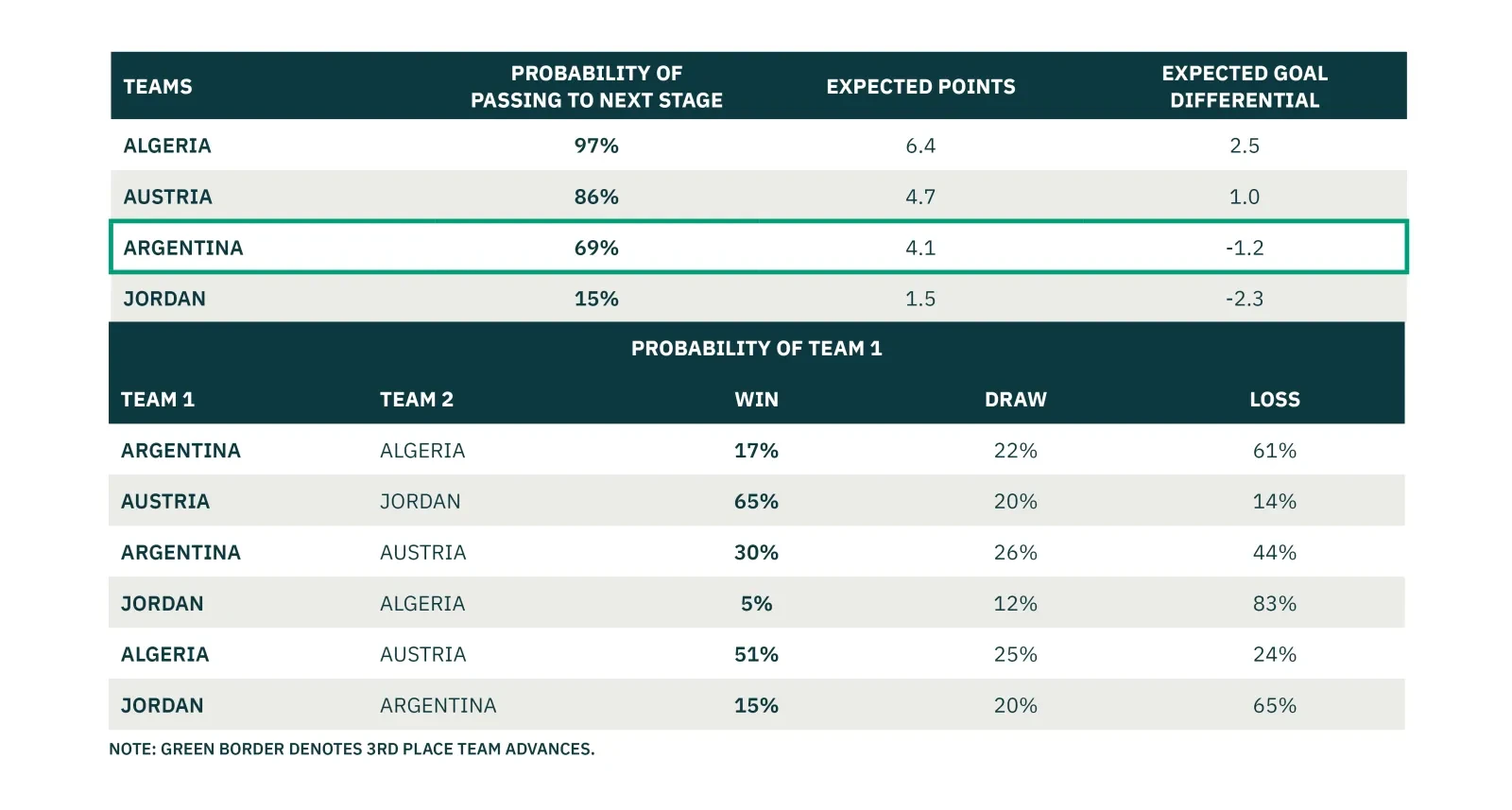
Argentina can still count on Lionel Messi. Even at less than full fitness, he possesses the ability to change a match with a single touch, pass, or moment of brilliance. At his sixth World Cup, La Pulga is looking to further cement one of the most remarkable careers in football history.8 Whether the rest of the squad can match his longevity is another question. Continuity remains one of Argentina’s greatest strengths, and Lionel Scaloni could field a starting eleven remarkably similar to the one that lifted the trophy in Qatar, with Ángel Di María’s retirement representing the most notable change. That familiarity brings experience and chemistry, but it also raises questions about aging legs and the difficulty of remaining at the summit four years later.
The "Winner’s Curse" adjustment reduces the reigning champion’s probability of winning each match by 20%, reflecting the historical difficulty of defending a World Cup title. As a result, the model projects that Argentina will finish third in the group and advance only as one of the best third-placed teams (Table Group J). Ironically, the expanded tournament format may prove to be Argentina’s lifeline, offering the defending champions a path forward even if they fall short of expectations in the group stage.
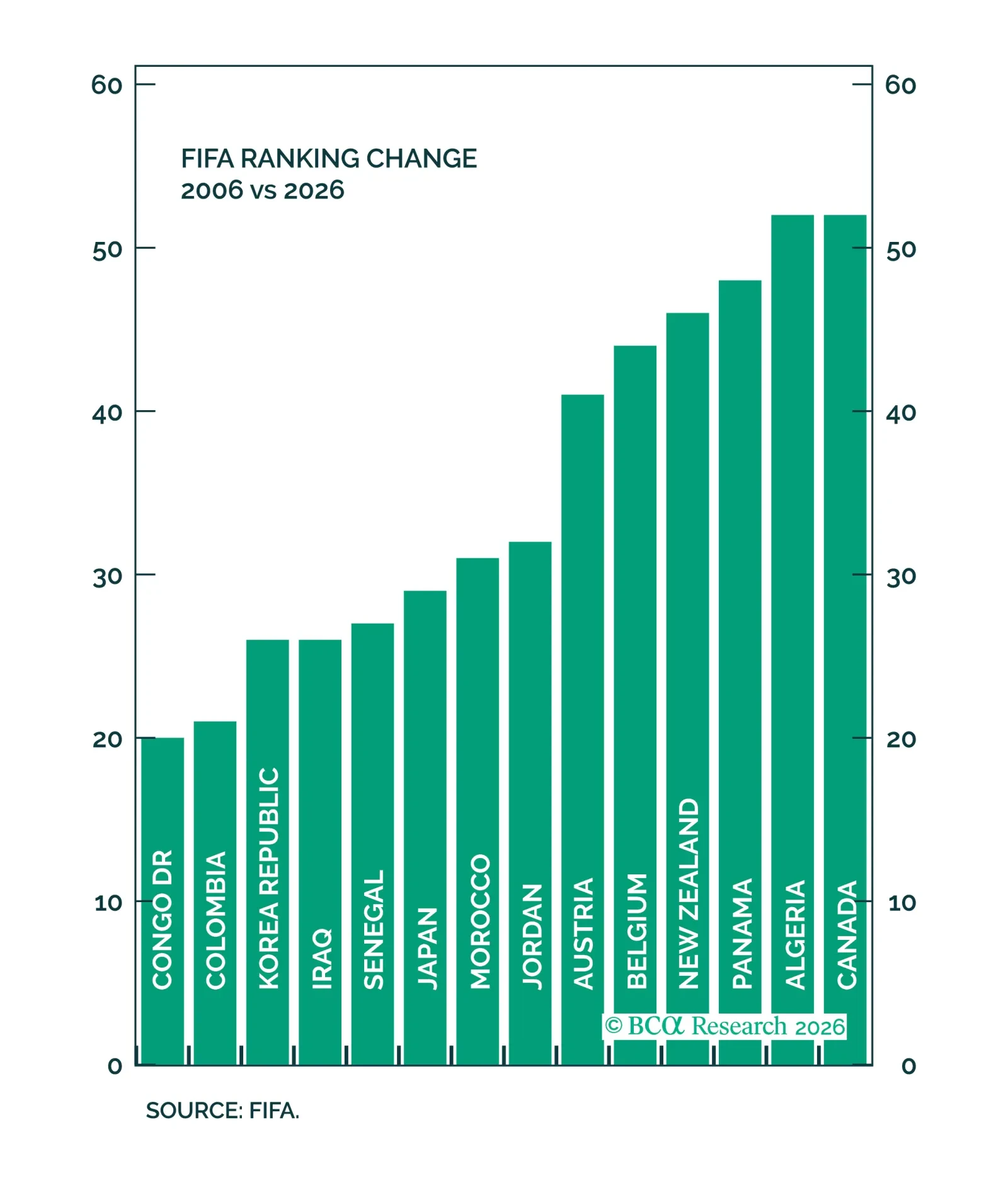
Algeria arrives at the World Cup hoping to carry over the momentum and confidence generated by its recent success at the Africa Cup of Nations. The Desert Foxes boast an appealing blend of youth and experience, combining emerging talent with seasoned leaders such as Riyad Mahrez, whose creativity and leadership remain central to the team’s ambitions. Our model is particularly bullish, projecting them to spring a surprise by finishing top of their group. Surprising? Maybe not. Algeria is one of the teams that has improved the most in recent years, according to FIFA rankings (Chart 10)
Austria returns to the World Cup for the first time since 1998, allowing grizzled David Alaba and Marko Arnautović to make their World Cup debut. Built around a well-drilled collective and a clear tactical identity, the Austrians are widely regarded as one of the tournament’s most dangerous dark horses. Their credentials were on full display at the 2024 Euros, where they topped a group containing both France and the Netherlands before falling narrowly to Türkiye in the Round of 16. Austria navigated qualifying with impressive consistency, and with a favorable first game against Jordan, our model projects them to finish second in the group.
Jordan's first-ever appearance on football’s biggest stage is another example of how the expanded 48-team format is allowing new nations to live out what once seemed an impossible dream. Jordan arrives with genuine momentum. Runners-up at the 2024 AFC Asian Cup and the 2025 Arab Cup, the nation continues to rewrite its footballing history. Much of that remarkable rise is attributed to Moroccan head coach Jamal Sellami, whose influence has transformed Jordan into one of Asia’s most improved sides. Unfortunately for the Nashamas, the quality gap within this group will be too large to overcome, according to our model.
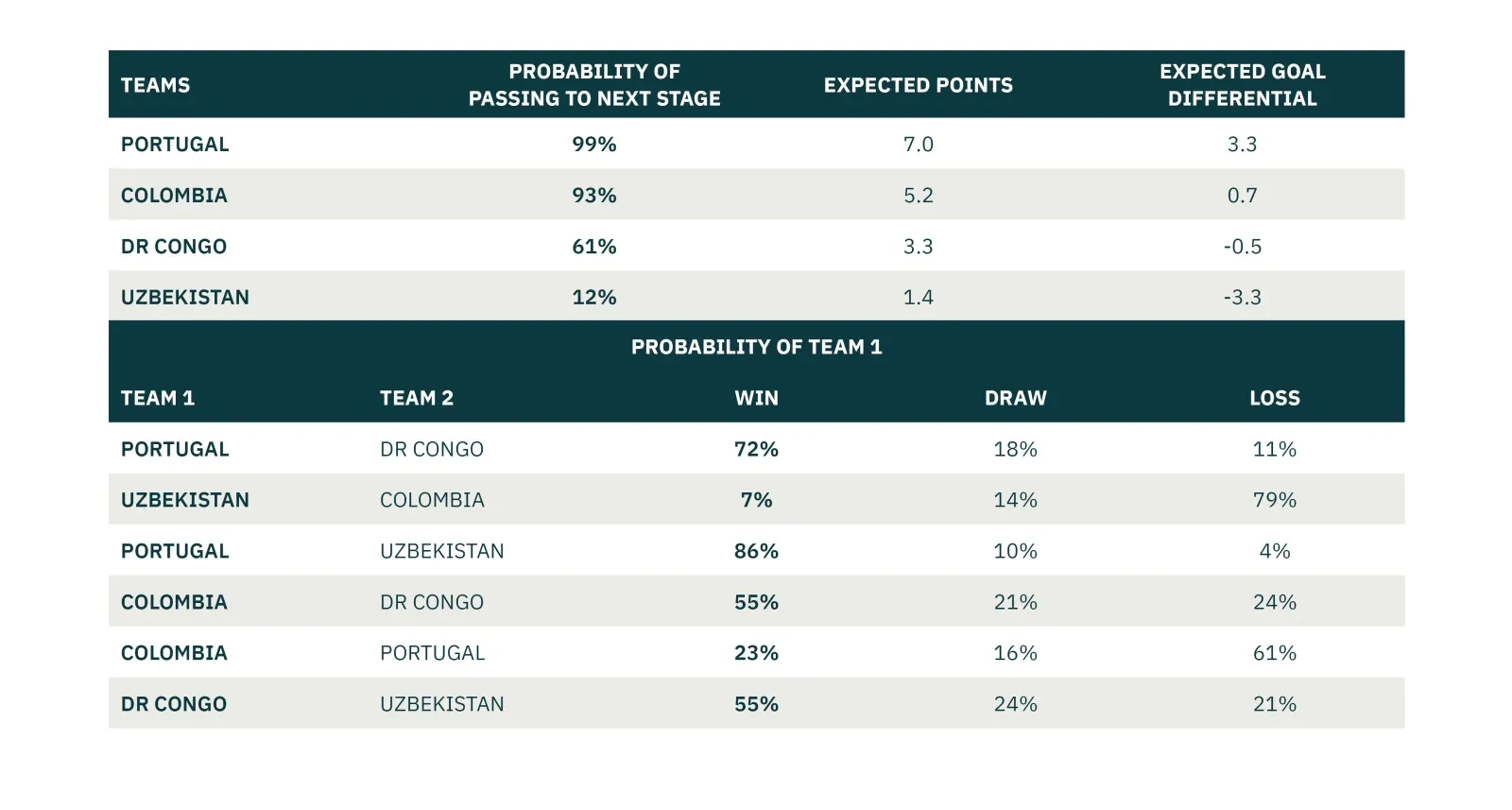
Group K: Portugal, DR Congo, Uzbekistan, Colombia
Portugal enters the World Cup carrying perhaps the greatest expectations in its history. Roberto Martínez has inherited what many consider the most complete and talented squad the country has ever produced, blending experienced leaders with a new generation reaching its prime. One name is tragically missing from the squad after Diogo Jota passed away last year.9 Rest in peace, Diogo.
The story of this Portugal team inevitably begins with Cristiano Ronaldo. At 41 years of age, CR7 is set to appear in a record sixth World Cup, which is widely expected to be the final chapter of one of football’s greatest careers. Unlike previous Portuguese generations, however, this team is no longer solely dependent on Ronaldo. It is brimming with elite-level quality across the pitch. Portugal may not possess the star power of France, but few nations can match its depth. Our model views Portugal as one of the leading contenders to lift the trophy (Table Group K).
DR Congo could have hoped for a less challenging group for their return to the World Cup after more than 50 years. Although the team has proved to be quite solid defensively, it has shown limitations at the front. Our model sees them landing 3rd in the group but not qualifying.
A major part of the excitement surrounding Uzbekistan comes from the man on the bench: Fabio Cannavaro. The legendary Italian defender, captain of Italy’s 2006 World Cup-winning side and one of the few defenders ever to win the Ballon d’Or, now leads Uzbekistan into its first-ever World Cup. His appointment has brought credibility, discipline, and a winning mentality to a squad eager to make history. On the pitch, Uzbekistan is built around one of the most promising generations in its history, including Manchester City defender Abdukodir Khusanov. Our model is cautious about Uzbekistan’s prospects for advancement.
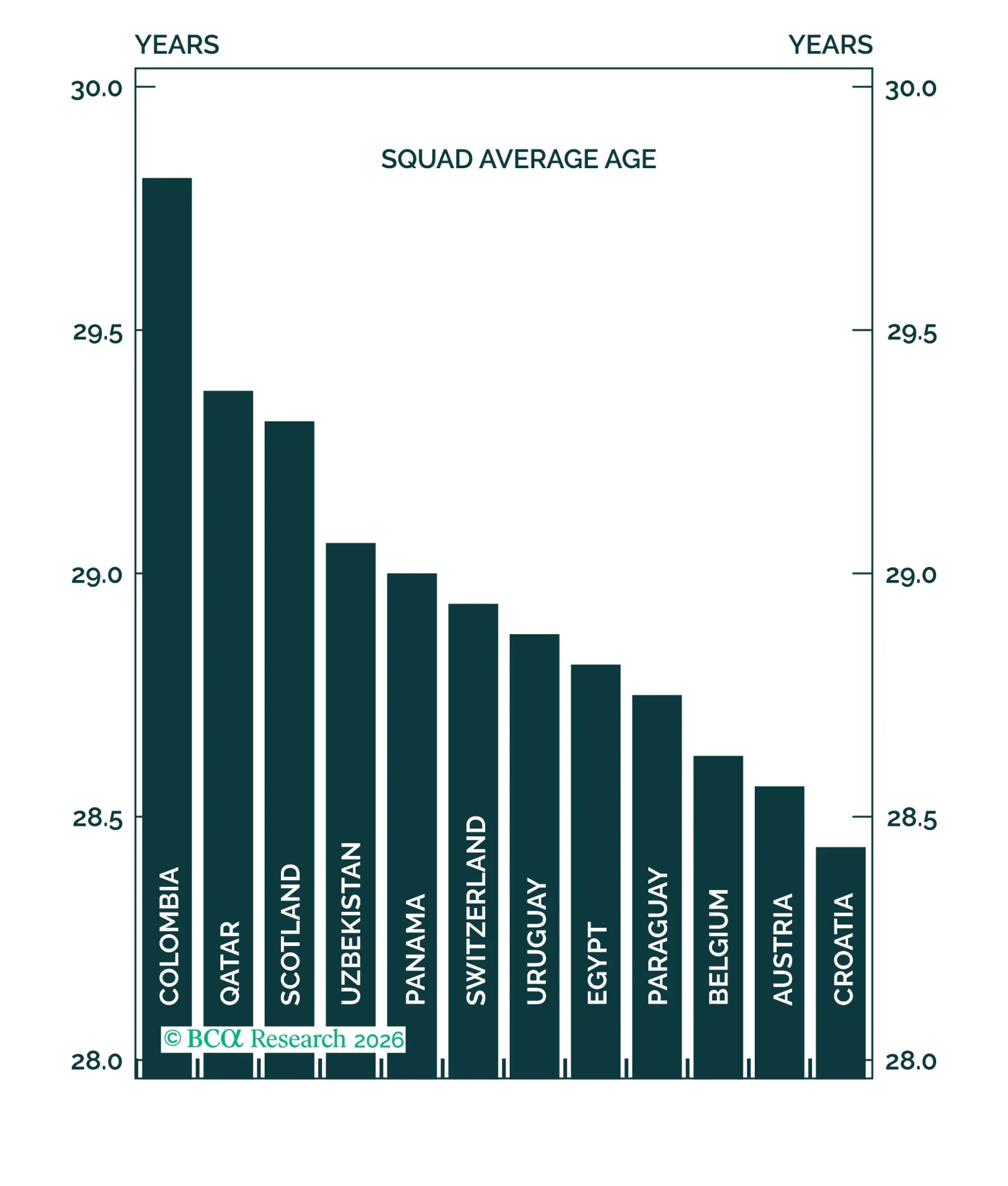
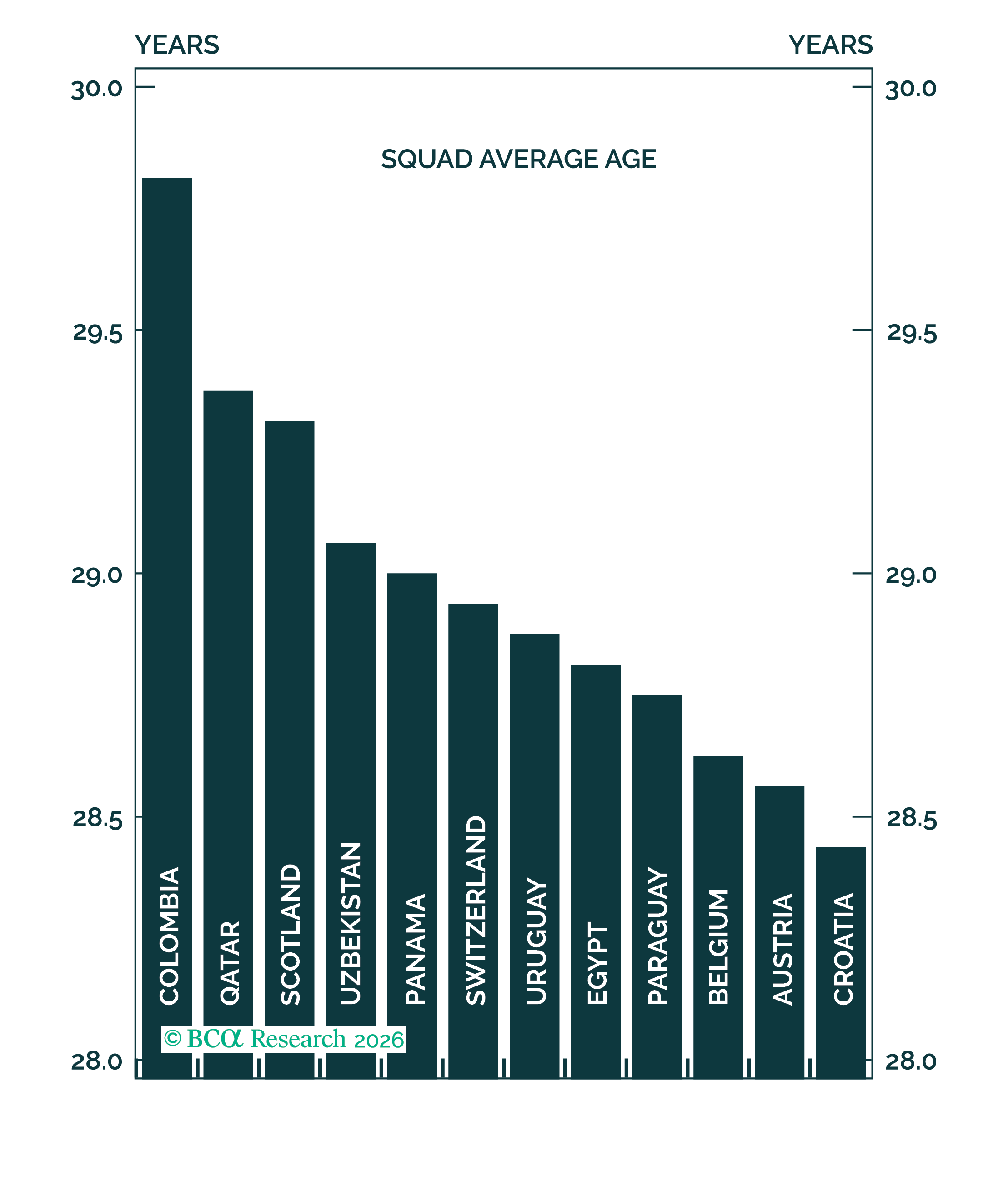
After narrowly missing out on the 2022 World Cup, Colombia has re-established itself among the continent's elite and enters the tournament with confidence. James Rodríguez, the breakout star of the 2014 World Cup, is part of the adventure and has become a key pillar of Néstor Lorenzo’s system. But the undisputed star of this Colombian side is "Lucho" Díaz. Fresh off an outstanding season with Bayern Munich, Díaz is the focal point of Colombia's attack and probably the most dangerous wingers in the tournament. Experience is both Colombia's greatest strength and its biggest question mark. The Cafeteros arrive with the oldest average squad age of any team at the World Cup (Chart 11). Still, they have a 93% chance of advancing to the next stage according to our model.10
Group L: England, Croatia, Ghana, Panama
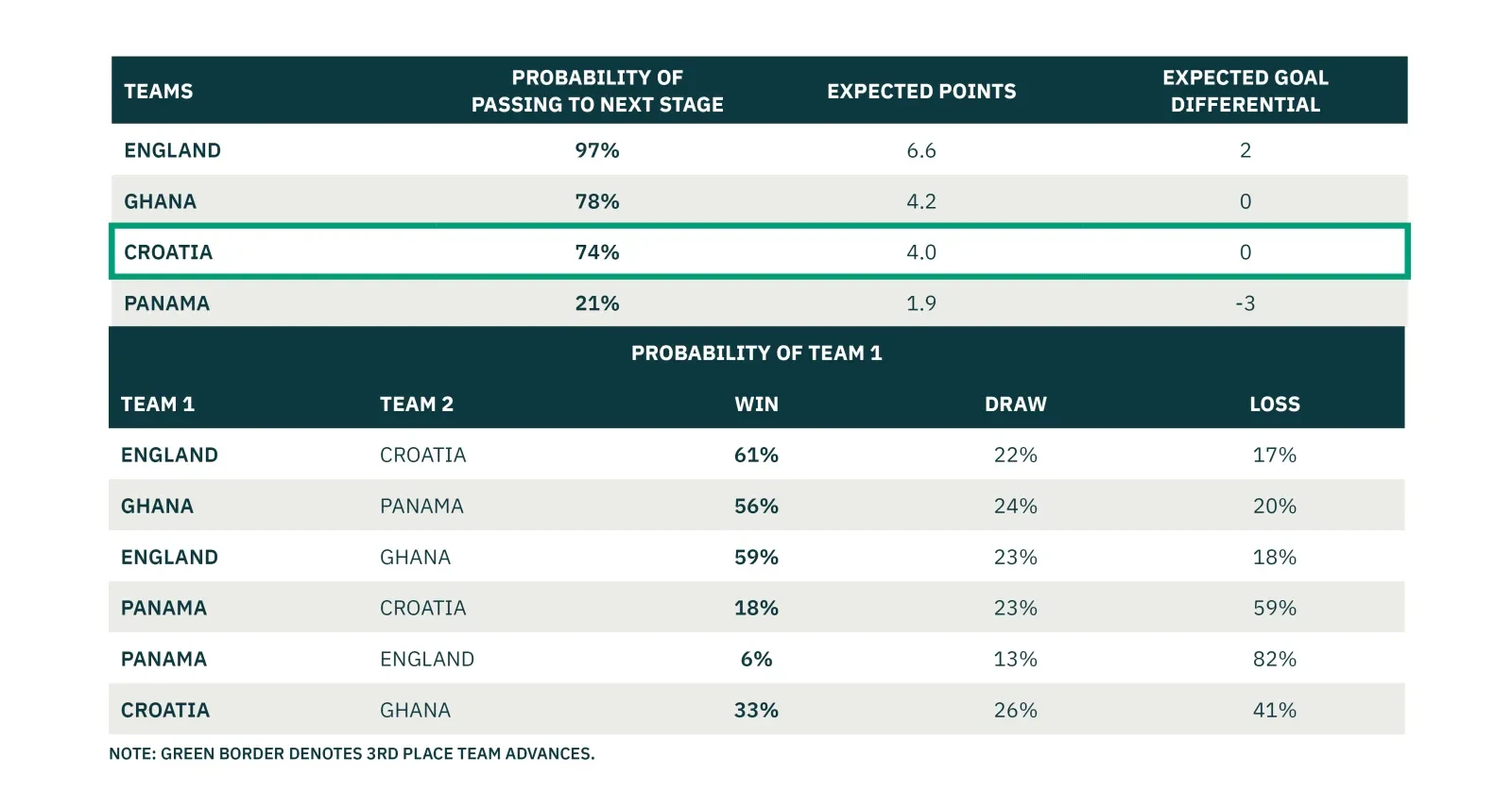
At last, we get to the final group of the 2026 World Cup. We hope you still have an appetite for more, especially since our model’s output might surprise you in this group (Table Group L).
No team arrives at a World Cup carrying a heavier burden of expectation than England. The same question keeps resurfacing every four years: Is [enter a name] the man who can finally “bring it home” for the first time since 1966? The appointment of Thomas Tuchel was intended to provide the final push for a generation that has repeatedly come close. England reached the semifinals of the 2018 World Cup, the final of Euro 2021, and the final of Euro 2024, yet still has no trophy to show for it. Tuchel's reputation as a tournament tactician is one reason for optimism, but his tenure has already generated controversy. Most notably, he decided that Cole Palmer, Phil Foden, and Harry Maguire would best help England's World Cup campaign by watching it from home. England's fate may also depend on how quickly its Arsenal stars can put Budapest behind them. Declan Rice and Bukayo Saka arrive fresh from the pain of a Champions League final defeat on penalties, a particularly sensitive subject for a nation whose World Cup history has been repeatedly haunted by shootout failures.
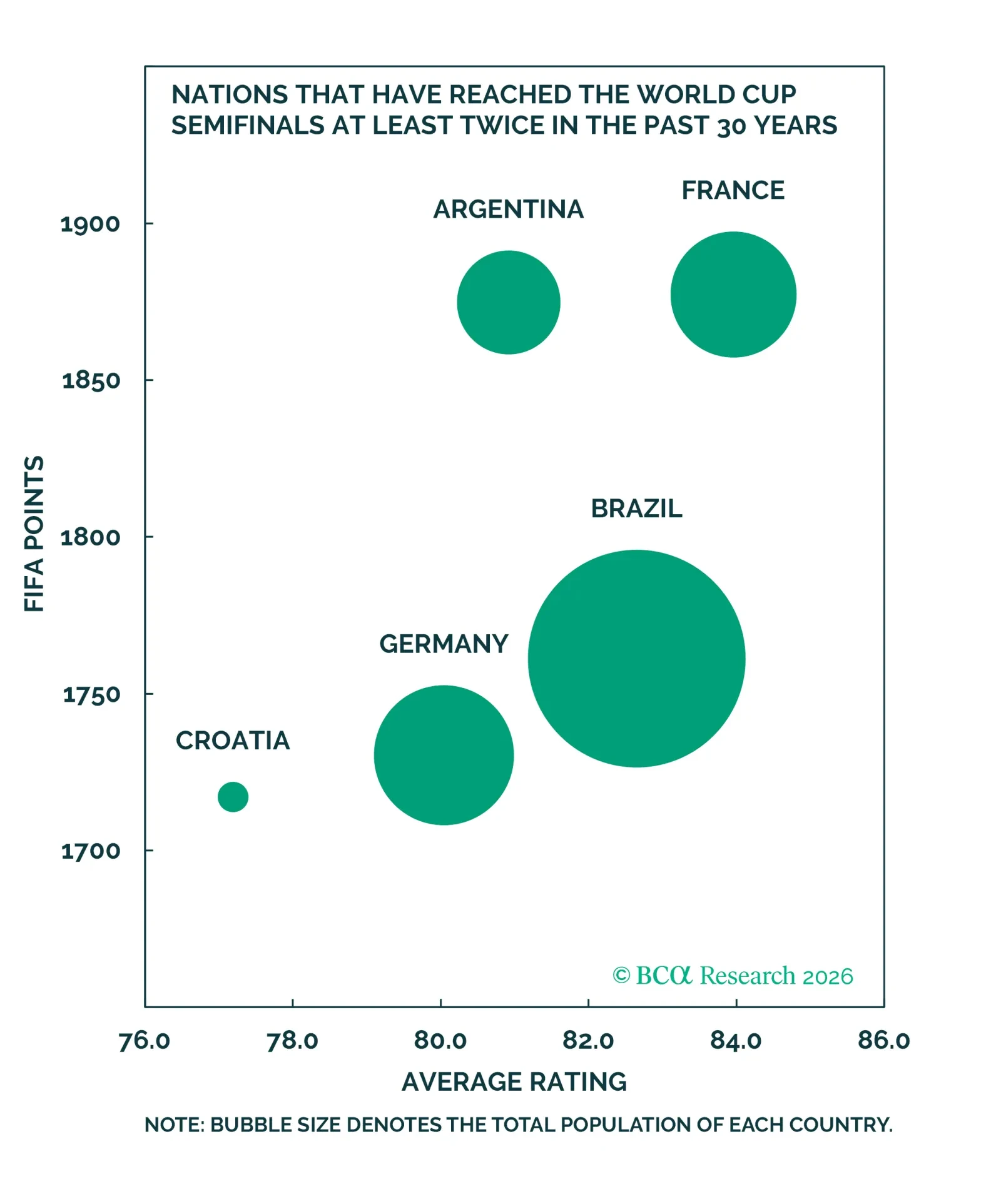
If there is such a thing as a "small-country superpower" in international football, Croatia is the gold standard. With a population of just 4 million, Croatia has achieved what many far larger football nations can only dream of: Reaching the final of the World Cup. Croatia has done it once and has reached the semifinals twice (Chart 12), placing it in the company of giants such as Brazil, Germany, France, and Argentina. At the heart of this remarkable story remains the seemingly eternal Luka Modrić. The Croatian captain has announced that this will be the final tournament of his extraordinary career. The core of the squad that reached the 2018 World Cup final will once again be on the plane. Experience remains Croatia’s greatest strength, but it also underscores the challenge of generational renewal. In fact, only two players in the entire squad—Luka Vušković and Petar Sučić—will be under the age of 23 when the tournament begins. This weighs on their odds of progressing according to our model, which sees them advancing as one of the best third-place teams.
Ghana heads into the World Cup under new leadership, having appointed Carlos Queiroz just two months before the tournament. The former Real Madrid, Manchester United, Portugal, and Iran coach brings a wealth of experience and a pragmatic approach to the Black Stars. Athletic Bilbao forward Iñaki Williams11 will be the team's main attacking threat as Ghana looks to make an impact. The key question is whether Queiroz can quickly instill his ideas and get the squad firing in time for the tournament.
The Central American nation of Panama will be making only its second-ever World Cup appearance, following its debut at the 2018 tournament in Russia. Los Canaleros face a difficult challenge. After an impressive qualifying campaign—recording three wins and three draws—Panama will be aiming to improve on its 2018 performance. The team will look to its standout players, Coco Carrasquilla and Michael Amir Murillo, for inspiration. Guided by head coach Thomas Christiansen, Panama has made significant progress in recent years and will be eager to showcase that development this summer in the United States.
Commercial Break For The Risk Seekers
Disclaimer: The authors do not endorse or encourage gambling on sporting events using our models.
In our 2022 in-tournament update, we showed that our model is a good value investor bettor.
Our model does not make predictions for individual games; instead, it assigns probabilities. If it gives Team 1 an 80% probability of winning, it does not mean Team 1 will win. Rather, it simply indicates that there is a 4/5 chance it wins, a 1/5 chance Team 2 wins, or a tie.
The only way to assess the model’s performance is to compare it against a benchmark, such as betting markets. Essentially, if our model gets a better probabilistic assessment than betting markets, then it should deliver positive returns.
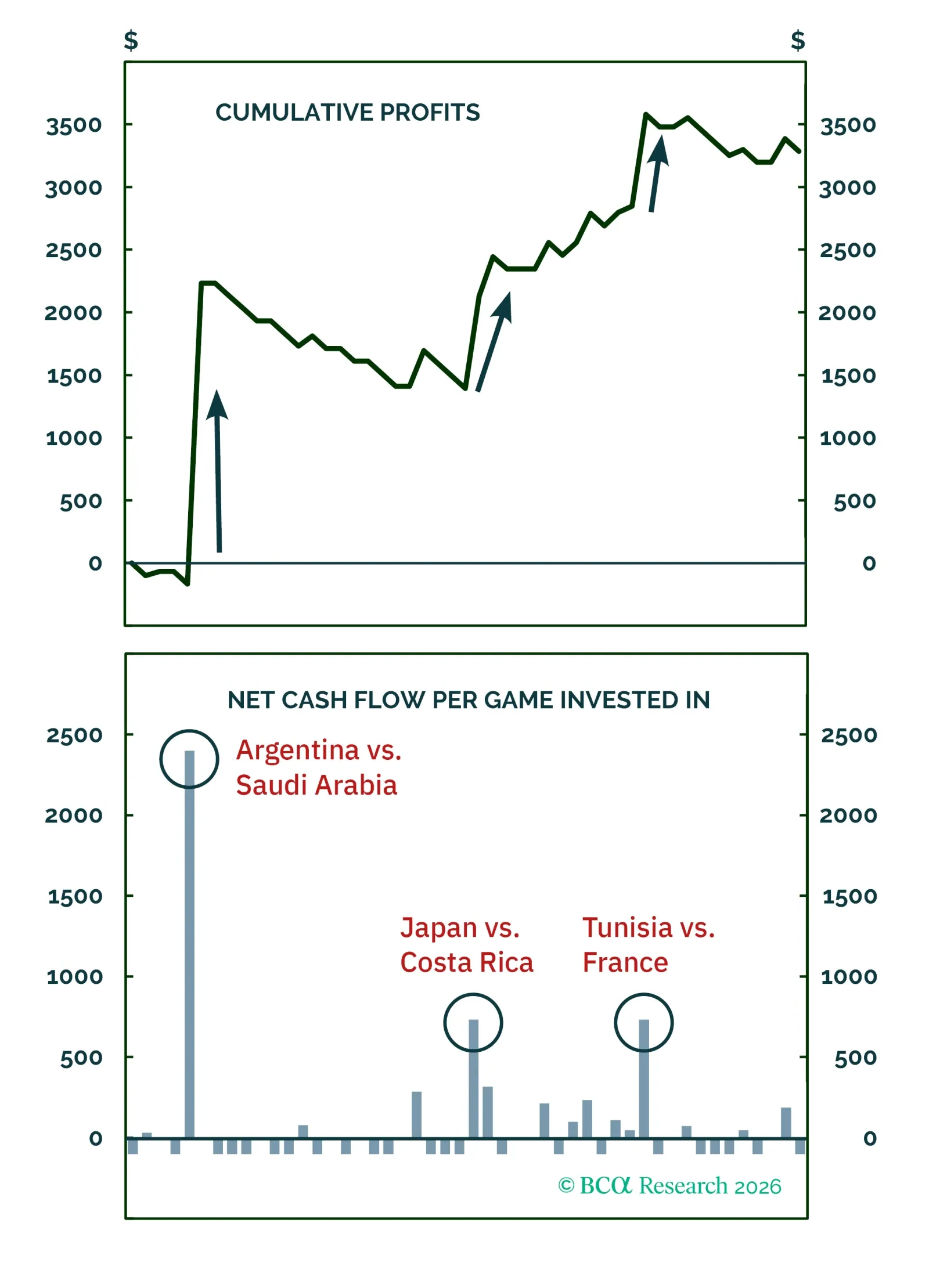
To that end, we tracked the performance of an investment strategy involving going long games where the spread between our model and the market betting odds exceeded 5%. Chart 13 shows the cumulative returns from this strategy.
In total, the strategy invested in 38 of 48 games, for a total of $3,800 (assuming a $100 investment per game) and a net return of $3,284, or +86%.
Most of the net cash flow was generated by games in which our model assigned better odds to underdogs than the betting market (Chart 13, bottom panel).
Our model successfully identified matches in which market betting odds had mispriced rare, low-probability events, making them appear rarer than they actually are. Saudi Arabia's win against Argentina is an example. Importantly, our model displayed good judgment as to which ‘underdogs’ were more underpriced versus the ones that were fairly priced.
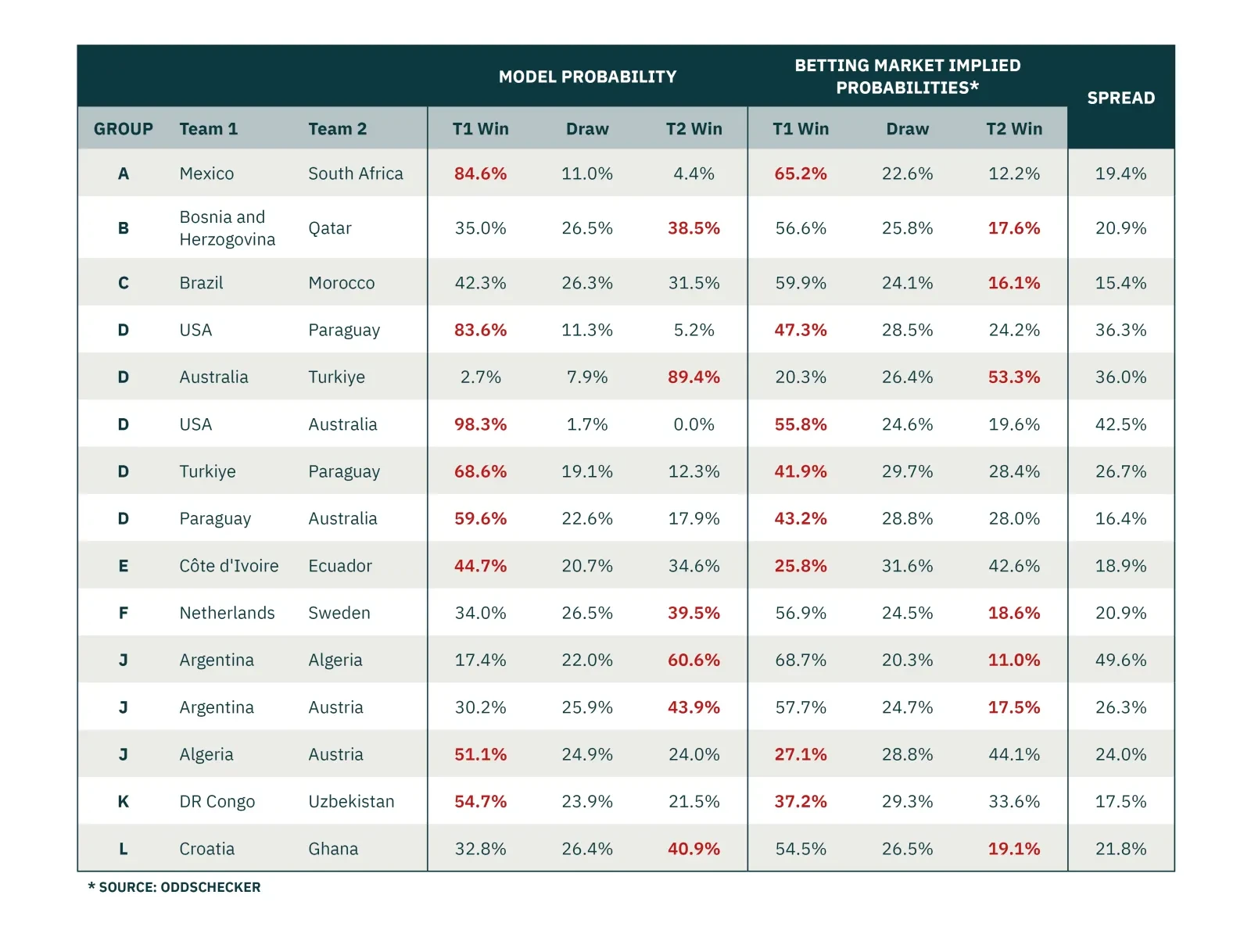
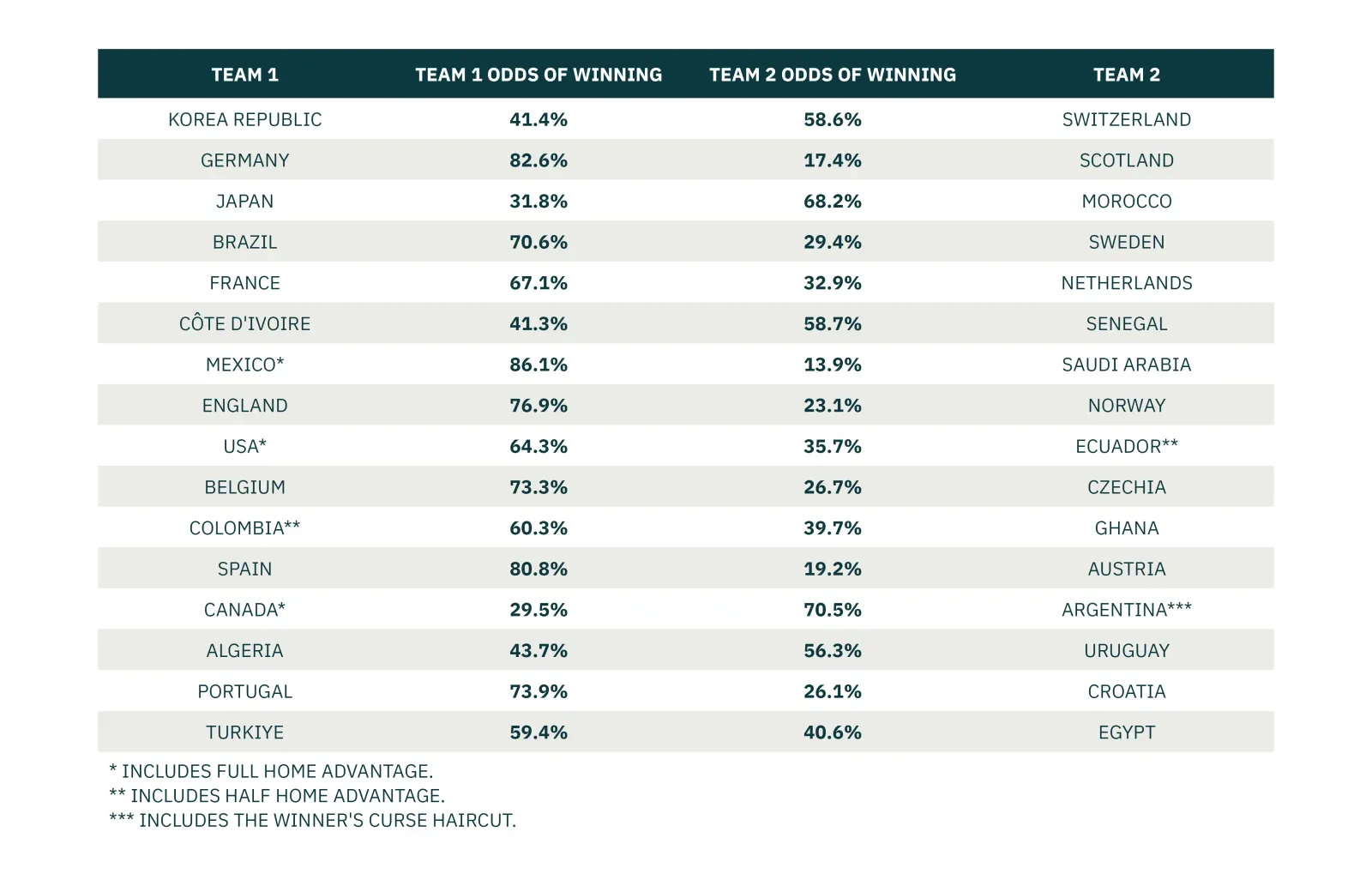
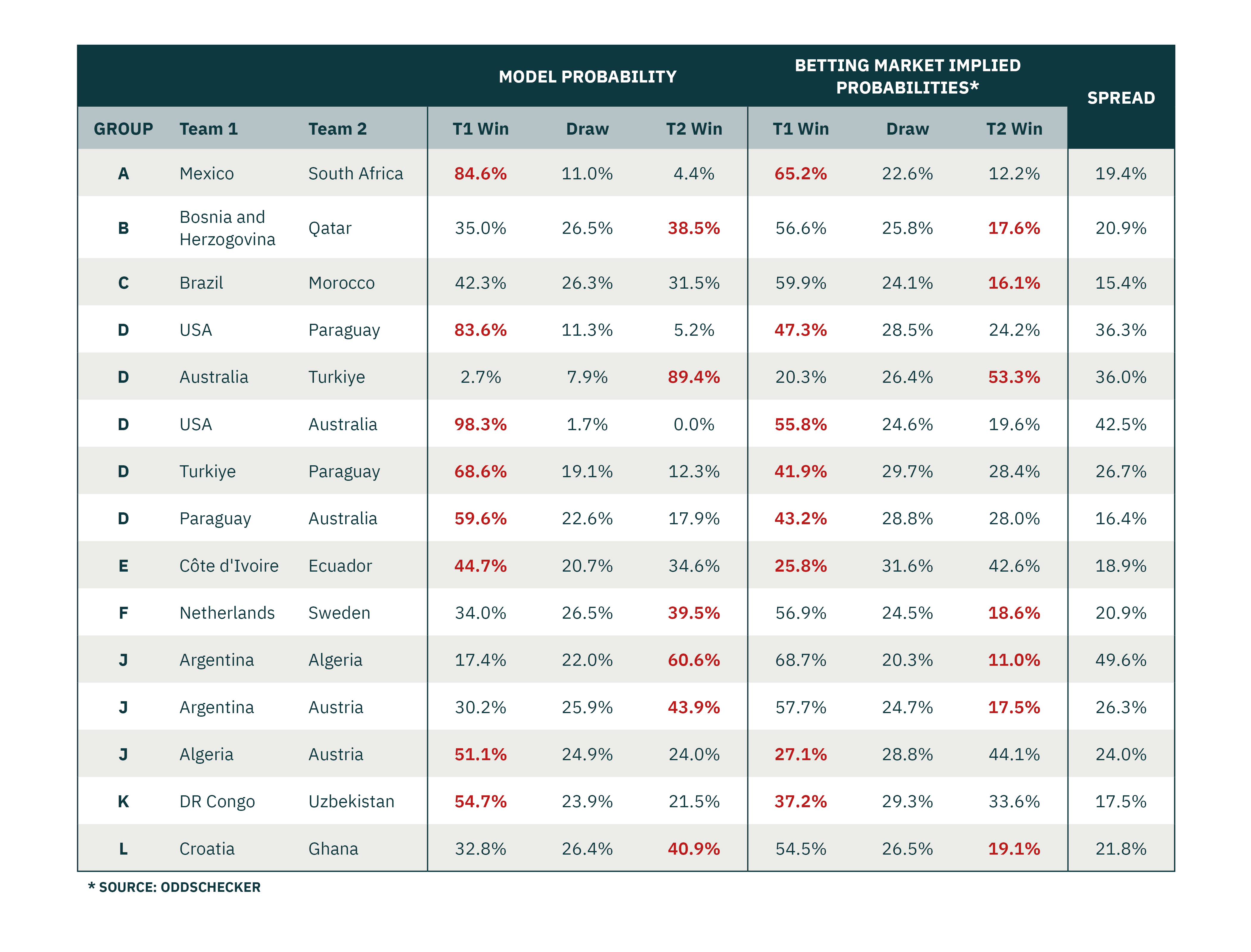
Based on this strategy, we have identified the 15 group stage games in which our model's probabilities show the greatest divergence from bookmaker’s odds (Table 4). Our host advantage and previous winner dummy are responsible for some of the differences, as we assign larger advantages/penalties to each than the bookmakers do. Interestingly, in Group D, our model sees value in 5 of the 6 games.
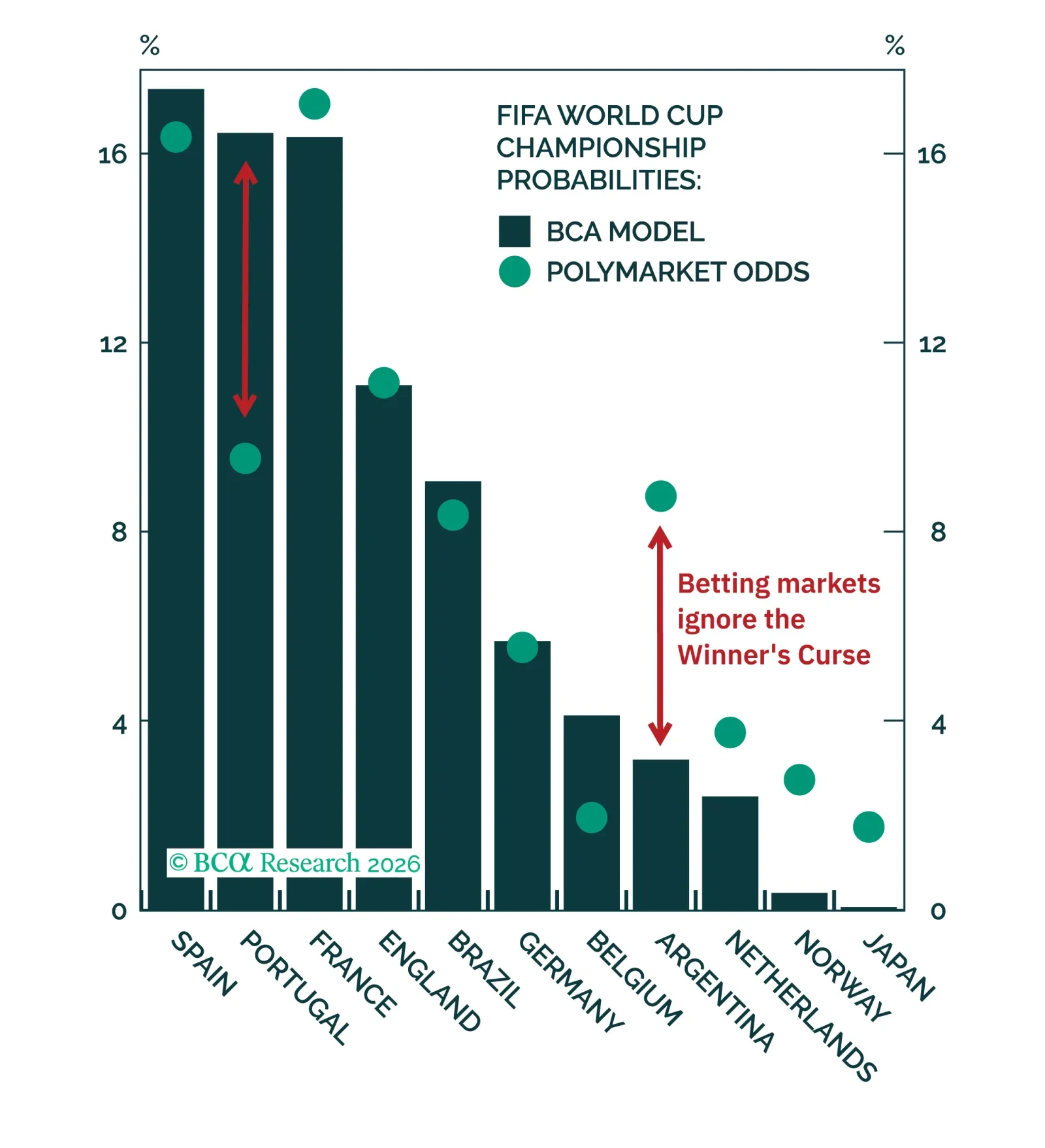
When it comes to championship probabilities, our model closely aligns with Polymarket's odds (Chart 14). The biggest divergence exists for Portugal, where our model assigns a 16.4% winning probability, compared to Polymarket’s 9.5%. Our model also has some higher hopes for the hosts, Mexico and the US, with 1.7% and 1.5%, respectively.
Step Two: The Knockout Stage Model
The knockout stage is somewhat easier to model, given that the set of possible outcomes is reduced to only {loss; win}. This difference with the group stage is not only relevant to the model's math; it is also relevant to the strategy teams employ during the games. Therefore, we simulated this part of our analysis using a probit model estimated from a sample of only knockout-stage games from 2006 onward.
Just like in 2018 and 2022, we found the following factors to be the most important at this stage of the competition:
- Team Average Player Rating
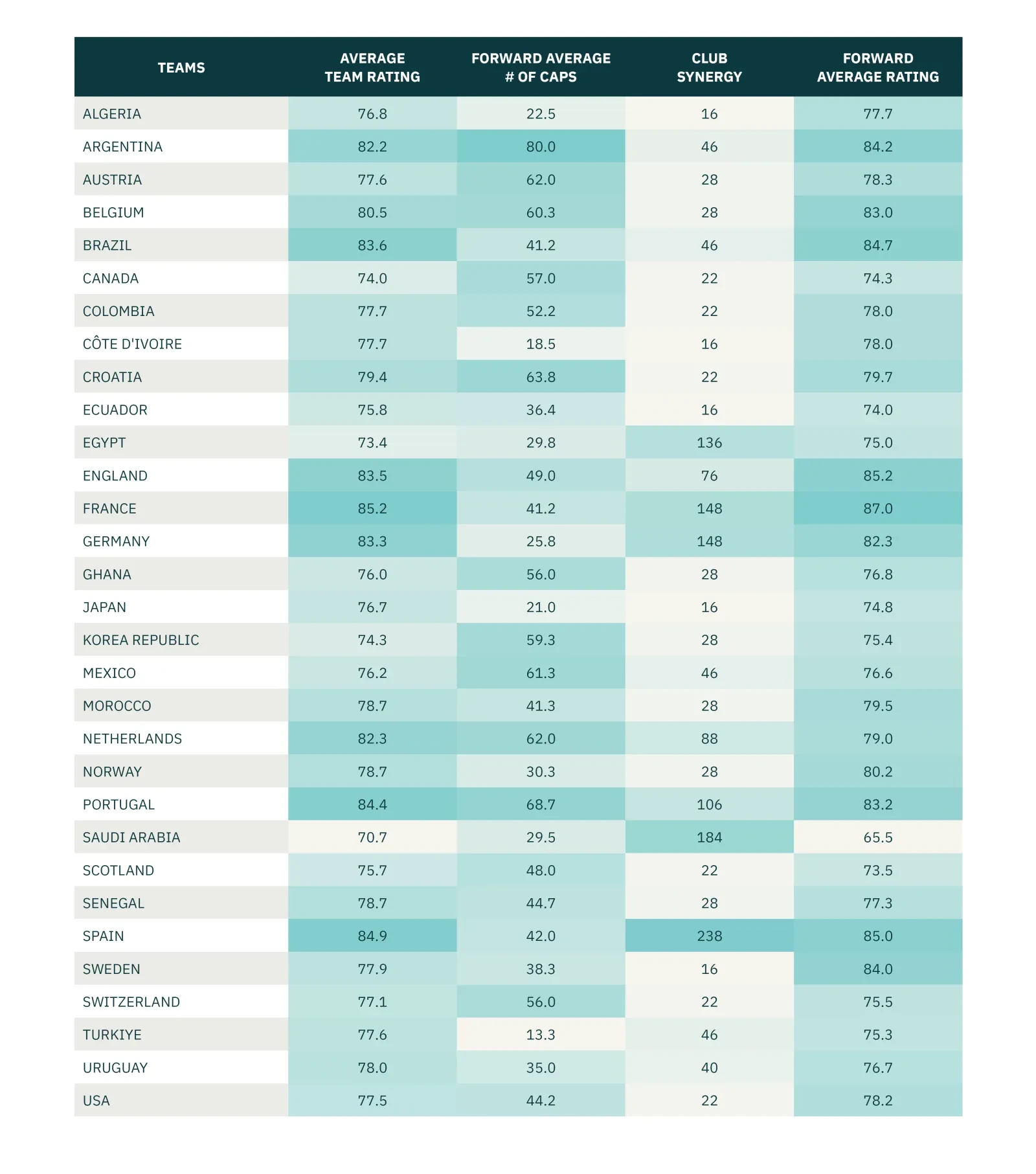
- Club Level Synergy
- Forwards Average Rating
- We replaced the Forward Average Age by Forward Average number of Caps as an explanatory variable.
Swapping Forward Average Age for Forward Average Number of Caps
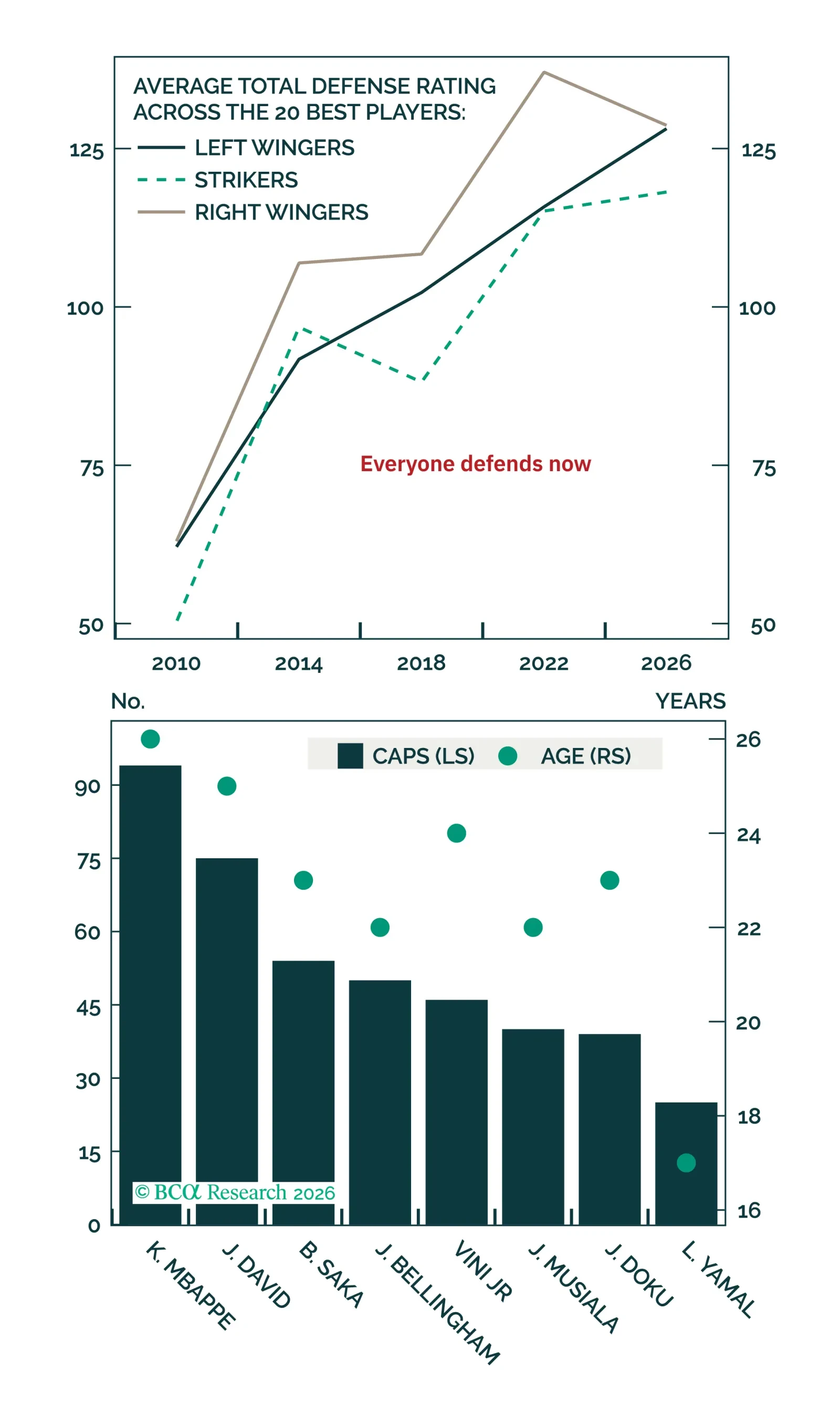
High-intensity pressing has become more common in recent years. This now includes wingers and strikers as well (Chart 15, top panel). Why do you think PSG has managed to win two Champions Leagues titles back-to-back? Because players like Khvicha Kvaratskhelia, Ousmane Dembélé, and Désiré Doué press and defend constantly. Forwards who are in their 30s might be more experienced, but their bodies cannot keep up. The actual experience, captured in games played rather than age, is therefore a better measure. That way, our model does not penalize teams with young forwards who have started playing at the top level very early (Chart 15, bottom panel). As Kylian Mbappé said when he was only 18, “Moi, tu me parles pas d’âge.”12 He obviously knew what he was talking about.
Winner’s Curse Dummy
The Winner’s Curse Dummy is still included even after France proved in 2022 that the curse is not a lock. We had already foreseen in our 2022 report that France had a good chance of breaking the curse. The 2022 squad was bolstered by young talent, while some of the 2018 World Cup winners had left or taken a back seat. This cannot be said about Argentina since the team largely features the same starting 11 now as it did four years ago.
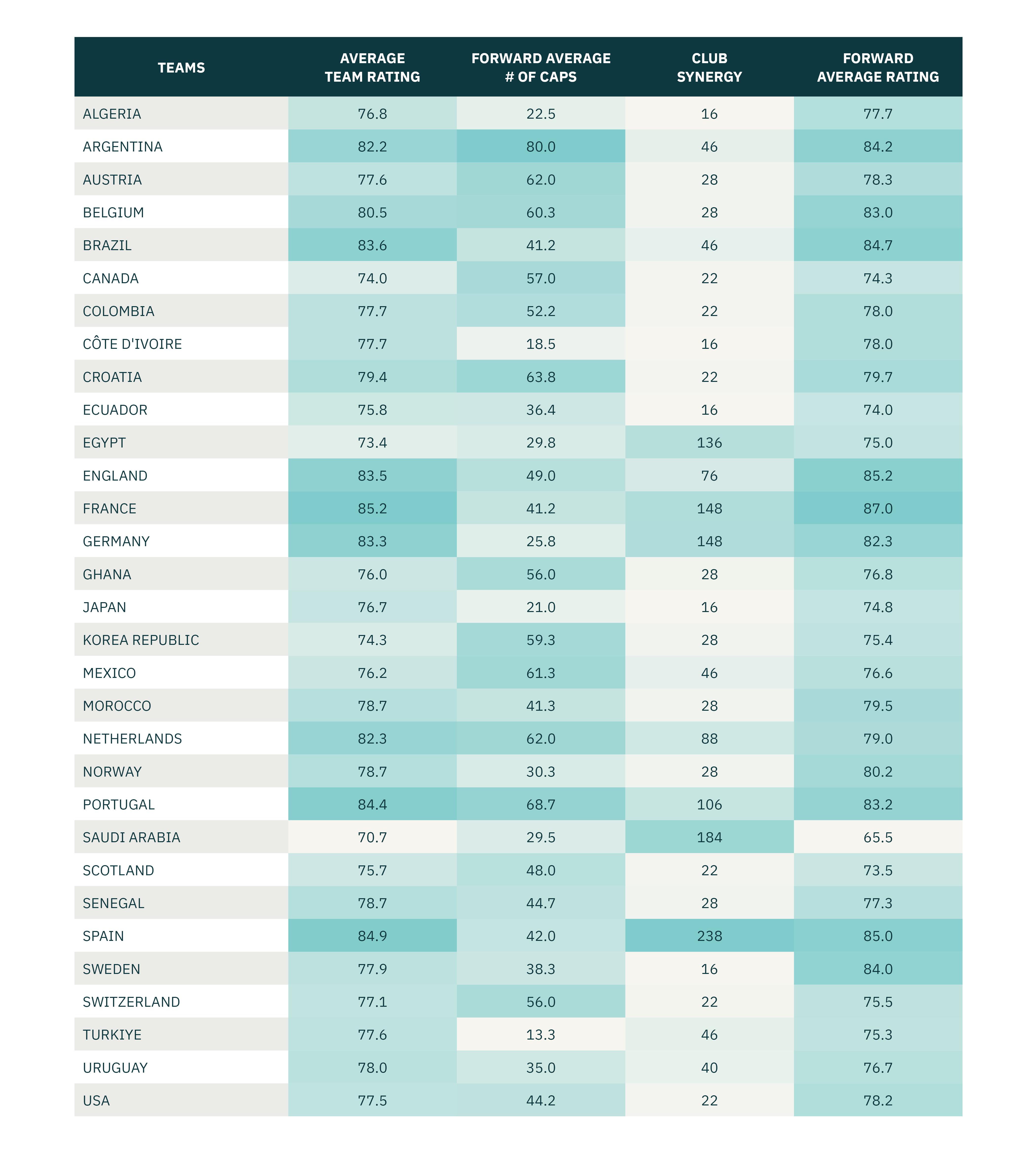
Table 5 summarizes the descriptive statistics for each team, based on the variables used to model their performance.
Knockout Stage: Model Results
The Round of 32
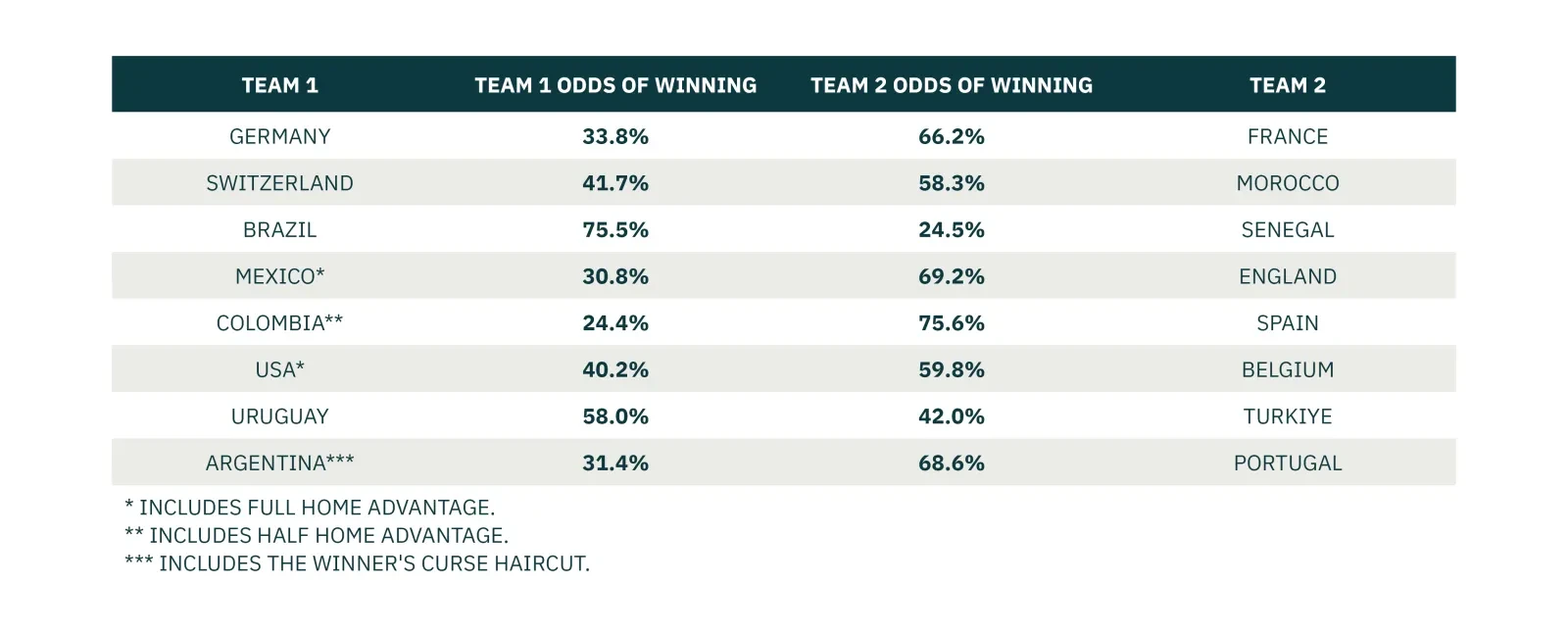
Let’s begin with the hosts. Mexico has the highest odds of advancing to the next stage. With or without the Home Advantage Dummy, El Tri is superior to its opponent, Saudi Arabia. The same is true for Team USA, which actually has a smaller home advantage in this game, as Ecuador also has many local supporters due to its large immigrant population. Team USA advances to the round of 16 just as it did when it hosted the WC in 1994. O Canada. No shame in losing against the defending champion—Canada has managed to not only win a World Cup game for the first time in its history, but also to exit the group stage. Not bad for a 3rd World Cup participation.
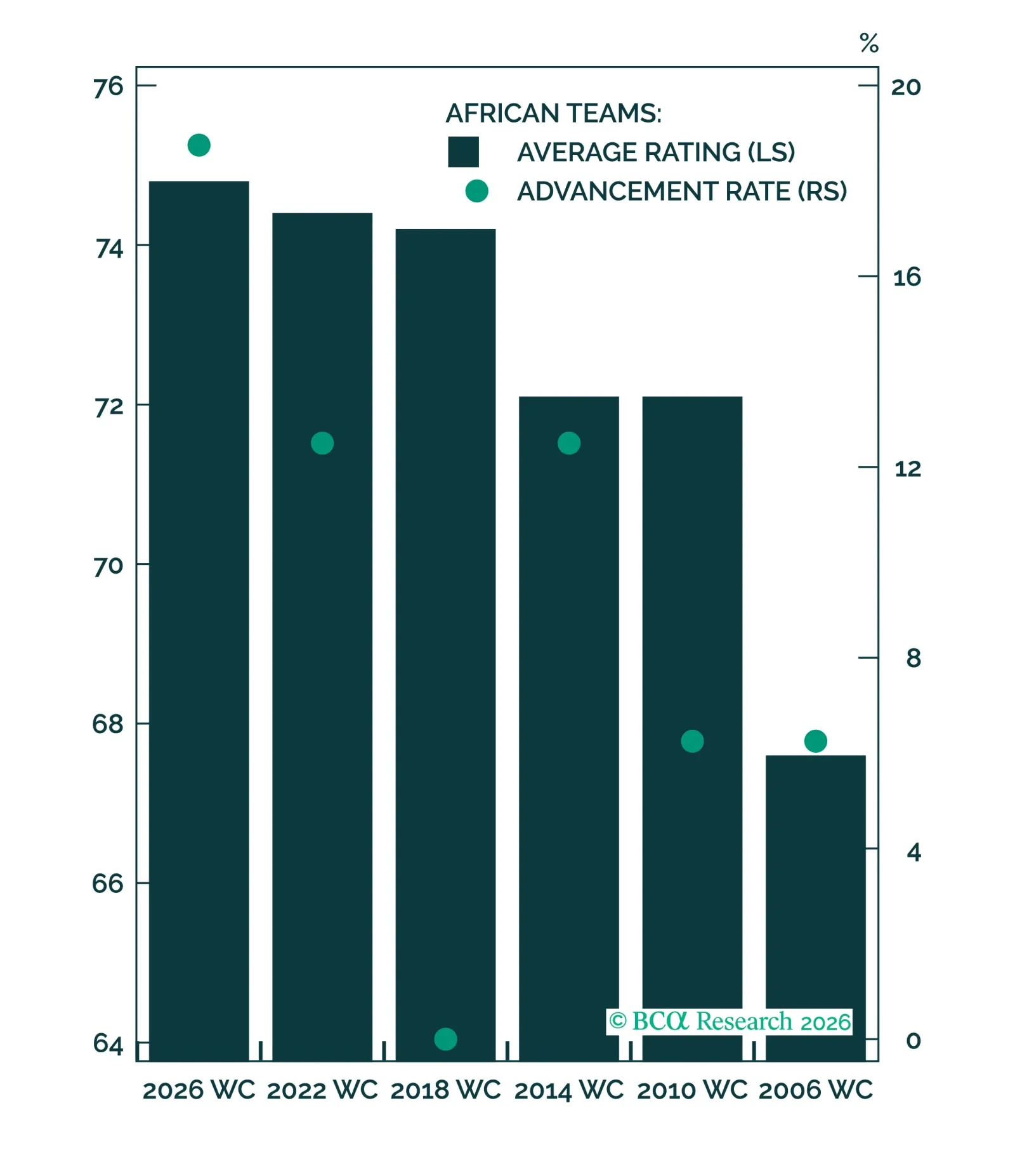
Special mention for the African nations. Six of the ten African teams participating in the World Cup have advanced from the group stage, continuing a trend of improvement over the past five World Cups (Chart 16). Morocco’s fourth-place finish at the last World Cup—the best ever by an African team—is symbolic of the rise of Africa on the global football stage. With Côte d’Ivoire facing Senegal, at least one is ensured to make it to the Round of 16. Our model sees Senegal narrowly advancing with a 59% probability. Morocco is the only other African side to progress to the Round of 16. The Atlas Lions are set to continue where they left off at the last World Cup, beating a solid Japanese team.
For most of the tournament favorites, the Round of 32 should be a formality. Germany and Spain have a probability of advancing above 80%. Meanwhile, Brazil is expected to take care of business against Sweden with a 71% probability of advancing in a replay of the 1958 World Cup final.
Of note, we are looking forward to watching the following three matches:
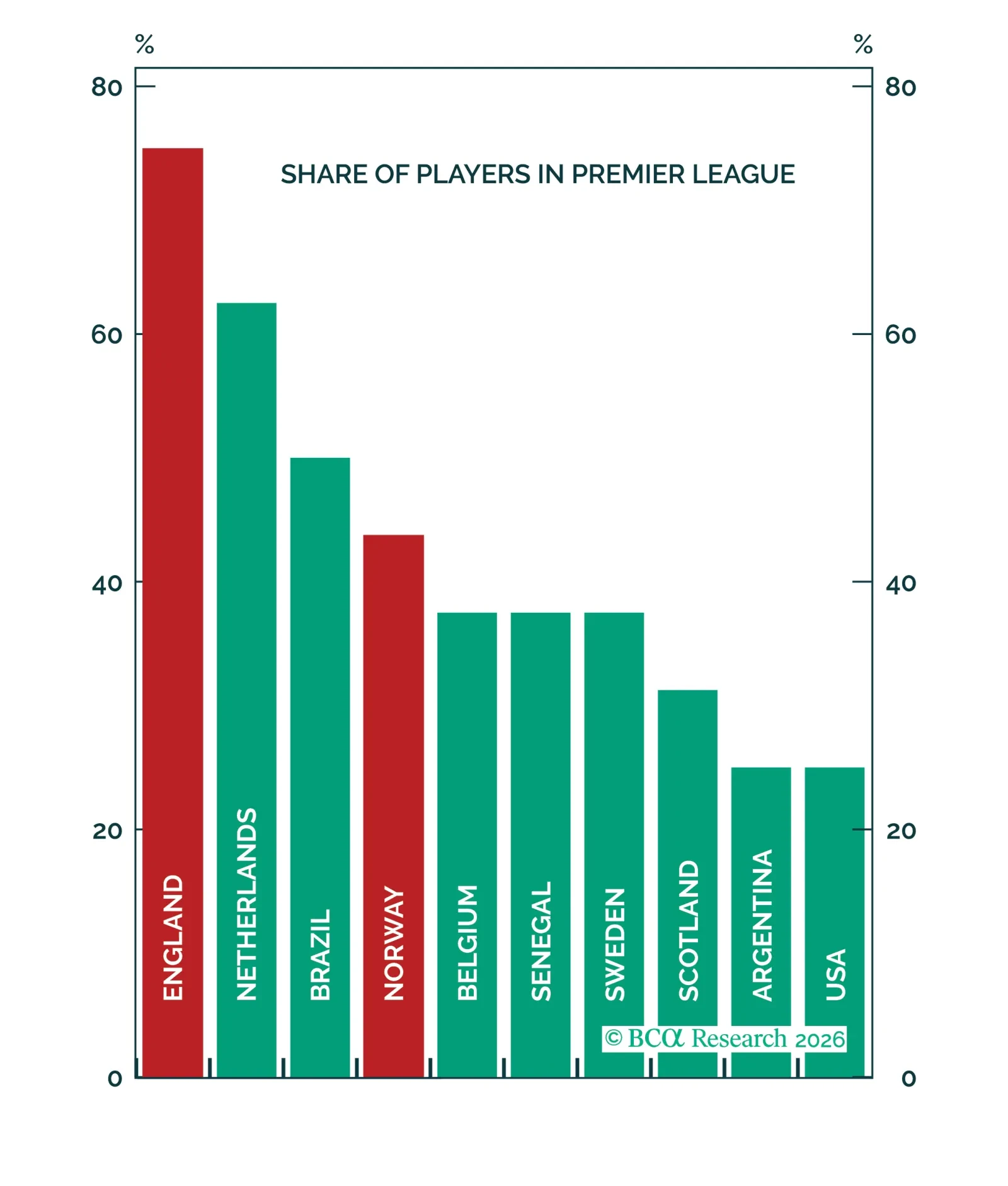
- A Premier League Matchup: Norway’s leaders, Haaland and Odegaard, will meet many familiar Premier League faces against England, including club teammates (Chart 17). However, they do not stand much of a chance against England’s overwhelming odds of advancing at 77%.
- Real Madrid Legends Matchup: CR7 and Luka Modric will face each other as captains of their respective nations. Portugal continues to foster new and exciting talent, which provides the edge over an aging Croatian team.
- The Long-Overdue Matchup: With three appearances in a World Cup final each, the most exciting match in this round is between France and the Netherlands. Despite the storied history of both teams at the World Cup, this game marks the first confrontation in the tournament for these two footballing giants. Outside the World Cup, they have played each other eight times in the past ten years, with France clinching six wins and losing only once in the 2018 Nations League. France will come out on top again.
The Round of 16
The Round of 16 marks the end of the journey for Mexico and the USA, who both fall to stronger European opposition. Mexico’s game against England will be played in the legendary Azteca Stadium, but even that advantage will not be enough to overcome the quality of the Three Lions. Belgium versus the USA will be a repeat of the 2014 round of 16 match that saw Belgium advance only in extra time. US goalkeeper Tim Howard played the game of his life and nearly brought Belgium to despair. Younger Kevin De Bruyne and Romelu Lukaku were the difference-makers for the Red Devils back then. Our model assigns 60% odds of Belgium advancing once again, which is far from certain, so there is hope for Team USA.
A similar fate awaits the Albiceleste, which has low odds of winning against Portugal. The direct matchup between Ronaldo and Messi will be the storyline. In 36 direct matchups, Messi holds the upper hand with 16 wins versus Ronaldo’s 11. Messi has 22 goals in direct matchups, outscoring Ronaldo by only one, but La Pulga has provided 12 assists, compared to Ronaldo's one. While all the attention will be on the clash between the two legends, Portugal is not favored because of Ronaldo. It is the depth and quality of Portugal’s team, by far the best to accompany CR7, that gives them the edge over a (too) mature Argentinian squad.
When Germany meets France, the match features two of the most successful nations in World Cup history. Just like PSG disposed of Bayern Munich in the Champions League semifinals, Les Bleus will get the better of Die Mannschaft. While there is no shame in losing to a strong French side, German fans will be disappointed by another early exit after failing to reach the knockout stage in the past two World Cups.
In the other games, Brazil is set to comfortably beat Senegal just as it did in their friendly last fall in London. Uruguay is the second South American team to advance to the Quarterfinals. However, it will be a close affair, with our model giving La Celeste a 58% chance of making it past Türkiye. The final South American team in the Round of 16, Colombia, faces an overwhelming opponent in Spain. La Roja has a 76% probability of advancing. Finally, Morocco continues its momentum from previous tournaments and moves past Switzerland.
Quarterfinals
France vs. Morocco
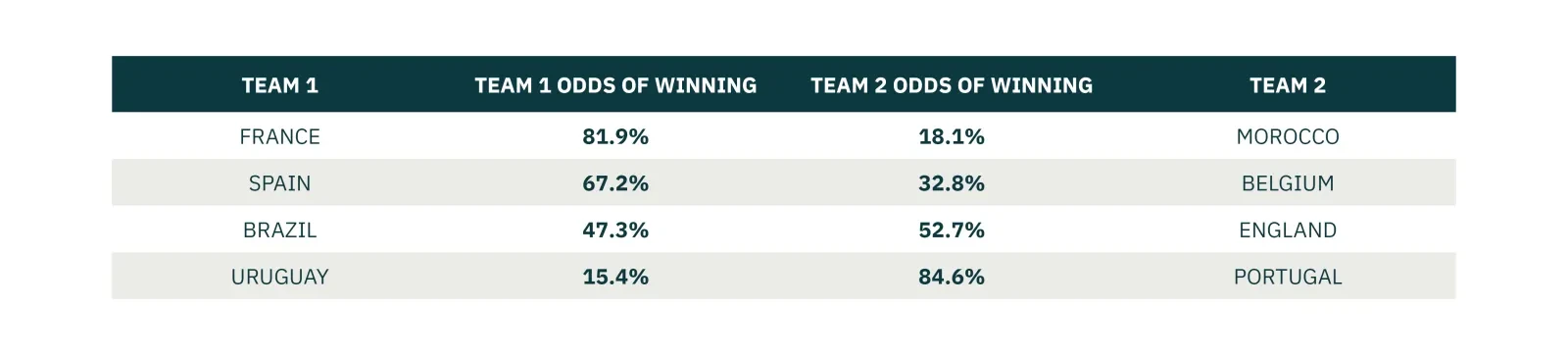
In this rematch of the 2022 semifinal, Morocco once again finds itself up against France, with Morocco’s captain Ashraf Hakimi facing many of his PSG teammates on the pitch. The team led by Didier Deschamps will again prove too strong, with our model giving France an 82% chance of moving ahead.
Spain vs. Belgium
In the 1986 Quarterfinals (in Mexico), Belgium drew Spain 1-1 and won 5-4 on penalties. We see little chance of the Red Devils repeating this outcome. Let’s be honest. Even at its peak—when it reached the semifinals in the 2018 World Cup—Belgium would be unable to beat this Spanish team. We see Spain advancing relatively comfortably with 67% odds.
Brazil vs. England
The two sides are meeting for the fifth time in the World Cup, and England has never won. However, England has recently shown strong tournament performances, reaching the final in the last two Euros and losing in the Quarterfinals to France in a tight match at the 2022 World Cup. In contrast, while there is still some star power in Neymar and Vini Jr., the Seleção looks rather pale compared to the team that got the better of England in the 2002 quarterfinals, led by Ronaldo (R9) and Ronaldinho. In a very tight match, our model predicts that Thomas Tuchel’s side will make it past Ancelotti’s Brazil with a 53% probability.
Uruguay vs. Portugal
This will be the third consecutive time that the two sides meet in a World Cup. In 2018, Uruguay beat Portugal 2-1 in the Round of 16; in 2022, they played in the Group Stage. This time, Portugal is set to advance with 85% odds - the highest odds out of all Quarterfinal matches.
Semifinals
The World Cup will return to Europe, given that the semifinals will be 100% European. This outcome has become more frequent, also occurring in the 2006 World Cup in Germany and, more recently, in the 2018 World Cup in Russia. It is worth noting that Argentina was the first non-European team to win the World Cup in over 20 years. The dominance of European football lives on.
France vs. Spain
The two teams favored by betting markets are meeting in the semifinal. Spain is looking to reassert its dominance in world football as it did in the early 2010s (Euro 2008, World Cup 2010, Euro 2012) after winning the 2024 Euros. Meanwhile, France is looking to make a third consecutive World Cup final. A feat only achieved by Germany (1982-1990) and Brazil (1994-2002).
In a head-to-head comparison, Spain leads with 18 overall victories in 36 games, but France has more wins in competitive games. The latest match between the two sides ended in a 5-4 win for Spain. Both teams feature excellent squads, but when it's all said and done, France wins with a razor thin 52.5% probability. It is France’s forward rating that narrowly puts it over the top, so do not be surprised if this game features many goals and goes to extra time.
England vs. Portugal
The second game features two illustrious European sides that have not had much success in past World Cups. England has only won the Cup once – at home in Wembley and with the help of a ghost goal – while Portugal has never reached the final. This game is expected to be a coin toss, with Portugal slightly favored. Our model predicts that Portugal will finally break through, giving them a 55.2% chance of advancing. Once again, England goes far but cannot quite make it. Interestingly, in the initial run of our model, England would have reached the final but lost to France. Updating the squad according to Tuchel’s nominations, which meant taking out Palmer, Foden, and Maguire, the model swung in Portugal’s favor.

The Final
BCA's Two-Step World Cup model predicts that, on July 19th, 2026, the world will watch a final between France and Portugal (Diagram 1).
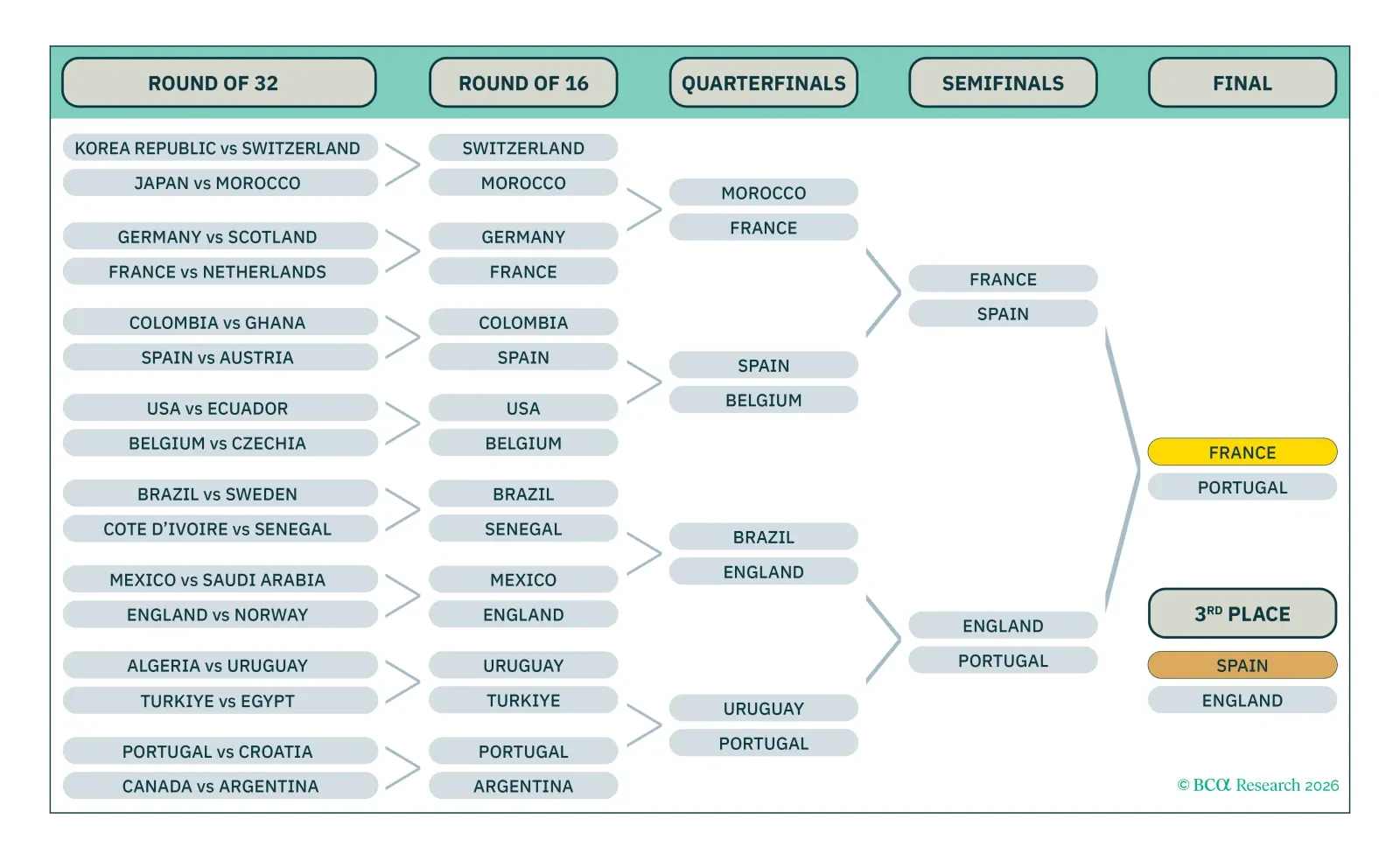
This final carries special significance for both nations. For France, victory would allow Didier Deschamps to leave on the highest possible note. Already one of the most successful managers in international football history, he would become only the second coach ever to win two World Cups, joining Italy's Vittorio Pozzo. More remarkably, Deschamps would stand alone as the only individual to boast one World Cup as a player and two as a manager.
For Portugal, the stakes are equally historic. A victory would make them the 9th nation to join the exclusive club of World Cup winners. This is also, at least in theory, Cristiano Ronaldo's final opportunity to complete the one remaining gap in his extraordinary résumé and emulate his greatest rival, Lionel Messi. The two are universally acknowledged as part of the Mount Rushmore of Football, alongside Pelé and Diego Maradona. A World Cup title now separates the two.
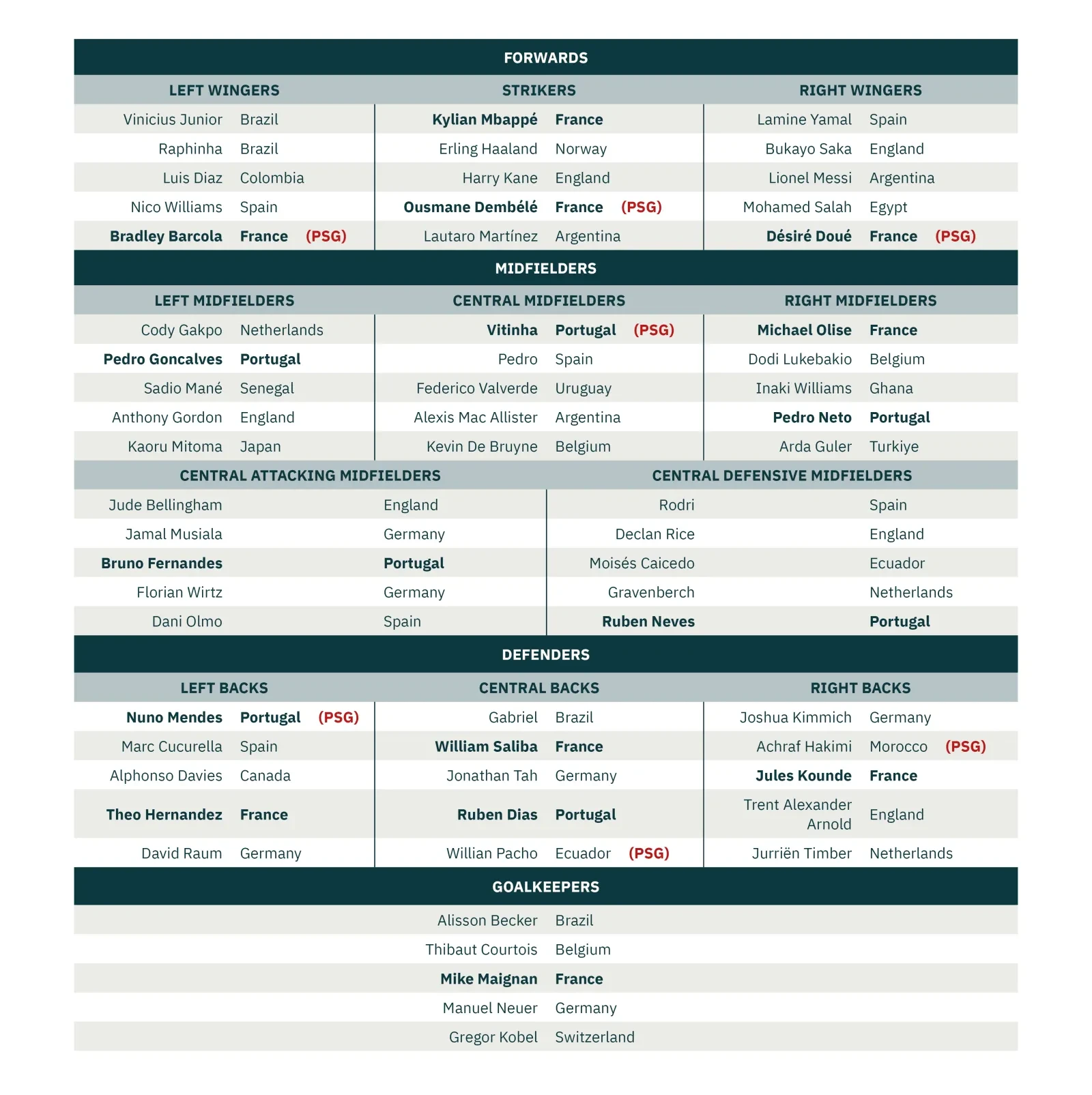
This final will also have special significance for many players on both sides of the pitch. For those who were delayed in joining their squads in June, they had a good reason: To play and win the UEFA Champions League in Budapest. We are talking about the Paris Saint-Germain players who are overrepresented in the French and Portuguese national teams and have a unique opportunity to win a World Cup too—a feat achieved by only four players since the Champions League era began (1992–93).13 Three Portuguese and two French players were in PSG’s starting eleven, plus one substitute on each side. In other words, the core of the Portuguese and French from France and Portugal is drawn from the strongest club side in Europe over the past two years (Table 6).
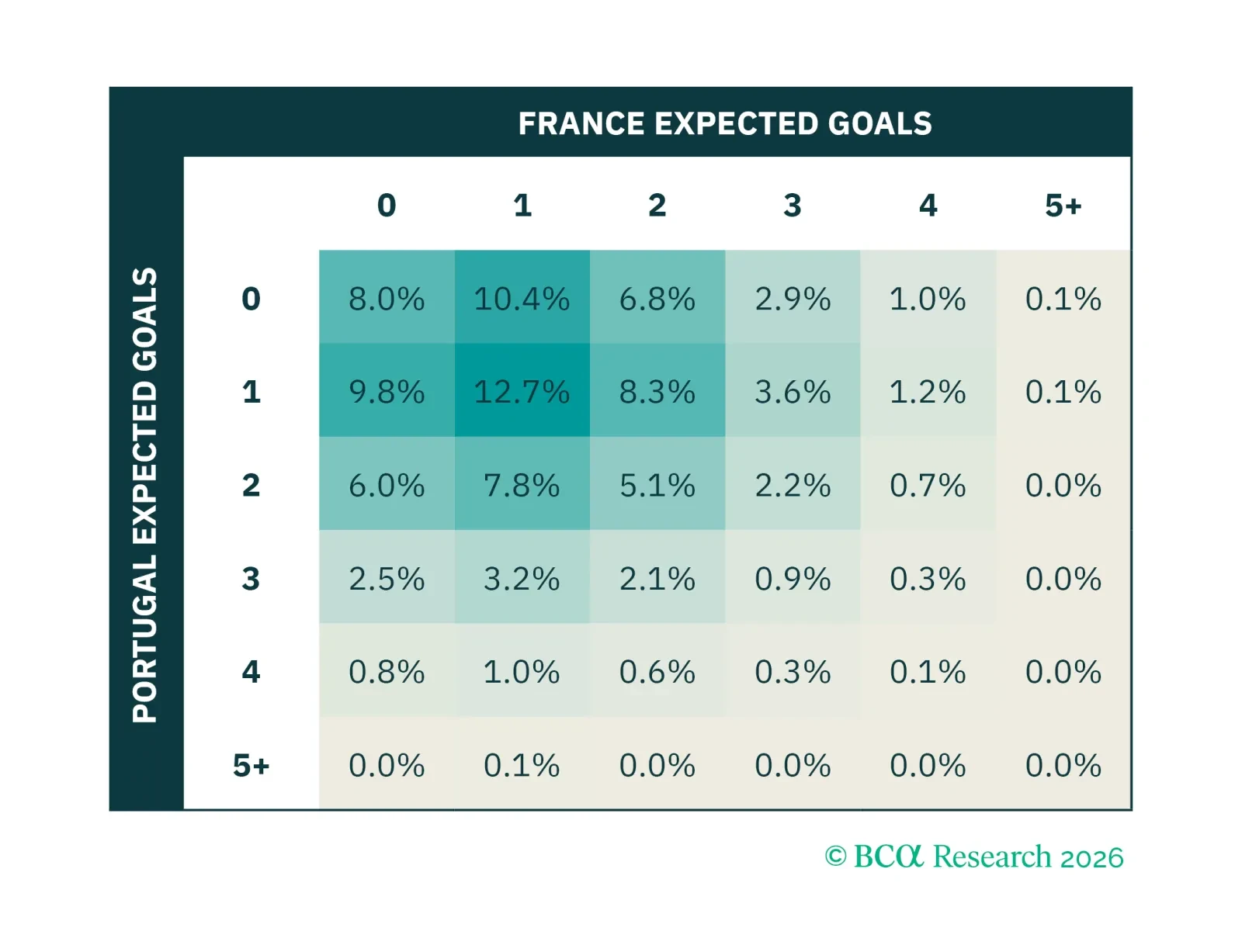
The two footballing nations also share history. This final is a replay of the 2016 Euro Cup final. Anyone in France or in Portugal can likely tell you who scored the only goal of the match: Éder14, who scored what remains to this day the most important goal in Portuguese football history. You know who else shares history? Portugal’s manager—Roberto Martinez. The last time his path crossed Les Bleus’ in a World Cup, it did not go well for him. In 2018, Roberto Martinez was in charge of the Belgian golden generation, who lost 1-0 to France in the semifinals.
After much deliberation, we believe that when all is said and done, Les Bleus will be the ones to lift the 2026 FIFA World Cup at MetLife Stadium. In a game with a high probability of a penalty shoot-out (Chart 18), France has the historical advantage in both experience and success rate.
II. Football And Macro
Football does not escape the laws of revenue. As much as we enjoy the Beautiful Game for the respite it offers from volatile markets and balance sheets, football remains at the mercy of revenues. In this section, we look at some of the latest avenues of growth for the football industry.
Can The MLS Become A Major League?
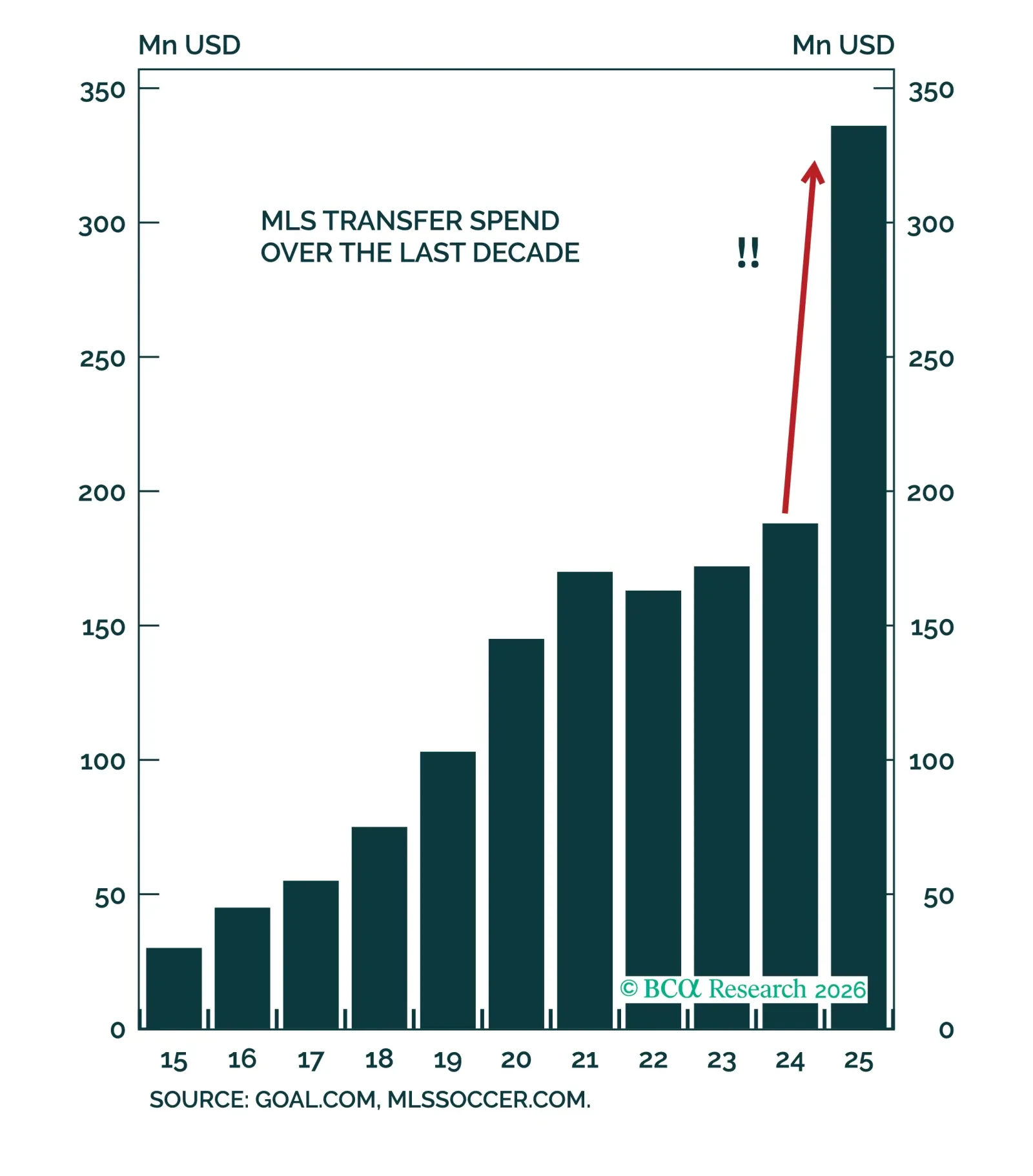
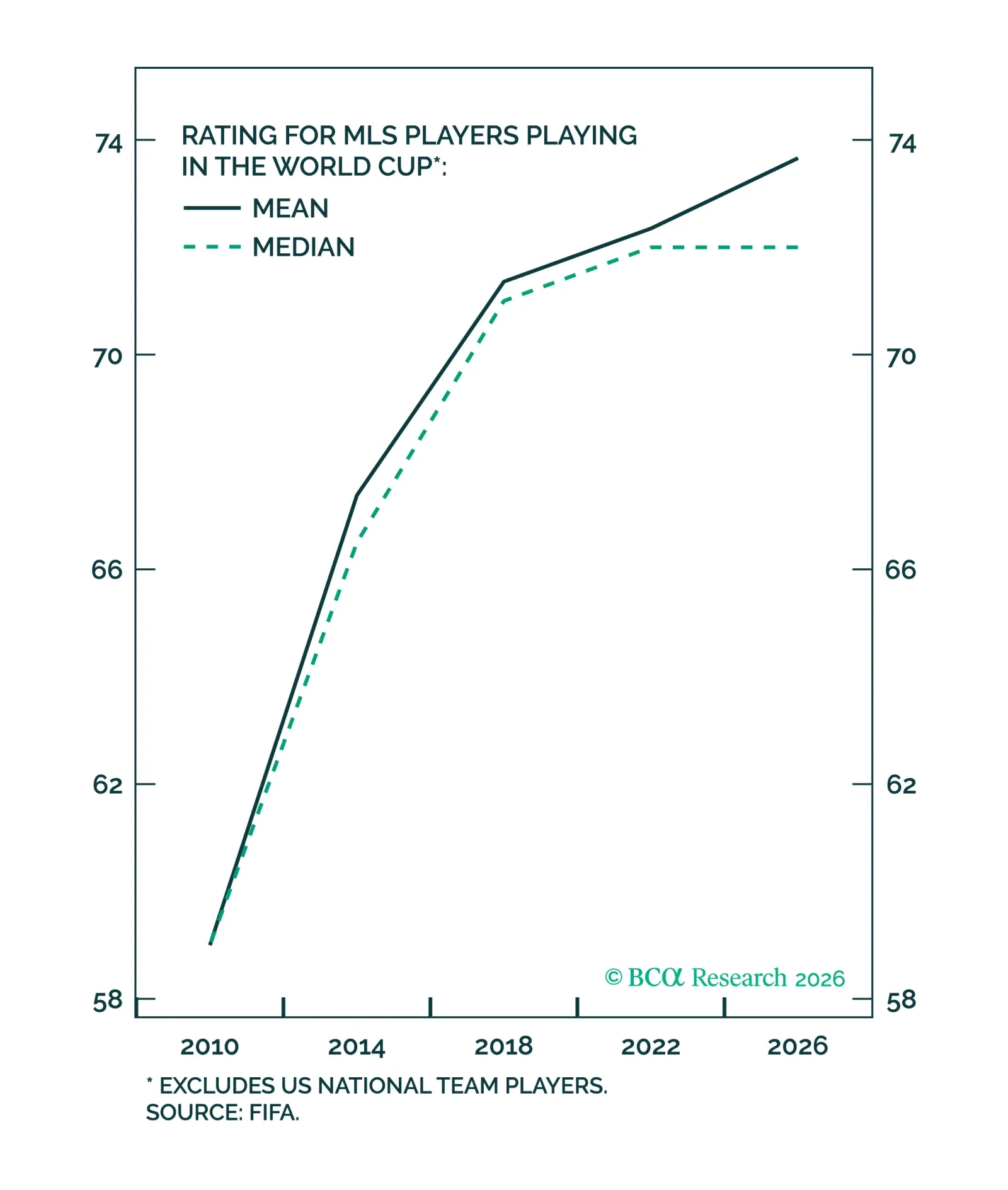
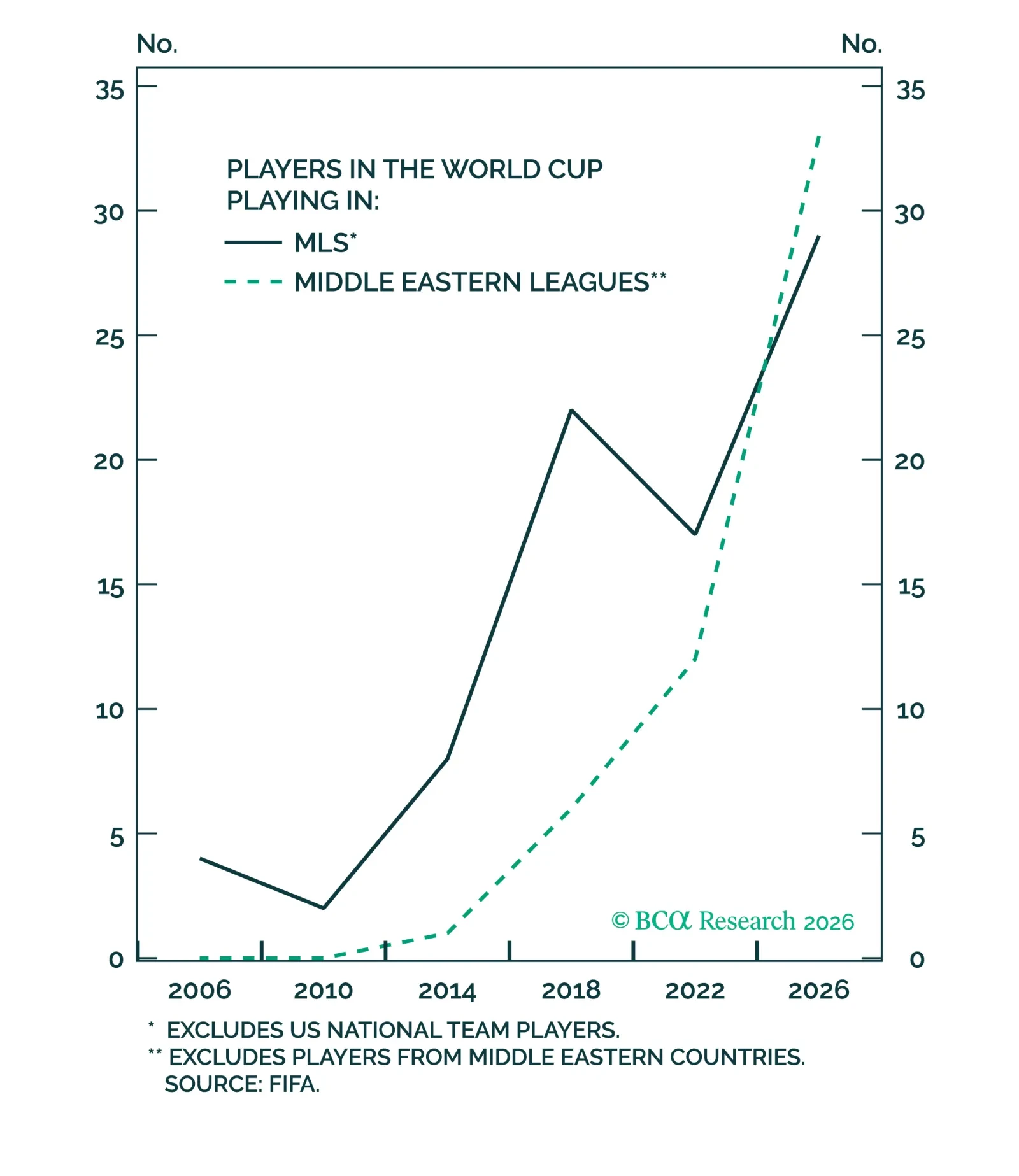
Major League Soccer wants to reach the major leagues. Last year, league-wide spending on transfers skyrocketed by almost 80%, reaching a grand total of $336 million (Chart 19). This spending spree is translating into player quality. Our player dataset shows not only that the number of players in World Cup squads playing in the MLS has increased, but that their quality has also improved (Chart 20).
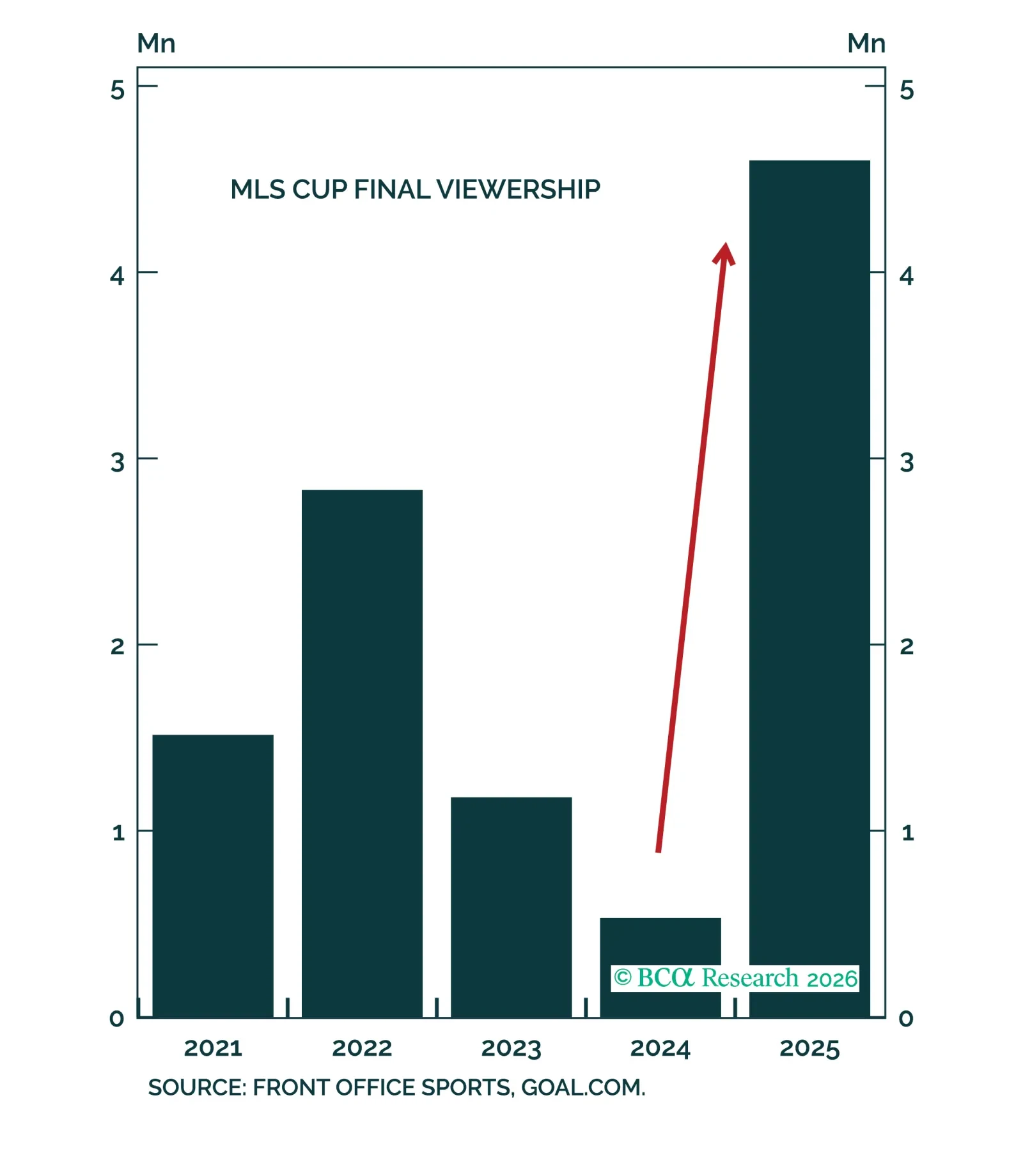
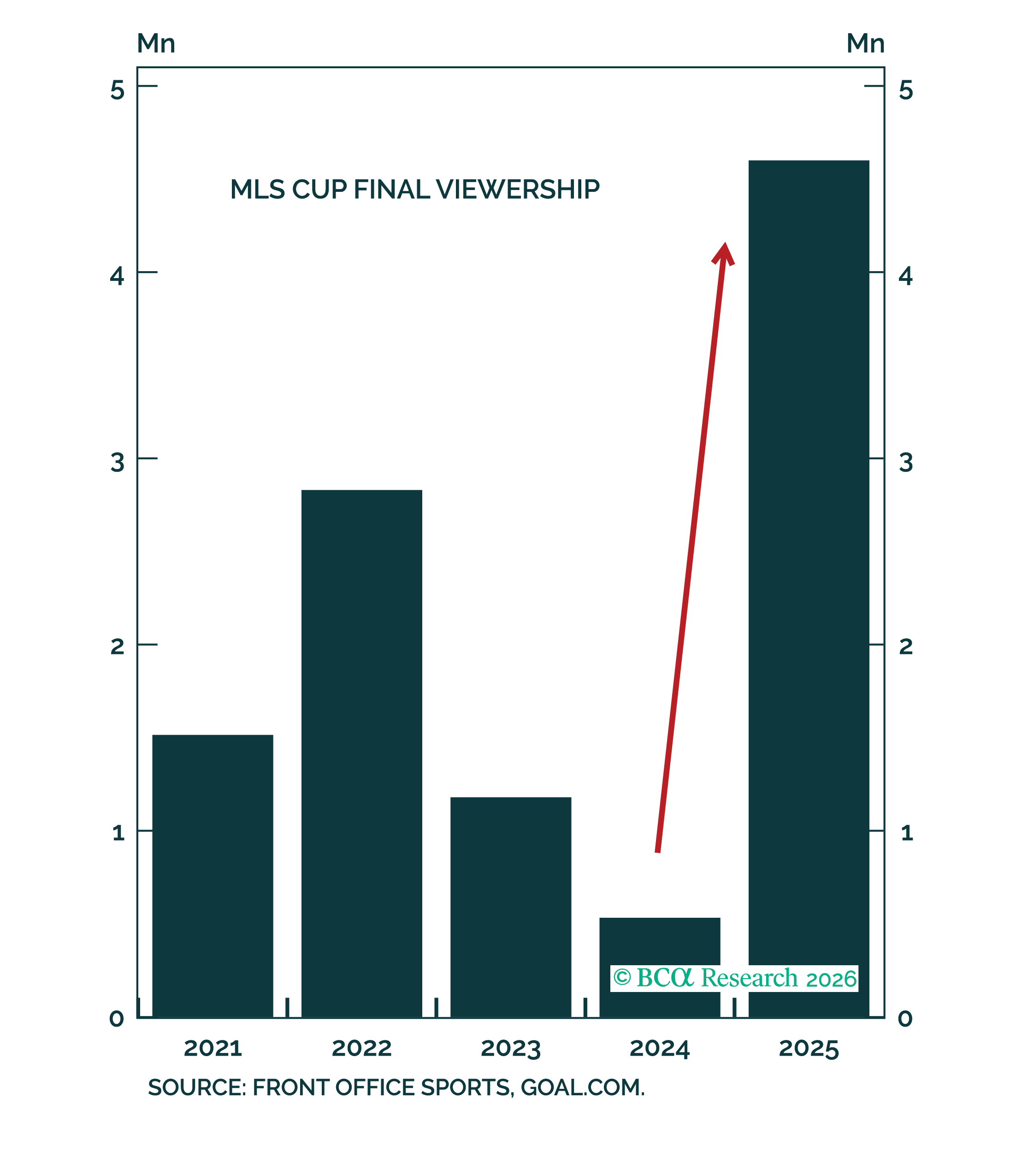
Amongst all these signings, none has been more pivotal to the popularity of the league than Lionel Messi. The greatest man to ever kick a football has not only set the league on fire with his scoring and playmaking but has also brought about commercial success. Since his signing, Inter Miami's operating income has increased from $8 million to $50 million in two years. His impact has spread beyond his club. The 2025 MLS Cup final, where Inter Miami beat the Vancouver Whitecaps, was the highest-rated in history, with viewership over 100% higher than the 2022 Cup—the previous record holder (Chart 21).
Beyond Messi, there are structural reasons that point to a bright future for the Beautiful Game in America. According to a poll by The Economist, football has recently surpassed baseball as the third-most-popular sport in the country, trailing only Basketball and American Football. Crucially, most gains in popularity have occurred amongst younger cohorts. According to a YouGov poll, the share of Americans aged 18-34 who actively watch and follow football has increased from 14% right after the 2022 World Cup to 22% currently.
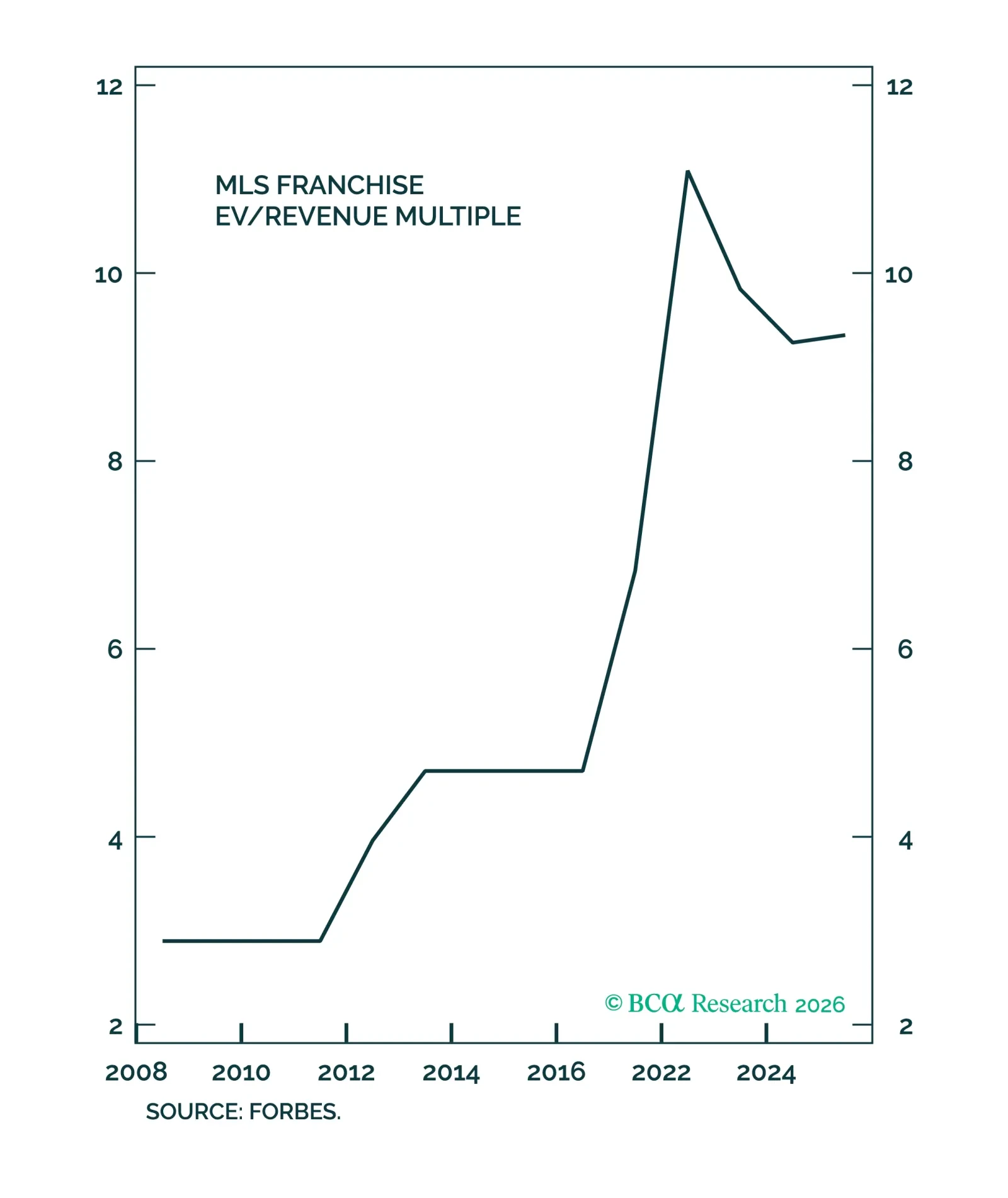
There is no doubt that some obstacles need to be overcome. The positive structural story is known by market participants, with EV-to-revenue multiples more than doubling over the past 10 years (Chart 22). The league will need to show that it can translate all this potential into dollars. It is also facing stiffer competition from other emerging leagues, such as those in the Middle East, which can outspend the MLS on wages. This spending advantage is evident in the number of players in World Cup squads. The number of foreigners from Middle Eastern leagues in the World Cup is now higher than the number from the MLS for the first time ever (Chart 23).
As a result, this World Cup will be pivotal to the league's future. For all the challenges it faces, capturing even a fraction of the American sports market—by far the biggest and most profitable in the world—would be transformative. The NFL generates more revenue than every European football league combined. If the MLS can use this World Cup to turn a new generation of new fans into lifelong ones, the question will no longer be whether the MLS can be a major league in world football, but when.
What’s Next for the Saudi Pro League? The Chinese Not-so-Silky Road or the American Dream?
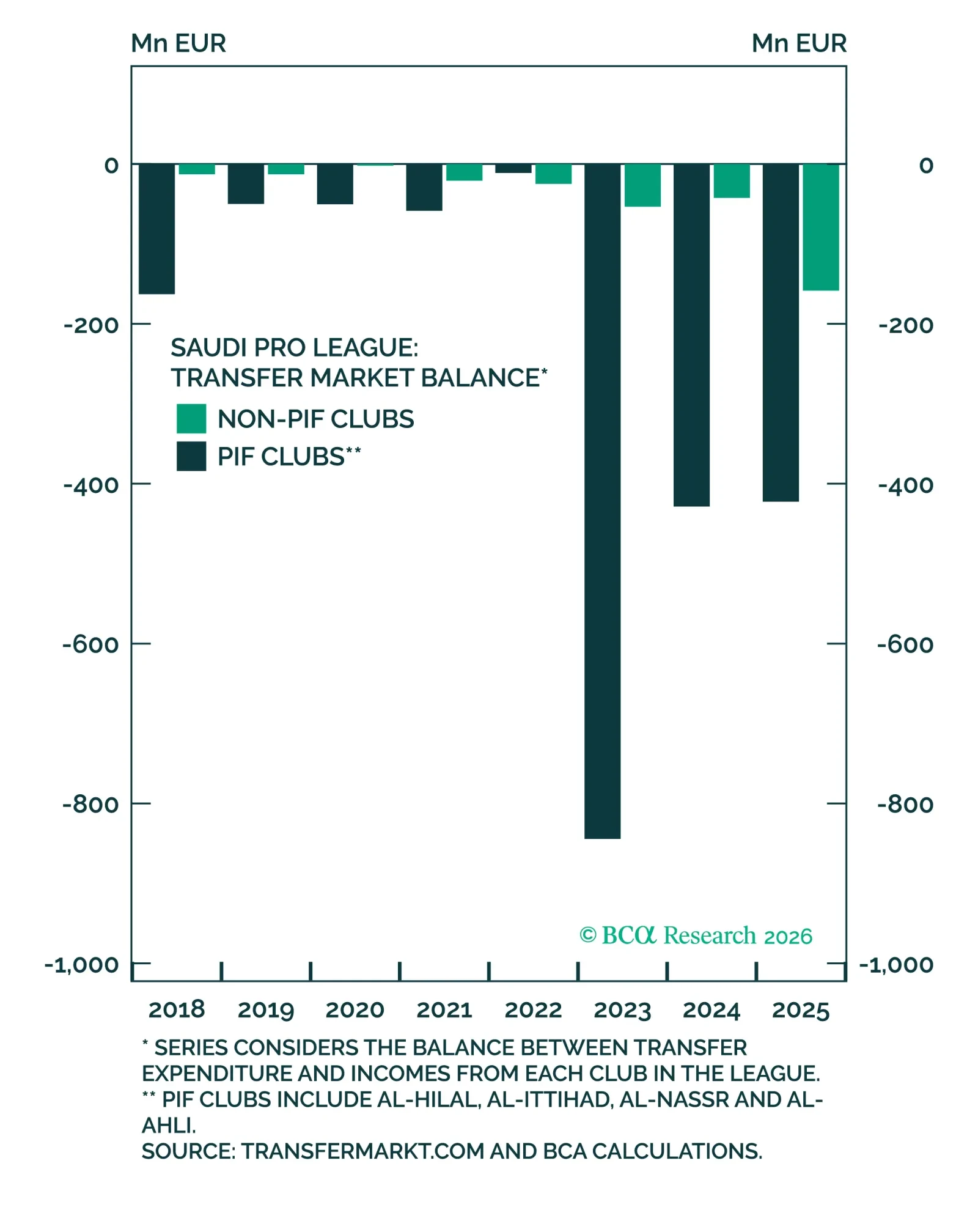
January 1, 2023—Cristiano Ronaldo officially joins the Saudi Arabian club Al-Nassr. On that day, Saudi Arabia did not just buy a player; it bought attention and placed the Saudi Pro League (SPL) on the map for football fans. His signing was the first of many. Neymar, Karim Benzema, N’Golo Kanté, Sadio Mané, Riyad Mahrez, João Cancelo. They all succumbed to the petrodollars appeal of the SPL, whose transfer balance turned deeply negative (Chart 24).
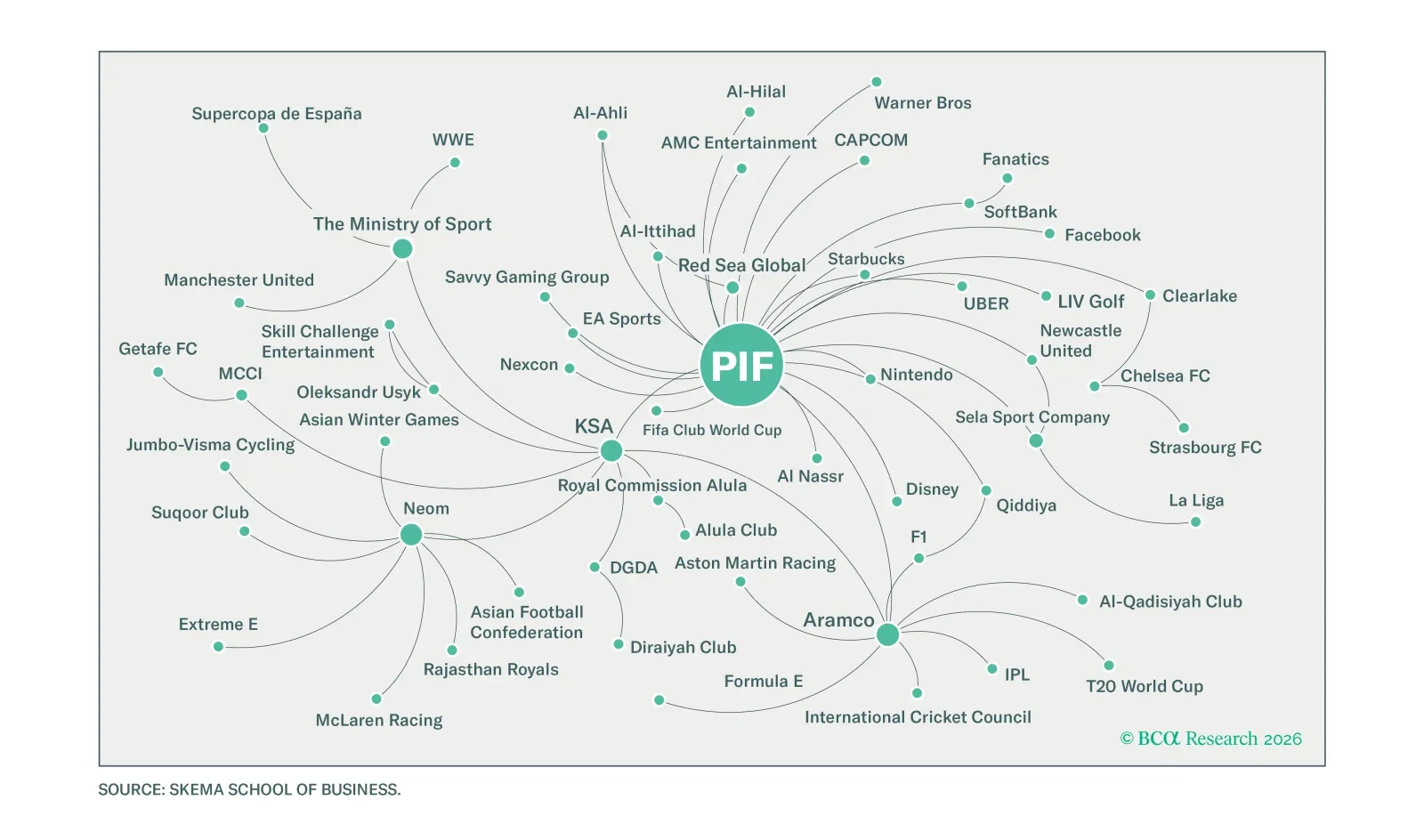
Behind this spending spree lies the Kingdom’s sovereign wealth fund: the Public Investment Fund (PIF), which took a 75% stake in the country’s four biggest clubs in 2023. Football sits inside Vision 2030, which is Saudi Arabia’s broader strategy to diversify the economy, expand tourism and entertainment, create jobs, build event-hosting capacity, and strengthen global influence (Diagram 2). Being awarded the hosting rights to the 2034 FIFA World Cup marks its culmination.
The war in Iran also put Saudi Arabia on the map, but not for the right reasons. Importantly, it is a reminder that the Saudi Pro League growth story embeds a geopolitical risk premium. Regional tensions could force Saudi Arabia to redirect fiscal resources or slow sports investment, as it is doing with LIV Golf. Player retention is another risk. It may become difficult to attract foreign talent, let alone retain existing ones. Players such as Neymar, N’Golo Kanté, or Roberto Firmino have already left the Saudi Pro League. What happens when Cristiano Ronaldo and Karim Benzema decide to retire for good? Fans follow them on social media, not the league itself.
This will have negative implications for broadcasting revenue. Today, live matches and highlights are available in more than 180 markets, and the SPL has partnered with major broadcasters such as DAZN, ESPN, and Fox Sports. Broadcasting revenue has reportedly tripled since 2023, when the SPL’s media profile was broadly comparable to that of mid-sized European leagues such as the Dutch Eredivisie and the Belgian Pro League.
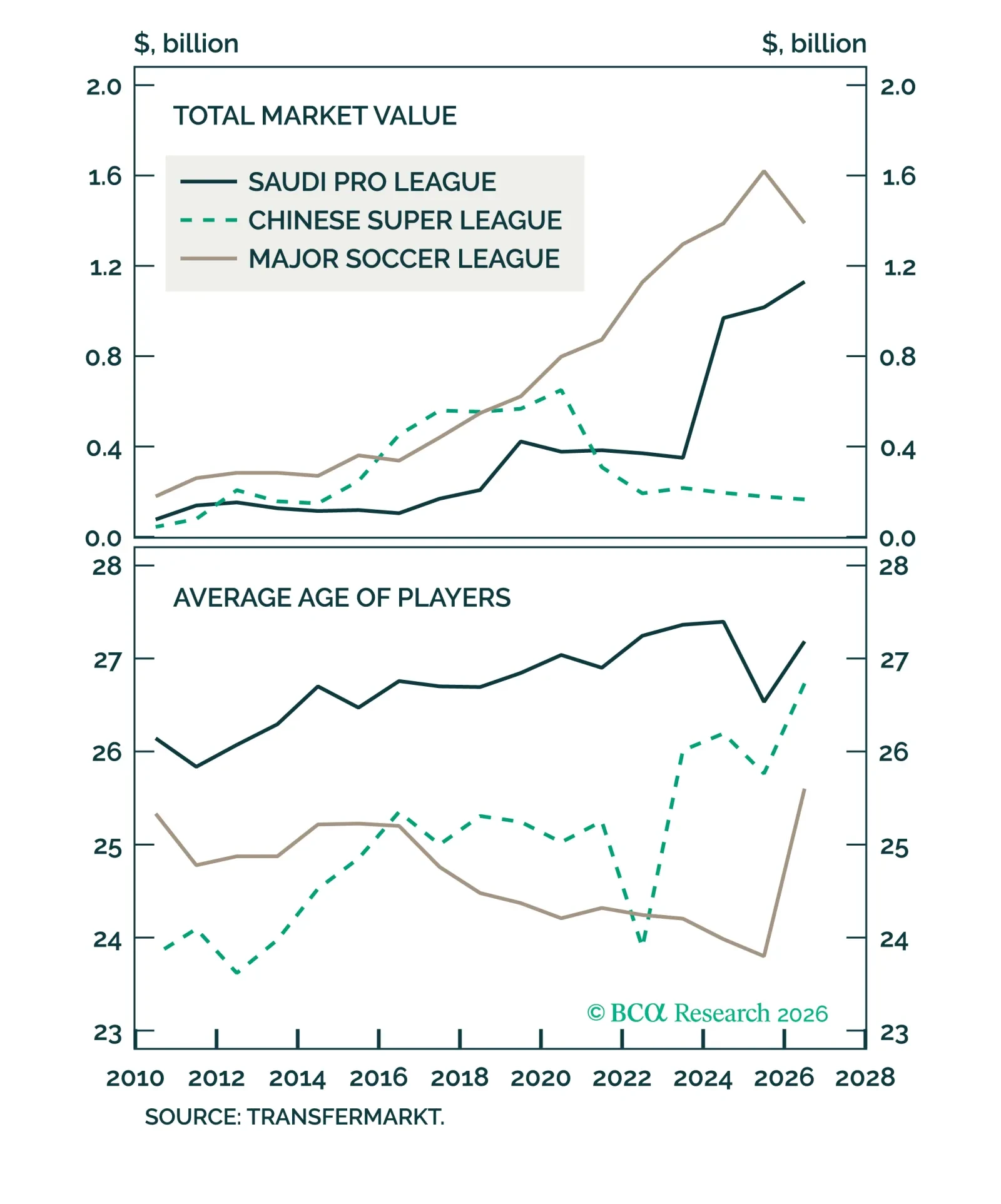
The Saudi Pro League At A Crossroads
The story of an emerging league signing aging big names is nothing new. The US Major League Soccer (MLS) and the Chinese Super League (CSL) did it, with different outcomes (Chart 25).
In the mid-2010s, large conglomerates, mainly real estate-linked, responded to Xi Jinping’s ambition to turn football into a national project by pouring money into football clubs. Like the SPL today, Chinese clubs attracted foreign stars with ridiculously high salaries and invested in academies. For a couple of seasons, the CSL looked like football’s next frontier. Then the music stopped. Financial regulations tightened, foreign player salaries were capped, and property developers came under pressure from the Chinese real estate bubble. The Guangzhou FC (formerly Guangzhou Evergrande) and the Jiangsu FC, two of Asia’s powerhouses, went into oblivion.
The story of the MLS is one of gradual discipline. While star signings drew attention over the years (David Beckham in 2007, Thierry Henry in 2010, Zlatan Ibrahimovic in 2018, and Lionel Messi in 2023), salary controls, roster rules, academy investment, homegrown-player pathways, stadium development, and younger-player mechanisms built a strong foundation for the league. From the beginning, the ambition has been to rival the best leagues in the world.
Bottom Line: Saudi Arabia has changed the map of football’s transfer market. The Saudi Pro League has attracted global stars, lifted its market value, improved its broadcast profile, and positioned itself at the center of the 2034 World Cup. It now stands at a crossroads: if it keeps signing retiring stars without building recurring revenues, credible governance, and developing youth talent, it risks following the same fate as the Chinese Super League. If, instead, it uses state capital as seed funding and gradually builds MLS-style discipline and monetization, the league could become something more durable: not Europe’s replacement, but football’s first sovereign-backed growth league.
The Real Growth Story in Football: Women’s Football
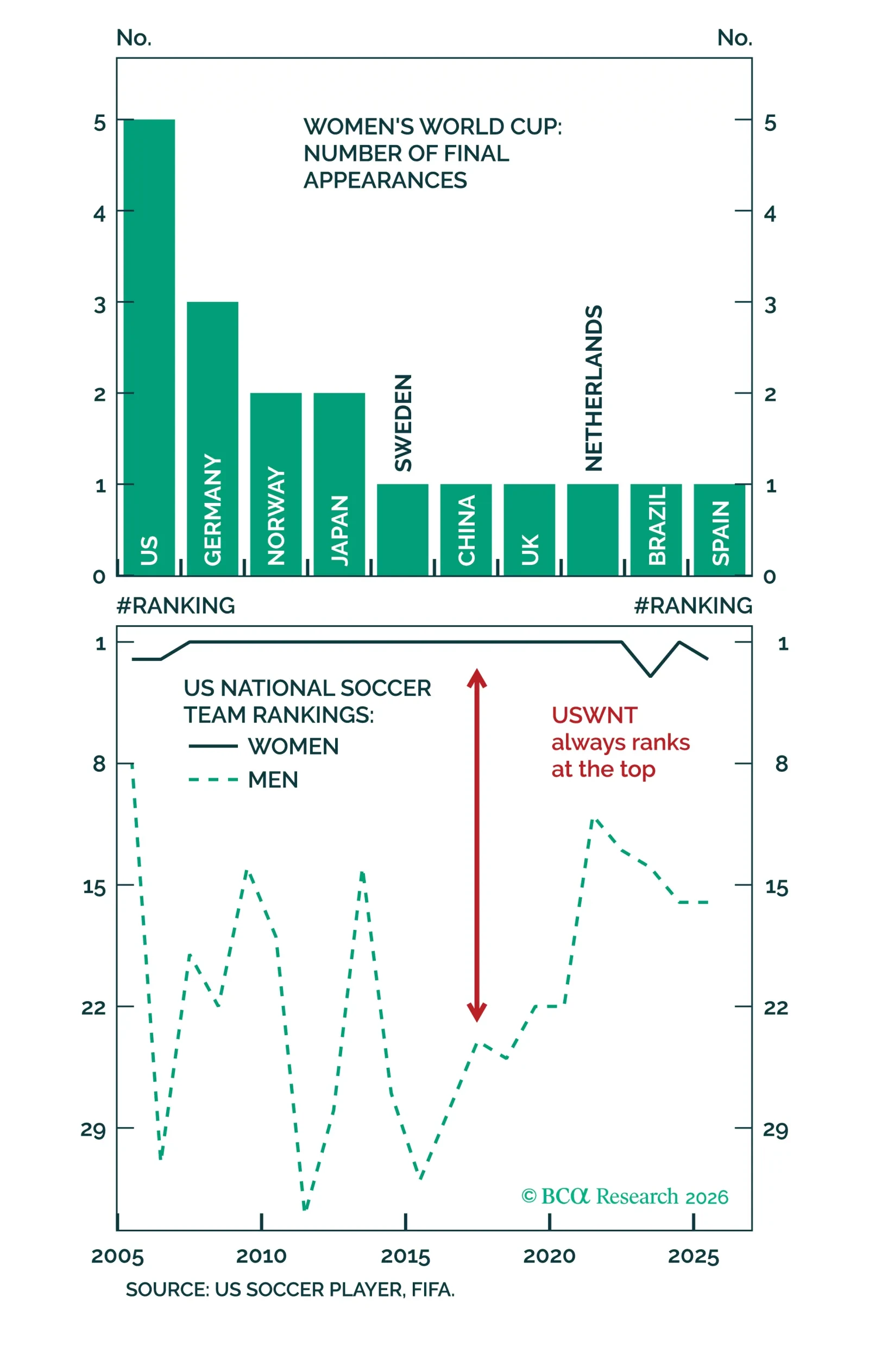
For the next few weeks, the spotlight will be on the US men’s national team. Yet, when it comes to international success, the real powerhouse remains the women’s team.
Since the inaugural Women’s World Cup in 1991, the US women’s national team has set the global standard, consistently ranking among the world’s elite and winning more major trophies than any other nation (Chart 26). The contrast with the men’s team is striking. While a Round of 16 appearance would be celebrated as a successful tournament for the men, the same result would likely be viewed as a disappointment for the women.
The more important story, however, is not sporting dominance but growth. Women's football is rapidly emerging as one of the most attractive investment opportunities in global sports. While the average MLS franchise value increased by 39% between 2021 and 2026, reaching $767 million, the NWSL franchise valuations surged by 179% in just two years. The NWSL’s revenue multiple of 9.8x now exceeds MLS’s 9.2x, suggesting that investors see greater long-term growth potential in women’s football than in the men’s game.
This optimism is supported by underlying business fundamentals. Between 2015 and 2019, US women’s national team matches generated more total revenue than those of the men’s team, according to audited US Soccer Federation financial reports. Angel City FC, currently the most valuable club in the NWSL, generates more revenue than any other women’s football club globally. Yet even here, the center of gravity may be shifting. European women’s leagues are now growing faster than their North American counterparts (Chart 27), reflecting the increasing investment by major European clubs and broadcasters.
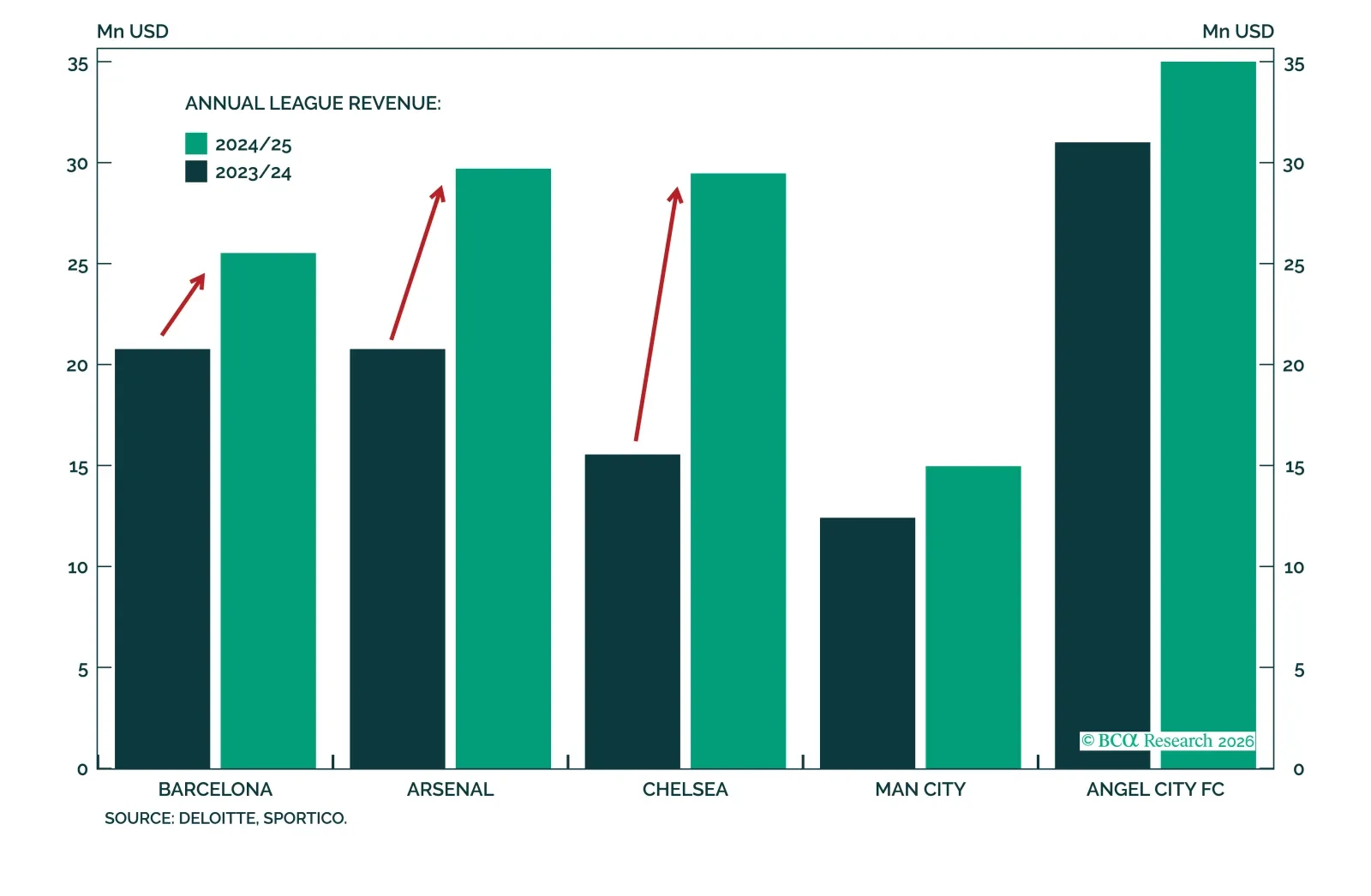
That growth is also making the sport more competitive. The United States’ disappointing exit at the 2023 Women’s World Cup was not merely an upset; it was evidence that the rest of the world is catching up. As investment, infrastructure, and talent development improve globally, the competitive gap that once separated the US from the field is narrowing.
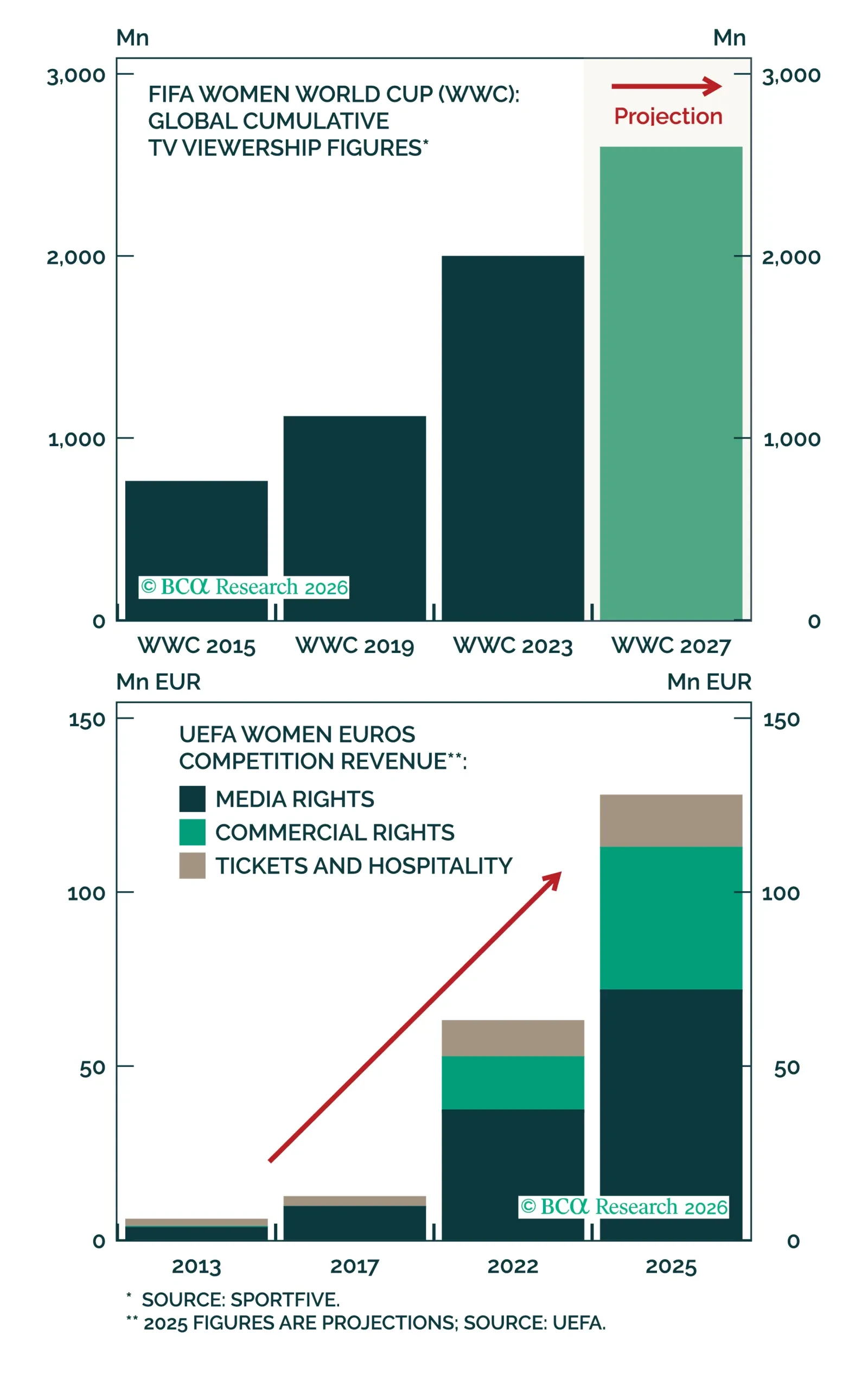
The audience opportunity remains enormous. Global television viewership for the Women’s World Cup has tripled in less than a decade and is expected to rise by another 30% at the 2027 edition (Chart 28, top panel). FIFA is targeting $1 billion in revenue from the Women’s World Cup, nearly double the $570 million generated in 2023. Europe tells a similar story. Media rights revenues have surged from less than €4 million in 2013 to nearly €70 million today, while commercial sponsorship has become an increasingly important source of revenue (Chart 28, bottom panel).
Yet women’s football remains far from fully monetized. Only 17% of women’s football revenue comes from broadcasting, compared with 38% in the men’s game. Most clubs still lack dedicated women ’s-only sponsors, and only a minority have independent kit sponsorship agreements. In other words, the sport is growing rapidly despite revenue streams that remain significantly underdeveloped.
Bottom Line: If you are looking for the fastest-growing segment in football, do not focus on MLS or the Saudi Pro League. The most compelling growth story is women’s football. The United States remains the sport’s benchmark on the field, but the biggest opportunity lies in the continued commercialization of the women’s game—both in North America and increasingly in Europe.
Taking A Closer Look At The World Cup Premium
World Cups provide players with a unique opportunity to showcase in front of every scout and sporting director in global football. Players who stand out during the event tend to see their market value skyrocket—a phenomenon we define as the World Cup Premium.
The top goal contributors (goals and assists) inevitably end up in the spotlight. We include the top 10 goal contributors from the past five World Cups, yielding a sample of 52 observations (from 44 players).
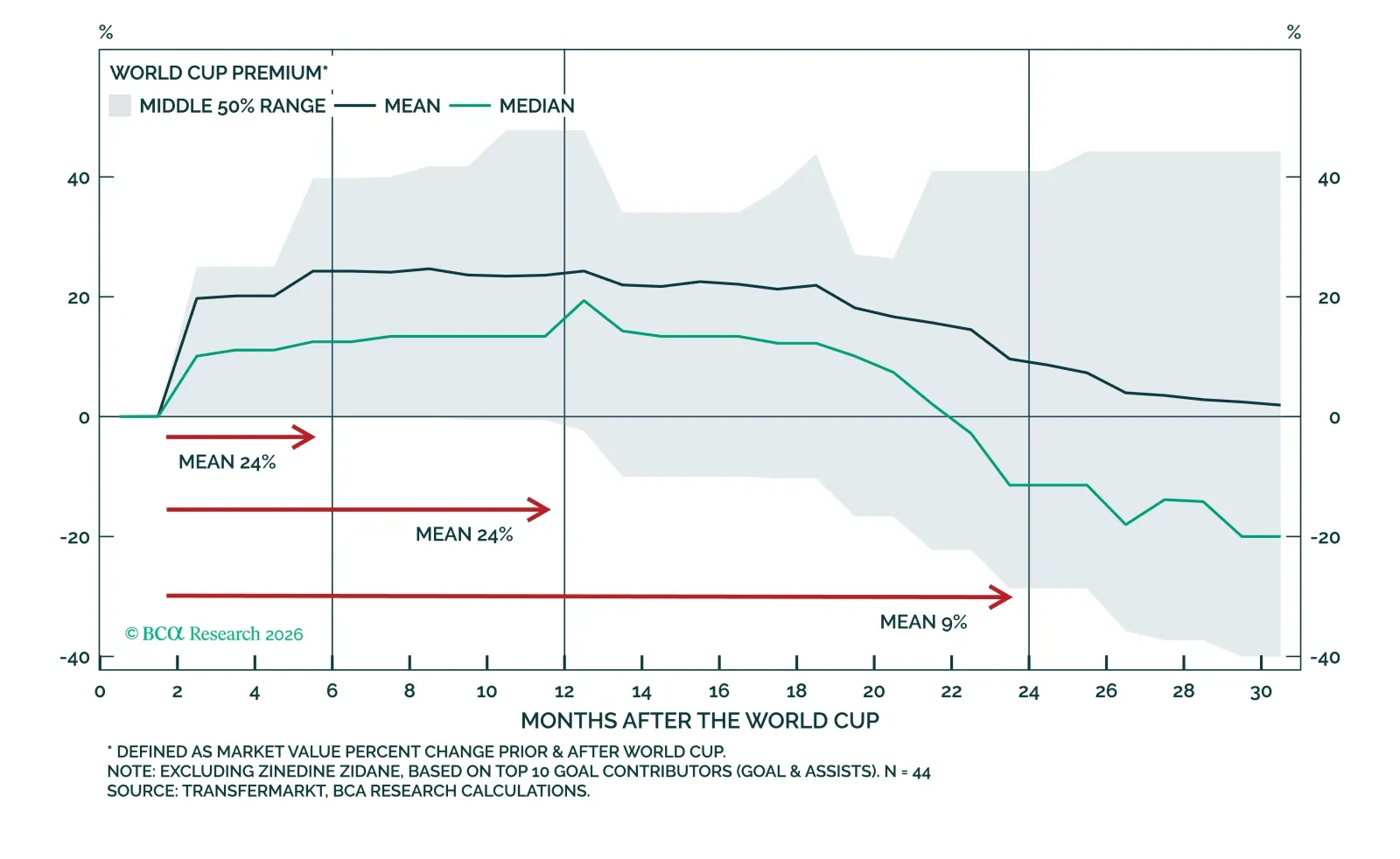
The World Cup Premium, as displayed in Chart 29, is calculated as the percentage change in a player's market value (based on Transfermarkt data) from one month prior to the World Cup start month to different points in time. The average premium amounts to a 24% increase in market value in the 6-12 months after the World Cup, before slowly vanishing beyond the two-year mark. The pattern is broad-based, not concentrated in a handful of outliers, though as the next sections show, its size varies dramatically with player characteristics.
What Drives The World Cup Premium?
We examine three potential drivers: age, players' quality (proxied by the average player rating based on EA Sports FC scores), and the league in which they play. We acknowledge that the line between correlation and causation amongst these variables is fairly thin.
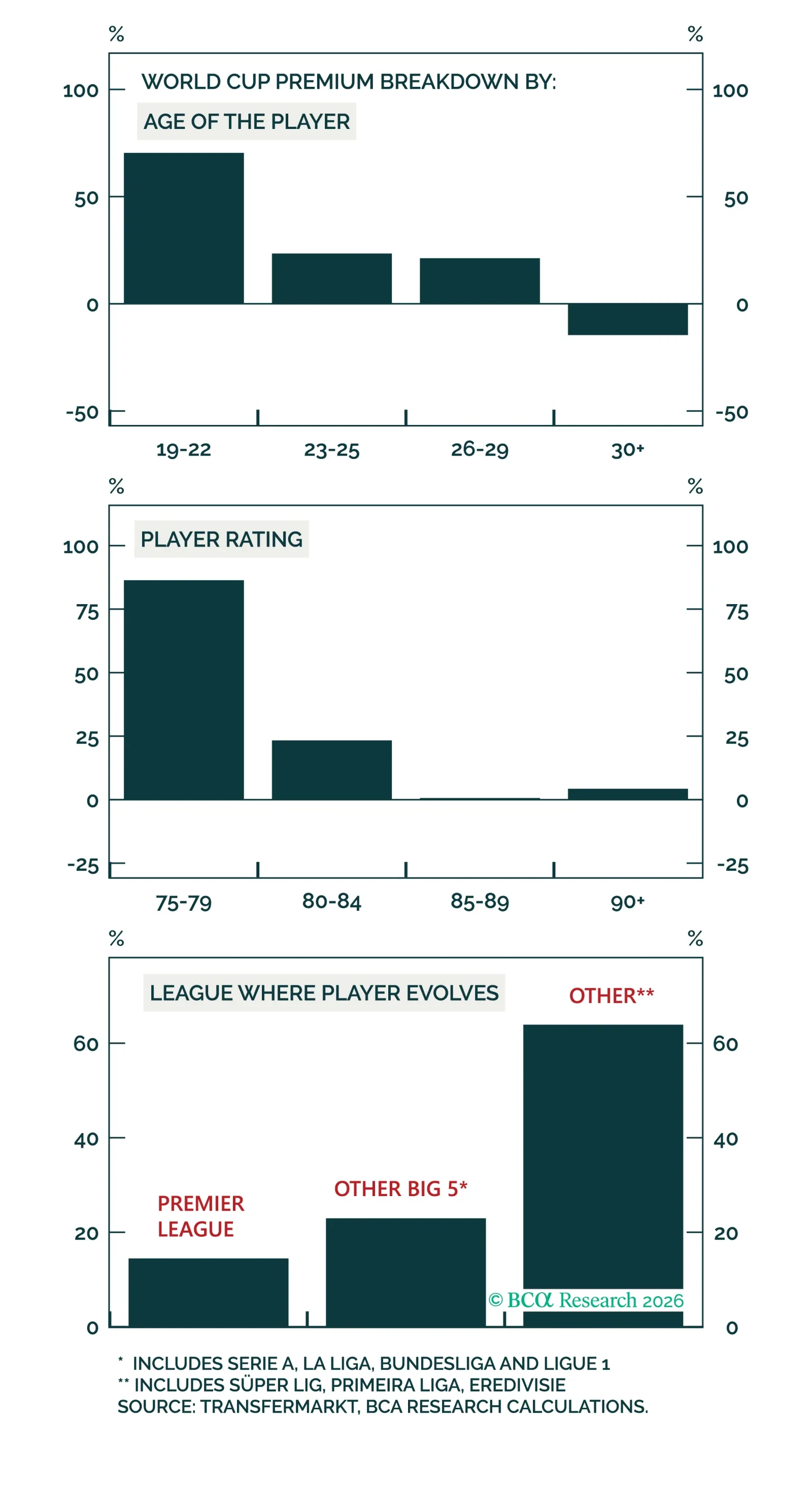














- Age of the player: This is the most important driver (Chart 30, top panel). Top goal contributors aged 19 to 22 experience a +70% increase in market value within one year. For players aged 30 or more, the premium is negative. Even an excellent showing at the tournament cannot offset the depreciation that age imposes.
- Player’s Quality: This driver shows the widest spread (Chart 30, middle panel). The lower-rated players produced the strongest and most persistent premium. Players whose skills are already well known to the world going into the World Cup do not experience a rise in market value—everything is already priced in.
- League Origin: Players evolving in the highly advertised Premier League do not see much of an increase in their market values (Chart 30, bottom panel). Not the case for the other leagues in the Big Five. This should not come as a surprise. Compared to the other leagues in the Big Five, the Premier League is flush with cash, which drives up the market value of players from the French Ligue 1 or the Italian Serie A. The phenomenon is even more pronounced among players in second-tier leagues such as Portugal and the Netherlands.
Bottom Line: The World Cup premium is real but selective. Players who shine during World Cups see their market value increase by 24% on average in the following 12 months. However, unlike the fiscal risk premium embedded at the long end of the curve in France or the UK, this premium vanishes quickly. The largest and most durable gains accrue to young, inexpensive, and underrated players outside Europe’s top leagues. For players whose reputations and valuations are saturated with expectations, even an excellent tournament often leaves the market value unchanged.
Appendix A: Ordered Probit Model – Group Stage
The Ordered Probit model selected is represented using a continuous latent variable yi* that is linearly determined by a set of explanatory variables χi:
yi* = χi’β + εi
Our observed ordinal variable, yi , represents the outcome of each game in our sample, and can take on the values of loss, draw, or win. Therefore, the observed outcome is expressed as:
yi = loss, if yi* ≤ γ1;
yi = draw, if γ1 < yi*≤ γ2;
yi = win, if γ2 < yi*
The probability of observing a particular ordinal outcome is given by:
Pr(yi = loss | χi, β, γ) = φ(γ1 - χi’β)
Pr(yi = draw | χi, β, γ) = φ(γ2 - χi’ b) - φ(γ1 - χi’β)
Pr(yi = win | χi, β, γ) = 1 - φ(γ2 - χi’ β)
Where φ is the cumulative normal distribution function, and γ are arbitrary thresholds selected via log-likelihood maximization.
Our final probabilities are derived from the weighted average of two separate estimations, Model 1 and Model 2. This allows our model to capture the importance of the speed positions average rating in predicting the outcomes of the group stage matches, which displays the highest marginal impact on the winning probability.
Therefore, our final model for the probability of winning a game is:
Pr (yi= win | χi, β, γ) = E(αM1, (1 - α)M2)
Where:
Model 1 (M1) = ƒ(Team Average Player Rating, Forward Average Age, Defender Average Caps)
And,
Model 2 (M2) = ƒ(Speed Position Average Rating, Forward Average Age, Defender Average Caps), and α and (1- α) are the weights given to each model.
To favor our core model (M1), which uses the team-average player rating variable, we assigned a weight of α = 0.66.
Adjusting To The New Format
With the expansion to 48 teams, the eight best 3rd places will also advance to the next stage—some adjustments to our model are required.
In 2022, we calculated the conditional probability for every team to finish in each place in their group. We did so based on each game’s probabilities and the resulting points a team earns from a win or a tie. Computationally, it would become very heavy to do this for every possibility, now that most 3rd place are also advancing.15 We have therefore opted for a Monte Carlo simulation with n=100,000.
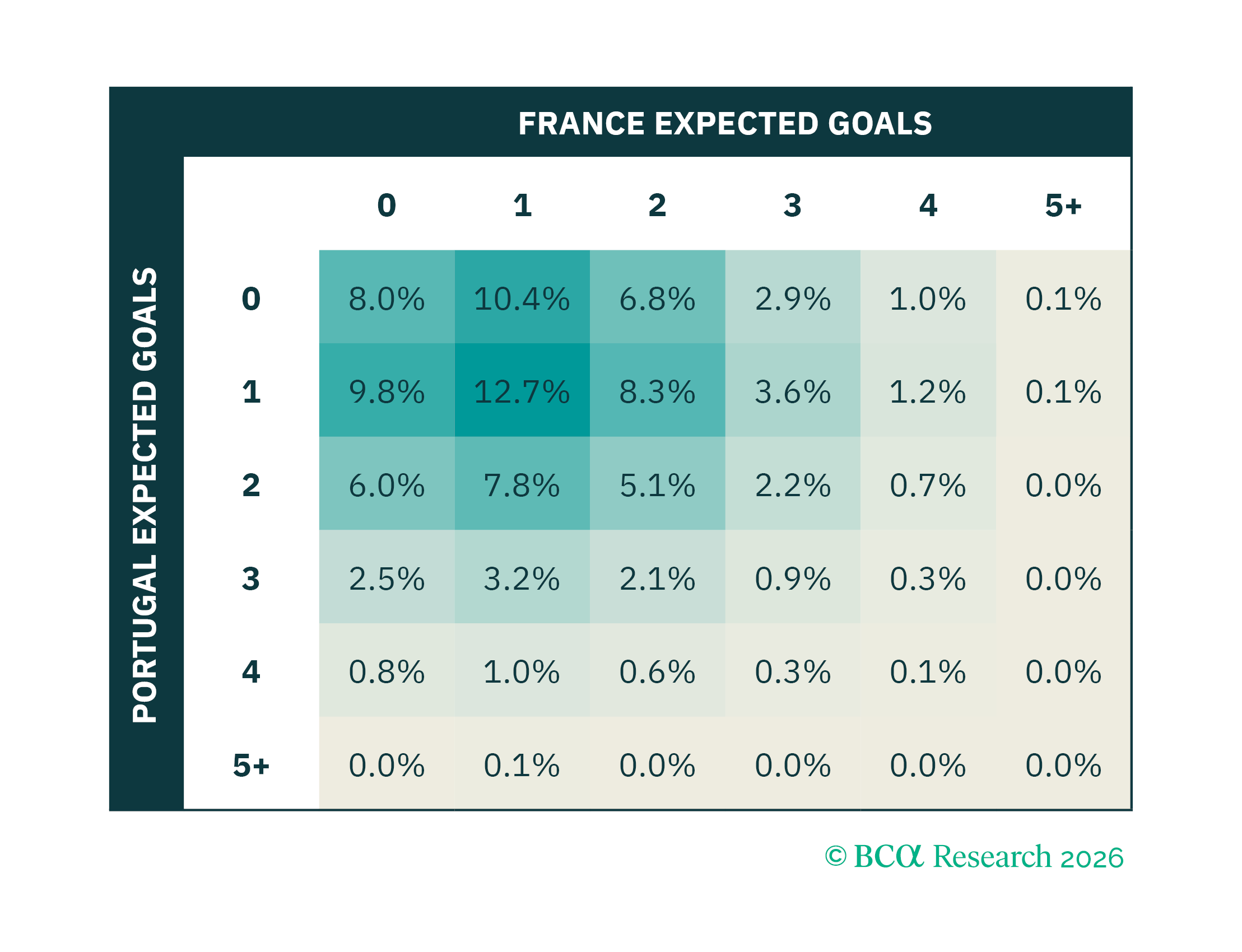
The teams’ expected goals differential is used as a tiebreaker when teams have the same number of points. We are using a Poisson model to obtain a probability distribution for the number of goals scored:
E(Y) = Var(Y) = λ
Where Y is the goal count9 and λ is estimated using the following Poisson regression model:
log(λi ) = β’χi
This allows us to calculate the expected number of goals a team scores in each game and determine the expected goal differential in the group stage. The model uses the same input variables as the Ordered Probit model and therefore also employs the weighted-average approach with two models, as described above.
Appendix B: Ordered Probit Model – Knockout Stage
The binary choice probability of observing a specific outcome for the probit model becomes:
Pr(yi = loss | χi, β) = φ(-χi’β)
Pr(yi = win | χi, β) = 1 - φ(- χi’β)
As with the group stage model, the final probabilities for the knockout stage games were derived from the average of two models in order to maximize the information contained in the forward player rating variable
Therefore, our final probability is:
Pr (yi= win | χi, β) = E(αM1, (1 - α)M2)
Where:
Model 1 (M1) = ƒ(Team Average Player Rating, Club Level Synergy,
Forward Average Number of Caps) and,
Model 2 (M2) = ƒ(Forward Average Rating, Club Level Synergy,
Forward Average Number of Caps),
and α and (1 - α) are the weights given to each model.
- Yes, we say football throughout the report. As President Trump said, it really doesn’t make sense to call it soccer. For once, his logic is flawless. The NFL can come up with another name. We suggest American Handball.
- Expect that to show up in the US CPI data, just as the 2024 Summer Olympics and 2026 Winter Olympics led to monthly jumps in French and Italian CPI.
- We could not even get ChatGPT to give an accurate count of World Cup participations by country since 1998...
- He will turn 39 during the competition.
- We highly recommend that readers watch the Netflix documentary The Bus: A French Football Mutiny. Do it on July 14th with a glass of red wine to spice things up.
- Neuer’s performance in Bayern’s Champions League campaign this year garnered much attention, notably during Bayern’s now legendary 2-1 first-leg victory over Real Madrid in the quarter-finals.
- Enough to trigger a fight with Federico Valverde? Who knows.
- Messi is three goals away from matching Miroslav Klose’s World Cup goal-scoring record.
- Portugal announced a 27 plus one squad for the World Cup, with the extra spot reserved for the deceased Jota.
- Someone brings wheelchairs!
- An interesting family subplot accompanies his World Cup campaign: his younger brother, Nico Williams, represents Spain and was recently called up by national team coach Luis de la Fuente.
- “Don’t talk to me about age.”
- Christian Karembeu in 1998 (France / Real Madrid), Roberto Carlos in 2002 (Brazil / Real Madrid), Sami Khedira in 2014 (Germany / Real Madrid), and Raphael Varane in 2018 (France / Real Madrid).
- For those of you wondering, Éder retired in 2022, ending his career in Al-Raed Saudi Football Club.
- We are also aware of the acute shortage of compute due to AI model demand and do not want to contribute to that with the most important of all unimportant forecasts.