Sorry, you need to enable JavaScript to visit this website.
Skip to main content

South Korea

The global economy will not enjoy an “immaculate disinflation” but will suffer a very maculate one due to China’s growth slowdown and restrictive monetary policy in the developed world. Investors should stay overweight low-beta assets.

South Korean exports in the first 20 days of July corroborate the signal from Taiwanese export orders that Asian trade conditions remain weak. The former declined by -15.3% y/y, undoing the optimism following a 5.3% y/y increase in the first 20 days of June.…
Executive Summary New Orders Of Chips Are Downbeat Emerging Asian semiconductor (semi) stocks have rallied considerably. While momentum could push them higher in the short term, stock prices are vulnerable to the downside due to shrinking demand over the next six months. We expect global semi demand to continue contracting, but the pace of decline will moderate in 2023H2. While demand has increased briskly for Artificial Intelligence-type semiconductors, this will not be enough to lift aggregate global chip sales out of contraction.  Meanwhile, geopolitical headwinds will persist and spark more disruptions of the worldwide semiconductor supply chain. Nevertheless, the structural outlook for global semiconductor demand remains constructive.   Bottom Line: The AI-fueled surge in semi share prices is not sustainable and will correct later this year. We are waiting for a better entry point to take advantage of structural tailwinds. Meanwhile, a boost in AI chip demand will marginally bring more orders to the Taiwan Semiconductor Manufacturing Company Ltd. (TSMC). We are upgrading Taiwanese tech from underweight to neutral within the EM equity benchmark. In addition, we remain overweight Korean tech stocks and the Korean Composite Stock Price Index (KOSPI) within the EM equity benchmark. Feature Chart 1Semiconductor Stocks vs. Sales: A Significant Divergence Semi stock prices have been rallying strongly since last October, even though sales of global semis are still in a deep downswing (Chart 1). We believe the rally in Asian semi stocks cannot be justified due to the poor semi demand outlook for 2023H2. AI-related chips only account for a tiny share (2%-3%) of world semi sales. A significant upsurge in the demand for AI chips will not be able to lift global semi sales out of contraction for the rest of this year. Semi consumption for smartphones, personal computers (PCs) and servers will continue to shrink. Meanwhile, recent semi export restrictions imposed by Japan and China’s ban on Micron will hamper worldwide semi sales this year. Hence, Asian semi stock prices will likely relapse in 2023H2 as the reality of disappointing global chip demand sets in. Global Semi Demand: A Bleak Outlook In 2023H2 The ongoing shrinkage in international semiconductor sales has been broad-based, with the deepest reduction having occurred in China (Chart 2). Furthermore, the magnitude of the decline in global semiconductor sales is the largest since 2009. According to the most recent S&P Global Electronics PMI report, the global electronics sector continued to signal shrinking demand in May, with new orders down for the tenth time in the past eleven months (Chart 3, top panel). The new orders component of the Taiwanese semiconductor PMI dropped below 40 after failing to move above the neutral 50 line (Chart 3, bottom panel). Chart 2Semiconductor Sales Are Contracting Across Regions Chart 3New Orders Of Chips Are Downbeat We expect world semi sales to continue contracting in 2023H2, based on the following factors: Domestic semi demand in China will fail to recover in the next six months. At best it will stagnate at a very low level. Given that China accounts for one-third of the world’s semi usage, global semi demand will not improve as long as China’s demand remains very weak. Both Taiwanese export orders from mainland China and mainland China’s semiconductor imports are still in a deep contraction (Chart 4). Despite China’s reopening, domestic sales of smartphones, PCs and other electronic goods in April were significantly below their pre-pandemic levels in April 2019 (Table 1). Chart 4Declining Semiconductor Demand In China Table 1China: Consumer Electronics Sales Chart 5Chinese Consumers Still Prefer To Save Than To Spend Chinese consumers still prefer to save rather than spend and invest (Chart 5). Last week’s EMS/CIS joint report pointed out that Chinese households are showing symptoms of a liquidity trap. High debt-servicing costs along with downbeat sentiment will curb the household demand for credit. Semi demand in the world outside China will also face recovery challenges in the next six months. Imports of Chinese electronic products by US and EU countries have plunged (Chart 6). Shrinking demand for consumer goods will impede the revival of semi consumption in the developed world, which accounts for over one-third of global semi sales (Chart 7). A review of major semiconductor-consuming sectors below also paints a dismal picture for global semi demand in the coming six months. Chart 6Falling US And EU Imports Of Electronics Chart 7DM Demand For Consumer Goods Will Continue Shrinking Mobile phones, traditional PCs and tablets: These electronic goods account for about 40% of global semi sales. Despite price cuts and heavy promotions from vendors, consumer demand remained sluggish due to overconsumption in previous years and slumping global growth. Thus, global shipments of mobile phones and PCs plunged by about 14% and 30%, respectively, in the first quarter from a year earlier. We expect international shipments of smartphones and PCs to continue to shrink, albeit more moderately, in the next six months. Given that China accounts for the lion’s share of the world’s shipments of mobile phones and PCs, the country’s production of these goods can be used as a proxy for their global shipments. The decline of the former indicates that global demand remains in deep contraction (Chart 8). Servers: Many companies facing macroeconomic uncertainties have not invested, which has resulted in a reduction in IT spending. This aspect has surfaced in a slowing demand for servers. Trendforce in May predicted a nearly 3% year-on-year drop in worldwide server shipment volumes in 2023. Nonetheless, the AI enthusiasm will drastically boost AI server sales this year. Last week Trendforce predicted a nearly 40% surge year-on-year in AI server shipments in 2023, raising AI servers’ share of total server shipments to about 9%. As servers account for only 10% of global semi sales, a 40% surge in AI server sales will boost global semi sales by a mere 0.4% this year compared with last year. Automotive: Auto output levels in major producing countries have been on an upward trajectory as the chip shortage in this sector has eased (Chart 9). In the second half of this year, we expect moderate growth in auto chip shipments due to high borrowing costs dampening the pace of auto sales in both developed and emerging markets. Chart 8Plunging Chinese Phone And PC Output Chart 9Auto Production Will Continue To Increase, Albeit At A Slower Rate Chart 10Inventory Adjustment Is Not Over Yet Industrial electronics: Global manufacturing production will likely remain in contraction for the rest of this year. Nevertheless, given the structural tailwinds for industrial electronics (more use of Internet of Things chips), we expect the growth of industrial electronic sales to slow to mid-single digits in the short term. Automobiles, servers and industrial electronics, which together account for about 30% of global semi sales, will experience positive but subdued growth (0-5%) for the rest of this year. However, such an increase will not be enough to offset ebbing demand in the consumer electronic goods sector in the next six months. Ongoing inventory digestion: Customer and channel inventories have come down, but some of them are still higher than normal (Chart 10). In recent earnings calls, major semiconductor companies mentioned that an inventory adjustment will continue to weigh on semi sales in 2023H2. In addition, companies whose inventories are at normal levels will be cautious in making orders to avoid an inventory buildup in view of heightened macroeconomic uncertainty. Geopolitical headwinds: US-China tensions persist and will cause more disruptions on the global semi supply chain. For example, the US banned exports of advanced node (sub-14 nanometer) chipmaking equipment to China last September. Thus, US semiconductor equipment makers including Applied Materials, Lam and KLA have seen sharp drops in their sales to China (Table 2). Japanese chipmaking tool companies will also face dramatic declines in their sales to China when Japan’s semi export ban takes effect on July 23, 2023. In addition, China’s ban on Micron will curtail that company’s semi sales this year. Bottom Line: Worldwide semi sales will continue to shrink through the rest of 2023 or at best stagnate at a very low level. Chart 11 shows that Taiwan’s semiconductor new export orders, which generally lead global semi sales by about three months, remain in a deep contraction. Table 2US Semi Equipment Producers' Shipments To China Chart 11Taiwan's Semiconductor New Export Orders Point To Lingering Contraction In Global Semiconductor Sales   A Divergence Between Share Prices And Sales Chart 12A Similar Divergence Between Semiconductor Share Prices And Sales In 2019 A similar divergence between semi share prices and sales occurred in 2019 (Chart 12). In that episode, the 5G hype pushed up semi stock prices. However, the current driver is an AI frenzy triggered by the release of ChatGPT and other large language models. While AI development is structurally positive and will underpin long-term global semi demand, its contribution to semi sales is very limited in the short term. We think there are low odds that global semiconductor producers' stock prices will continue to rally through the second half of 2023. Our reasons are as follows: AI chips only account for about 2-3% of global semi sales, much lower than the one-third share for smartphone chips. The surge in AI chip demand helps only a few companies while the boom in smartphone chips benefited a much larger pool of semiconductor players. Nvidia is the major beneficiary as revenues from its data center business grew by 14% year-on-year in the first quarter of the year. This is because many cloud service providers (CSPs) and enterprises buy Nvidia’s AI chips to use in existing data centers to improve operating performances and efficiencies. By contrast, new data centers, which can benefit more chip companies by using a wider variety of chips, are experiencing slower growth. This year, major CSPs constrained their data center investments as revenue growth in their cloud divisions decelerated. Hence, since the release of ChatGPT at the end of November 2022, two major data center chip suppliers – AMD and Intel – have not yet seen any gain in sales. AMD revenues from its data center & AI group remained almost flat in 2023Q1 and Intel’s plunged by 38% year-on-year in the same period. Chart 13China: No Restocking Of Chips This Time China boosted its overseas purchases of processor and controller chips in 2019H2 and 2020 to build up domestic inventory. However, the country is now in a destocking process (Chart 13). While it was difficult for China to produce processor and controller chips in 2019, this time China can produce many of these items banned by Japan. In addition, the value of such items is much lower than that of processor & controller chips. Bottom Line: Semi producers' stock prices will likely relapse due to bleak fundamentals in the next six months. Ramifications For Taiwanese And Korean Markets Chart 14High-Performance Computing Chips Drive TSMC Sales The rally in global semiconductor stocks will not be justified by improving sales for the rest of this year. We have low conviction on share prices US semiconductor design companies that may sustain their frenzy. We have a higher conviction that the share prices of Taiwanese and Korean semi producers will relapse in absolute terms in 2023H2. For TSMC, there is one positive: a boost in AI chip demand will bring more orders and improve the company’s capacity utilization rate in its 5nm and 7nm fabrication plants. The high-performance computing (HPC) sector has far exceeded the smartphone sector to account for the largest share of TSMC’s revenues in 2023Q1 (44% vs. 34%) (Chart 14). A year ago, HPC’s share was 41%, marginally higher than the 40% share for smartphones. However, we still believe Taiwanese tech is more vulnerable to the downside in absolute terms for the following reasons: A contraction in global smartphone and PC sales in the next six months will hurt TSMC’s top and bottom lines. After all, smartphone makers, smartphone chip designers and PC chipmakers accounted for over 50% of TSMC’s revenues last year. In comparison, only 6.3% of TSMC sales were from Nvidia in 2022. Chart 15Memory Chips Demand And Prices Still Face Some Downside Taiwan remains the epicenter of US-China tensions. Chinese authorities have become increasingly confrontational with the US. Taiwan holds the most advanced chipmaking technology which mainland China needs to advance its long-term strategic policies. Tensions between the US and China have escalated as the Japanese and Dutch governments joined the US to impose restrictive policies curbing tech development in China. Such an escalation has increased the policy uncertainty between Beijing and Taiwan, and the pressure may negatively impact Taiwanese tech stocks. For Korea’s Samsung and Hynix, the memory market is in a free fall due to plummeting demand (Chart 15). We expect more downside in Korean semi stock prices in absolute terms. Nonetheless, Korean tech stocks will benefit on the margin from the following factors: First, China’s ban on Micron will benefit Samsung and SK Hynix as 18% of Micron’s sales in 2022 came from China. Second, Micron announced late last year that it would reduce memory chip supply and make more cuts to its capital spending plan. This may slow the pace of the decline in global memory prices. Overall, we expect the Korean and Taiwanese equity indexes to decline in absolute terms in the months ahead like the majority of EM bourses. Nevertheless, we expect the KOSPI to outperform the EM benchmark and the Taiwanese stock index to be in line with EM stocks for the following reasons: Chart 16Multi-Year Theme: Favor Global Industrials Semiconductor stocks are an early cyclical play. They start outperforming the overall equity benchmark in the late stage of the global manufacturing downturn, which we expect to happen later this year.   In contrast, EM ex-China domestic demand is in the early stages of a downturn. Hence, many EM bourses dominated by domestic plays will underperform in the months ahead.   The overall Korean and Taiwanese export sectors will benefit from a cheapening currency. However, a depreciating currency will not help the profits of companies exposed to domestic demand. Finally, the KOSPI is a play on our multi-year theme of favoring global industrials   relative to other sectors (Chart 16). Bottom Line: In absolute terms, both Taiwanese and Korean semi stock prices will likely relapse in the next six months. Within the EM equity benchmark, we are upgrading Taiwanese tech stocks from underweight to neutral while remaining overweight Korean tech stocks and the KOSPI. Ellen JingYuan He Associate Vice President ellenj@bcaresearch.com  
The Global Manufacturing PMI was unchanged at 49.6 in May – below the 50 boom-bust line for the ninth consecutive month. The details of the release were mixed. On the one hand, the Production sub-component rose to an 11-month high of 51.5. On the other hand,…
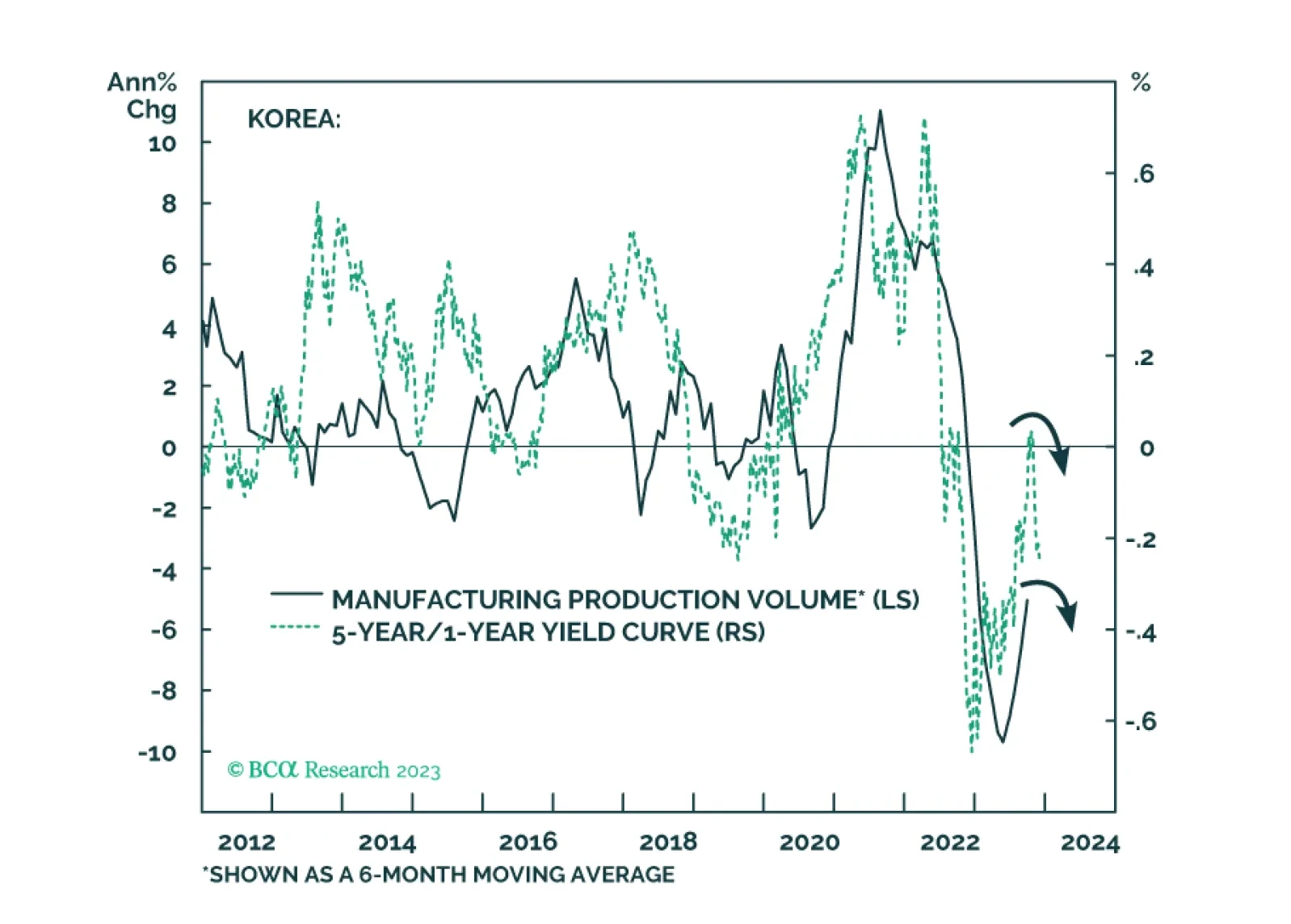
Recent Asian trade data do not provide any optimism that the global manufacturing slump is nearing its end. South Korean exports collapsed by 16.1% y/y in the first 20 days of May. While the decline was broad-based, sales to China were particularly weak,…

Macro and geopolitical risks may spoil the narrow window for a stock market rally before recessionary trends rise to the fore.

No, the secular rise in geopolitical risk has not peaked. EU-China trade ties underscore the multipolar context, but this multipolarity is unbalanced, as the US has not reached a new equilibrium with its rivals. While the second quarter is murky, investors should stay defensive this year on the whole.

Remain cautious and defensive overall. Stay long DM Europe over EM Europe. Look for EM opportunities in Southeast Asia and Latin America over Greater China.

Naïve Readings Of The Twentieth Party Congress (A GeoRisk Update)

Stay short Greater China assets. Stay long Japanese yen. Hold back on Brazil for now but look forward to opportunities in future.

Please note I will be hosting a live webcast on September 29, 2022 at 9:00 AM HKT for the APAC region. I will discuss the global/China/EM macro outlooks and financial market implications. For clients in the Americas and EMEA, we had a webcast on September 28, 2022. You can access the replay via this link. Arthur Budaghyan Executive Summary Global Semi Stock Prices: Further Downside Ahead Global semiconductor stock prices are still vulnerable to meaningful downside over the next three months. Global semi consumption will contract due to the corresponding waning demand of smartphones, personal computers, and other consumer electronics. Global semi demand in sectors of automobiles and datacenters will continue growing. However, such an increase in demand cannot offset the demand reduction in other sectors. Semiconductor consumption in China has entered a contraction phase.  Semiconductor inventories have swelled. Alongside a sharp upsurge in chip production capacity, this increase in inventories will lead to chip price deflation in the next nine months. Nevertheless, the structural outlook for global semiconductor demand remains constructive. We are waiting for a better entry point for semi stocks.  Bottom Line: There is more downside in global semiconductor share prices as well as Taiwanese and Korean tech stocks. We will seek to recommend buying semiconductor stocks when a more material decline in semi companies’ profits is priced in their share prices. At the moment, we are downgrading Taiwanese stocks from neutral to underweight relative to the EM equity benchmark but are maintaining an overweight stance on the Korean bourse within an EM equity portfolio.   The global semiconductor equity index is breaking below its technical support (Chart 1). The implication is that these share prices are in an air pocket and investors should not chase a declining market. Based on previous cycles, we expect global semiconductor stocks to bottom late this year or early next year and semi sales to trough in 2023Q2. In the previous five cycles, global semi stocks always bottomed before global semi sales and lead times varied from three-to-six months. Chart 2 shows that Taiwan’s semiconductor new export orders lead global semi sales by about three months, and they continue to point to considerable downside in the global semi-industry. Chart 1Global Semi Stocks: Breaking Down Chart 2Global Semi Sales: More Downside Ahead The semiconductor industry has a history of cyclicality. Shortages have been followed by oversupply, which has led to declining prices, revenues, and profits for semi producers. This time is no exception Global Semi Sales: A Cyclical Slump Underway Global semiconductor demand began its downward trajectory in May of this year and will continue to slide in the next three-to-six months. Both the volume and value of China’s semiconductor imports are in a deep contraction and China’s imports from Taiwan have also plummeted (Chart 3). China is the world’s largest consumer of semiconductors, accounting for 35% of global demand. We expect semi sales to remain in contraction in China and to shrink in regions outside China in the next six-to-nine months (Chart 4).  Chart 3China's Semi Imports Plummeted Chart 4Semi Sales Will Contract Across Regions There are several important reasons for the retrenchment worldwide. First, the lockdowns around the world in 2020 and 2021 generated an unprecedented increase in online activities and a corresponding surge in demand for smartphones/PCs/tablets/game consoles/electronic gadgets. This was the main driving force for the boom in global semiconductor sales from 2020Q3 to 2022Q1. The excessive demand for consumer goods and electronics has run its course and global demand will sag in the next six months. As we have been contending since early this year, global exports are set to contract. Households that bought these goods in the past two years probably will not make new purchases in the near term. In addition, declining real disposable income and rising interest rates will constrain consumer spending. Smartphones, PCs, tablets, home appliances, and other household electronic goods consume about half of global semi output. In addition, rising job uncertainties resulting from China’s dynamic zero-COVID policy and slowing household income growth will curb consumption within China. Here are our takeaways for each segment: Chart 5China's Output Of Mobile Phones And PCs Has Been Shrinking Mobile phones: Mobile phones are the largest contributor to global semi sales, with a share of 31% as of 2021, based on the data from World Semiconductor Trade Statistics (WSTS). According to the International Data Corporation (IDC), global smartphone shipments are set to decline by 6.5% year-over-year in volume terms in 2022. Smartphone OEMs cut their orders drastically in 2022 because of high inventories and low demand, with no signs of an immediate recovery. China accounts for 67% of global mobile phone production and its mobile phone production has been contracting (Chart 5, top panel).   Traditional PCs and tablets: Based on data from the IDC, global traditional PC1  and tablet shipments are set to decline by 12.8% year-over-year in 2022 and by an additional 2.6% next year in volume terms. Computer production in China, which is the world’s largest computer producer and exporter, also shows massive downsizing (Chart 5, bottom panel).   Home appliances: China is also the largest producer and exporter of air conditioners (ACs), washing machines, refrigerators, and freezers. Except for a slight growth in AC output in response to heatwaves in China and Europe, China’s output of other home appliances will shrink. Globally, these industries accounted for about half of all semiconductor sales in 2021. Given the overconsumption of these goods worldwide over the past two years, we expect a material decline in these sectors in the next six-to-nine months. Second, automobiles, servers, and industrial electronics, which together account for about 30% of global semi sales, will have positive single-digit growth going forward. Yet, such an increase will not be enough to offset the lost demand from the consumer electronic goods sector in the next six-to-nine months.  Chart 6Global Auto Production Will Rise Automotive (accounts for 11% of world chip demand): The chip shortage in this sector has eased only moderately. Auto output levels in major producing countries remain well below their pre-pandemic levels (Chart 6). In light of improved foundry capacity, semiconductor producers will be able to produce automotive chips and reduce lingering shortages. However, for most chips to automakers, there are no supply shortages. Only a small number of categories of automotive chips, such as microcontrollers (MCU) and insulated-gate bipolar transistors (IGBT), are still in tight supply. Given that the total automotive sector only accounted for about 5% of total global semi sales last year, the recovery in global automobile output will contribute only limited growth to global semi sales.   Servers (account for 10% of world chip demand): The surge in online activities resulted in greater demand for cloud services and remote work applications, both of which require computer servers. Total server demand is comprised of data servers for cloud providers and private enterprises, with the former as the main driving force in recent years.  Data center expansion among cloud service providers will be driven by 5G, automotive, cloud gaming, and high-performance computing. After expanding by 10% last year, the pace of annual growth in global server shipments will likely be more moderate, to about 5%-6% in the next couple of quarters.   Chart 7Global Industrial Demand For Chips Is Set to Decelerate Industrial electronics (account for 9% of world chip demand): The growth rate in semi demand for this sector is falling. The global manufacturing new order-to-inventory ratio has plunged, and global manufacturing production is set to decline for the rest of this year and through to 2023H1 (Chart 7). Nevertheless, given structural tailwinds for industrial electronics, we expect semi demand in this sector to dip to single-digit growth in the near term rather than to contract.  Third, with semiconductor inventories having surged, new orders for chips, and hence their production, will plummet.   The length and intensity of the chip shortage, which started in 2020H2, triggered stockpiling among a broad range of customers, including manufacturers of smartphones and other consumer electronics. Moreover, the recent slowdown in smartphone/PC demand increased the inventory of silicon chips. Chart 8Semiconductor Inventory Overhang China had also stockpiled semiconductors from 2020Q2 to 2021Q4. With faltering demand, the country will continue its destocking process in the next couple of quarters. Semiconductor inventories in Taiwan and Korea have surged, corroborating the fact that the current cyclical downturn in the global semi sector will be a severe one (Chart 8). Hence, businesses in the semi supply chain will continue to draw upon their inventories rather than increase their semiconductors orders. This will reduce semiconductor demand meaningfully in the coming months. Bottom Line: The cyclical slump in worldwide semiconductor sales has further to go, with the sector’s sale volumes and prices projected to contract in the next six months. Semi producers will experience a substantial decline in their profits. Comparing Cycles Previous cycles may provide insight in the downside of the cyclical slump in global semi sales. In the previous five cycles, global semi sales experienced a contraction, ranging from 7% to 45% (Table 1). In the current cycle, global semi sales still had 7% year-over-year growth in 2022Q2 (Chart 9). Table 1Six Cyclical Downturns In Global Semiconductor Market Chart 9Global Semi Stocks And Global Semi Sales Global Semiconductor Market: Sales & Share Prices In fact, the current downturn could be deeper than the one between 2018 and 2019 (when sales contracted by 16%) for the following reasons: Sales of both cell phones and PCs will likely dwindle further this time than they did in 2018 to 2019. The pandemic boosted demand for consumer electronics, but this also brought forward future demand. In comparison with 2018, the current cycle might have a longer replacement cycle for mobile phones and PCs. Unlike 2019, global demand for consumer goods will likely contract rather than decelerate. This has ramifications for the duration and magnitude of the semi downturn.   Economic growth, and job and income uncertainties in China are much worse now than they were between 2018 and 2019. These factors will likely lead to a bigger cut in IT spending by both consumers and businesses, resulting in a larger downturn in global semi demand in this cycle. The tech battle between the US and China is more intense than in it was from 2018 to 2019. In mid-2018, the U.S. imposed a 25% tariff on Chinese imports of semiconductor goods, including machines and flat panel displays. China retaliated by imposing its own 25% tariff on U.S. exports of semiconductor goods, such as test equipment. This month, the US imposed new restrictions on NVIDIA and AMD in relation to selling artificial intelligence chips to Chinese customers. The US also plans to curb further its shipments of chipmaking tools to China. These plans will cut China’s imports of high-end semi products, for which producers enjoy high profit margins. In addition, the shortage of these chips will stall the development and sales of many consumer products within China, which will thereby reduce demand for other types of chips needed for consumer products. Chart 10Rapid Semi Capacity Expansion Worldwide Global semi capacity expansion has recently been much stronger in current cycle than it was in the 2016-2018 cycle. This may lead to a bigger supply surplus in this cycle than in the last one. It takes about 18-24 months, on average, to build a new semiconductor fabrication plant. Thus, large capital expenditures by semi producers in 2021-22 entail considerable new supply in 2023-24. According to IC Insights, the annual wafer capacity growth rates were 6.5% in 2020, 8.5% in 2021 and 8.7% in 2022. This compares with 4%-6.5% between 2016 and 2018 (Chart 10). Rapid capacity expansion typically leads to price deflation for chips and is therefore negative for the semi producers’ profitability and their share prices. Are global semi stock prices already pricing bad news? We do not think so. Nearly all major players saw a drop in revenues in the past cycle. In sharp contrast, only Intel’s revenues have dropped so far in the current cycle (Chart 11). Global semi stock prices will continue falling as companies report shrinking sales and earnings in the next couple of quarters. In former cycles when global semi stocks bottomed, investor sentiment – as measured by the net EPS revisions – was more downbeat than it is currently (Chart 12). Chart 11More Semi Companies' Sales Are Likely To Contract Chart 12Global Semi Stock Prices: Net EPS To Drop More Bottom Line: The global semiconductor sector’s cyclical slump could be deeper than it was in the 2018-2019 cycle. Hence, shares prices will fall considerably more than they did in late 2018. Ramifications For Taiwanese And Korean Markets Taiwanese and Korean semiconductor stock prices will probably continue to fall in absolute terms. The former recently broke its three-year moving average and the latter its six-year moving average (Chart 13). Chart 13Taiwanese And Korean Semi Stock Prices Will Fall Further Chart 14TSMC: Smartphone And HPC Make 81% Of Revenue For TSMC, the smartphone sector still accounts for 38% of revenues (Chart 14). Hence, a contraction in global smartphone sales in the next six-to-nine months could hurt the company’s top and bottom lines considerably. Meanwhile, the high-performance computing (HPC) sector became the largest contributor of TSMC revenues with a 43% share. A slowdown in data center investment and a decrease in GPU demand due to falling bitcoin prices will also materially affect the company’s profitability. In addition, the US government’s AI chips export restriction policy will decrease NVIDIA and AMD AI sales to China. According to NVIDIA’s news release, approximately US$400 million in potential chip sales to China (including Hong Kong) will likely be subject to this new restriction. AI chips are manufactured by TSMC with its advanced node technology and have a high-profit margin. Hence, the new policy will negatively impact TSMC’s revenues and profits. For Samsung, the memory market is in a free-fall due to plummeting demand (Chart 15). TrendForce expects the average overall DRAM price to drop by 13-18% in 2022Q4 because of high inventories in the supply chain and stagnant demand. The semi shipment-to-inventories ratios for both Taiwan and South Korea nosedived, pointing to lower semi stock prices in these two markets (Chart 16). Chart 15Samsung: Vulnerable To Sinking Prices Of Memory Chips Chart 16Semi Shipments-to-Inventory Ratios Plunged In Taiwan And Korea Bottom Line: Both TSMC and Samsung stock prices have more downside over the next three months.  Equity Valuations And Investment Conclusions The global semiconductor stock index in USD terms has tumbled by 45% from its recent peak. Multiples of semiconductor stocks are near their long-term average levels (Chart 17 and 18). These multiples could undershoot as they did in 2018-2019, which means even more downside is ahead. Chart 17Multiples Of Semi Stocks Could Undershoot Chart 18Multiples Of Semi Stocks Could Undershoot Aside from the profit outlook, higher US bond yields are also causing multiple compression for global semiconductor stocks (Chart 19). As to the allocation to semi stocks within an EM equity portfolio, we recommend downgrading Taiwan from a neutral allocation to underweight and reiterate an overweight stance on the KOSPI. The US-China geopolitical confrontation will escalate in the coming years and Taiwan is at the epicenter of this. These are relative calls, that is against the EM benchmark (Chart 20). We remain negative on their absolute performance. Chart 19Higher US Bond Yields = Multiple Compression In Global Semi Stocks Chart 20Downgrade Taiwan To Underweight Relative To The EM Benchmark   Finally, the structural outlook for global semiconductor demand remains constructive. We are waiting for a better entry point. We would recommend buying semiconductor stocks after pricing in a more material contraction in semi companies’ revenues and profits. Ellen JingYuan He Associate Vice President ellenj@bcaresearch.com Footnotes 1     Traditional PCs are comprised of desktops, notebooks and workstations.