Economy

US GDP growth for Q4 was revised lower from 3.3% to 3.2% annualized, driven by a downward revision to private inventory investments (now detracting 0.27 points from a previous 0.07 contribution to GDP). However, consumer spending grew at a faster pace than…
New Zealand government bonds rallied, and the NZD was the worst performing major currency on Wednesday following the Reserve Bank of New Zealand’s (RBNZ) policy announcement. Although the central bank’s decision to keep its official cash rate (OCR) unchanged…
On the surface, the latest Taiwanese export orders release delivered a positive signal on the global trade cycle. The 1.9% y/y expansion in January marks a significant improvement from the 16.0% contraction in December. Moreover, a 28% surge in orders from…
Earlier this year it looked like the spread between the rate of 10-year and 2-year Treasury notes was heading toward positive territory. Yet the 2s/10s spread peaked at -16 bps on January 16 and the inversion has been deepening since. This peak in the yield…
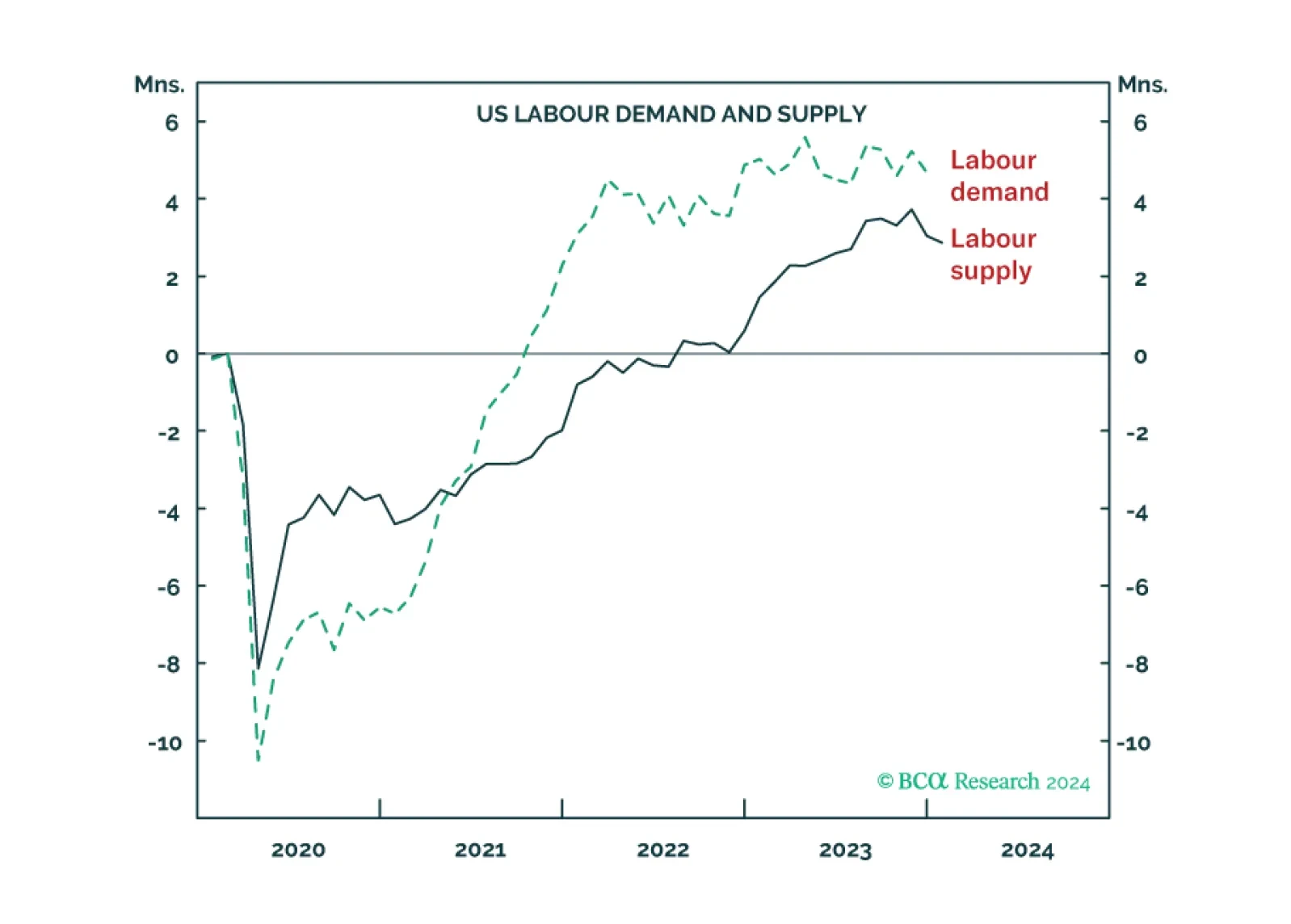
The US ‘immaculate disinflation’ has run its course, given that labour force participation is topping out. This leaves the Fed with a dilemma. Settle for price inflation stabilising at 3 percent, and cut rates early to avoid higher unemployment. Or, not cut rates early and go the final mile to 2 percent price inflation, at the risk of higher unemployment. We discuss which way the Fed is likely to tilt, and the investment implications. Plus: China is oversold while Japan is overbought.
Japan’s CPI inflation dropped from 2.6% to 2.2% y/y in January. However, the sharp slowdown comes on the back of falling energy prices. Meanwhile, the BoJ’s core-core measure of underlying inflation (CPI excluding fresh food and energy) eased from 3.7% y/y to…
Our US economic sentiment indicator – which is based on the difference between our equity valuation index and our bond valuation index – remains on an uptrend since its pandemic trough. Investors are pushing US stocks deeper in overvalued territory vis-à-vis…
On the surface, the US durable goods report delivered a negative surprise on Tuesday. The 6.1% m/m drop in new orders in January fell below expectations and the December figure was revised down to 0.3% m/m from 0.0% m/m. However, the details of the report…
According to BCA Research’s China Investment Strategy service, the odds of a “Minsky Moment” are low for the Chinese banking sector. Chinese banks, however, will continue facing cyclical and structural headwinds, including a dismal asset quality and profit…
The US Conference Board’s February Consumer Confidence release surprised to the downside. The index decreased to 106.7 from a downwardly revised 110.9, disappointing expectations it would improve to 115.0. Consumers’ assessment of both the present situation…