ユーロ圏

Citigroup’s economic surprise index for the Euro Area has been on a steady ascent since mid-2023. Its continued increase after breaking into positive territory at the start of February indicates that the region’s economic data are generating positive…
Various indicators of Eurozone wage growth have cooled off in recent months. Notably, the labor costs index eased sharply from a downwardly revised 5.2% y/y to 3.4% y/y in 2023Q4 – the slowest pace of increase since Q3 2022. Alternative measures such as…
The Eurozone Sentix Economic index improved from -12.9 to -10.5 in March, marking a fifth month of improved sentiment amongst investors and economic agents. Notably, the Expectation subindex rose to a 25-month high of -2.3 from -5.5 in February. The Current…
According to BCA Research’s European Investment Strategy service, last week’s ECB meeting confirmed their long-held view that the most likely date for the first ECB rate cut would be June. The ECB continues to acknowledge that the European economy is soft…
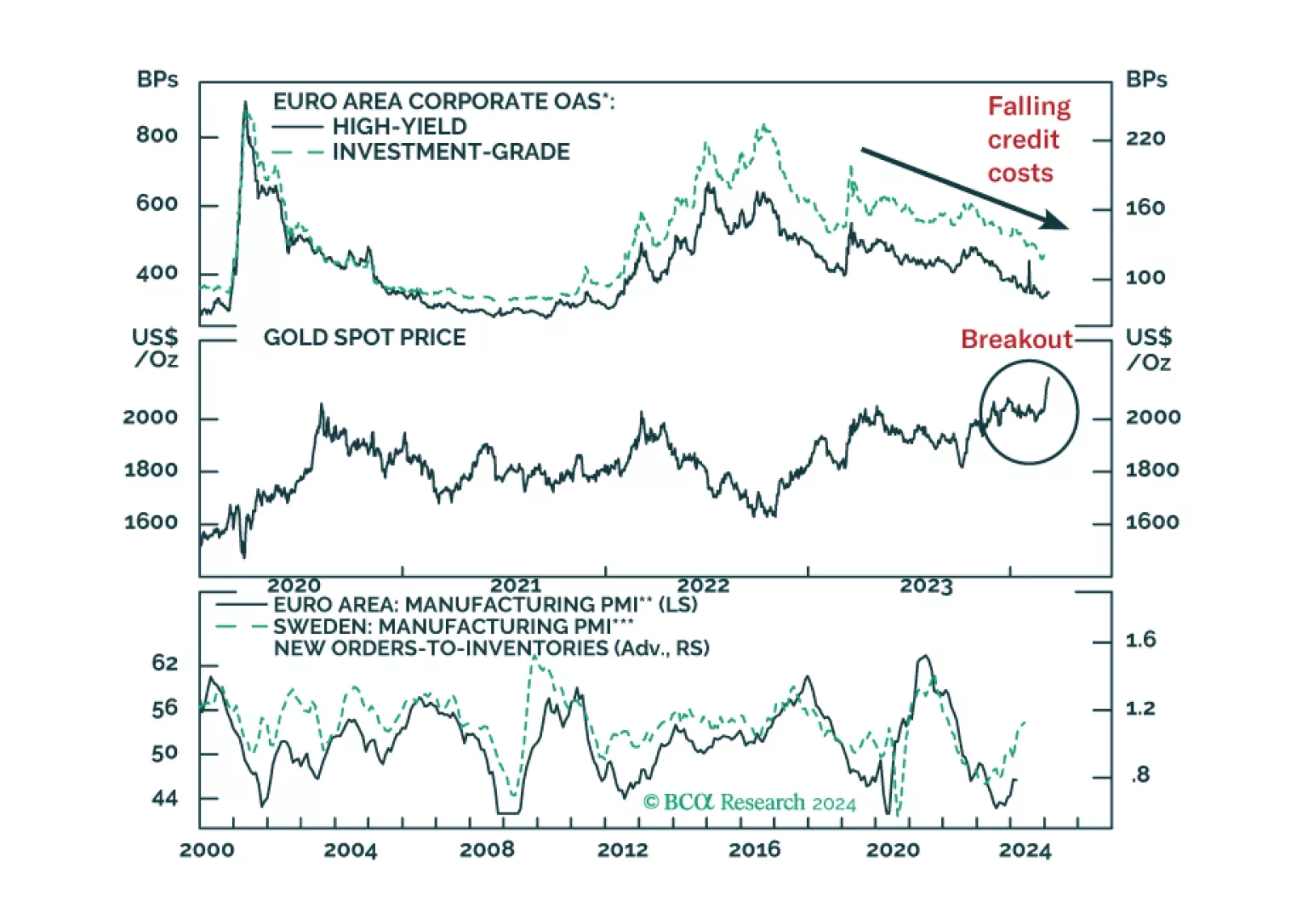
We are pushing back the anticipated start date for a Eurozone recession and assessing how it affects our equity stance.
BCA’s European Investment Strategy team continues to expect the German economy to trail that of the rest of Europe. Since 2020, Germany has fallen behind, with its real GDP lagging that of the broader Eurozone by 5%. The contribution of consumption to GDP…
The stock market of the Eurozone’s largest economy keeps grinding higher with the DAX 40 closing at new highs last week. Since its October low, the index of German blue-chip companies advanced by 20%. Does this rally have legs? On a relative basis,…
According to BCA Research’s European Investment Strategy service, the underperformance of European assets relative to the US is due its lagging productivity, even after adjusting for sectoral compositions in their stock markets. Structurally, European…

Europe’s productivity growth lags that of the US. While structural factors contribute to Europe’s lower productivity level, the region’s recent lost decade plays an even greater role.
The preliminary Eurozone inflation release suggests that price pressures eased by less than anticipated in February. Headline CPI inflation slowed from 2.8% y/y to 2.6% y/y (slightly above expectations of 2.5% y/y. Similarly, although the core inflation gauge…